Expert analysis of Berthe Morisot’s By the Water
Style: Impressionism · Genre: genre painting
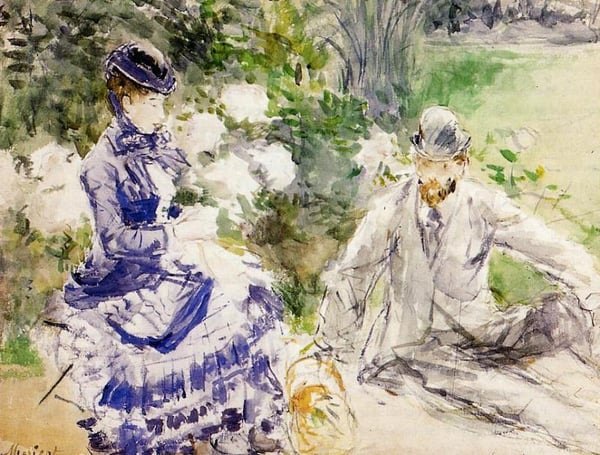
Analysis of “By the Water” by Berthe Morisot
As an Impressionist genre painting, “By the Water” exemplifies Berthe Morisot’s radical approach to capturing modern life through fleeting moments, intimate domesticity, and the play of natural light. The work is significant for several reasons:
-
Pioneering female perspective within Impressionism – Morisot was a core member of the Impressionist group, and her focus on women’s private experiences—leisurely moments by the water—offered a nuanced, often overlooked view of 19th‑century bourgeois life. Unlike many male contemporaries who depicted public spectacles, Morisot turned to quiet, personal scenes that are nonetheless charged with a sense of immediacy.
-
Impressionist technique and brushwork – True to the style, the painting likely uses loose, visible brushstrokes to convey the shimmering reflections on water, the dappled light filtering through foliage, and the soft contours of the female figure. This technique prioritizes optical sensation over precise detail, capturing the “impression” of a particular moment—here, the coolness and tranquility of a waterside setting.
-
Innovative treatment of the genre – Genre painting traditionally elevated everyday scenes, but Morisot infused hers with a modern, psychological resonance. The subject—perhaps a woman resting or a mother with a child—is not merely anecdotal; it becomes a study in contemplation, stillness, and the ephemerality of leisure. The water itself acts as both a reflective surface and a symbol of transient beauty.
-
Color and light – Morisot’s palette in this work is likely delicate and luminous, with whites, blues, and pale greens suggesting a hazy, sunlit atmosphere. Her handling of reflected light on water anticipates later Post‑Impressionist explorations while remaining firmly rooted in the Impressionist goal of capturing natural phenomena.
In sum, “By the Water” is significant not only as a fine example of Impressionist genre painting but also as a testament to Morisot’s ability to imbue a seemingly simple subject with sophistication, emotional depth, and a distinctly feminine gaze. It underscores her role as a vital innovator who expanded the boundaries of Impressionism beyond the boulevard and the ballet.
Museum / Gallery
Visually similar
20 works with related composition and palette
The Artist’s Son and Sister in the Garden at Sevres
Marie Bracquemond
In The Park
Julius LeBlanc Stewart
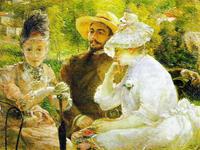
On the Terrace at Sèvres
Marie Bracquemond
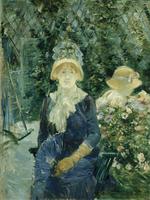
Woman in a Garden
Berthe Morisot
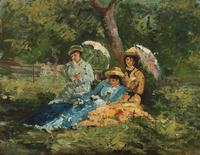
In the Park
Ion Andreescu
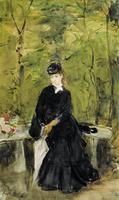
Young Lady Seated on a Bench
Berthe Morisot
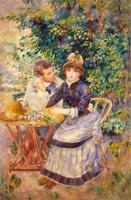
In the Garden
Pierre-Auguste Renoir
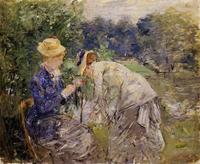
In the Bois de Boulogne
Berthe Morisot
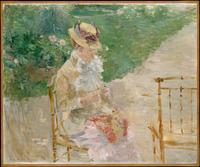
Young Woman Knitting
Berthe Morisot
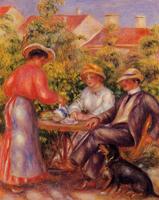
The Cup of Tea
Pierre-Auguste Renoir
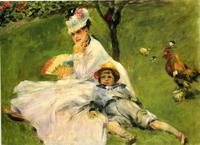
Camille Monet and Her Son Jean in the Garden at Argenteuil
Pierre-Auguste Renoir
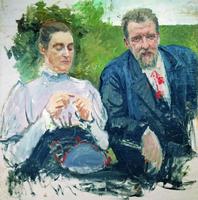
Portrait of I. F. Tyumenev with his wife
Andrei Ryabushkin
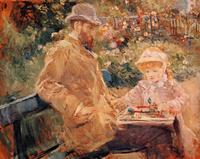
Eugene Manet with his daughter at Bougival
Berthe Morisot
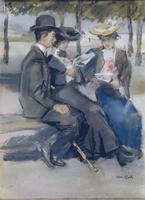
In the Bois De Boulogne Close to Parijs
Isaac Israels
Autumn Mood
Victor Borisov-Musatov
In the Garden
Berthe Morisot
Miss Wedewood and Miss Sargent Sketching
John Singer Sargent
The Lovers
Pierre-Auguste Renoir
Young Woman Sewing in the Garden
Berthe Morisot
Camille Monet in the Garden
Claude Monet