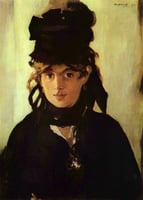
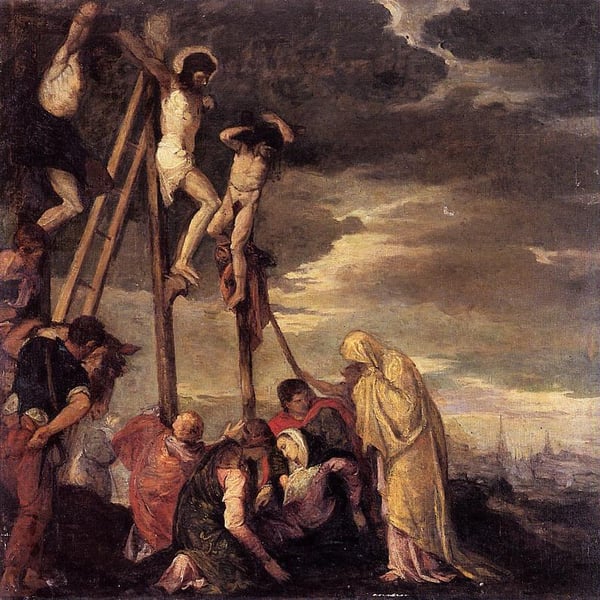
Analisi esperta di Calvary (after Veronese) di Berthe Morisot
Stile: Realism · Genere: religious painting
Expert Analysis: Calvary (after Veronese) by Berthe Morisot
Berthe Morisot’s Calvary (after Veronese) occupies a unique intersection of reverence and reinvention. Although the work is classified as Realism—a style devoted to depicting everyday life without idealization—the subject is a traditional religious scene borrowed from the Venetian Renaissance master Paolo Veronese. This juxtaposition is central to the painting’s significance.
By choosing to copy and reinterpret Veronese’s Calvary, Morisot engages directly with the male-dominated canon of Western art, a bold move for a female artist in the 19th century. Yet she does so through a Realist lens: rather than replicate Veronese’s theatrical chiaroscuro and opulent color, Morisot likely grounds the Crucifixion in a more subdued, naturalistic palette and a sense of intimate, human grief. The “after” in the title signals both homage and transformation—she is not simply reproducing but reimagining the biblical moment with the unvarnished emotional truth prized by Realists.
Within the Realist movement, religious painting was relatively rare; artists like Courbet and Millet focused on peasants, laborers, and landscapes. Morisot’s choice to paint a religious subject while remaining a Realist marks her as an innovator who expanded the movement’s boundaries. She demonstrates that Realism could address spiritual themes not through supernatural grandeur, but through honest human experience—the sorrow of Mary and the disciples rendered with ordinary, palpable pain.
Ultimately, the work’s significance lies in how Morisot bridges past and present: she respects the authority of a Renaissance master while asserting a modern, Realist sensibility, and she claims a place for women in a genre—religious history painting—that had long been dominated by men. Calvary (after Veronese) is thus a quiet manifesto, proving that Realism could be both historically literate and deeply personal.
Museum / Gallery
Visivamente simili
20 opere con composizione e palette affini
Crucifixion
Paolo Veronese
Crucifixion
Leonaert Bramer
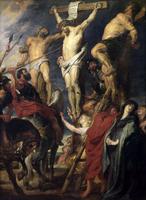
Christ on the Cross Between the Two Thieves
Peter Paul Rubens
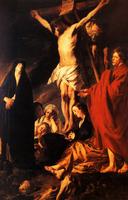
Christ on a Cross
Jacob Jordaens
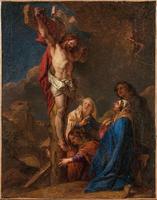
Les Saintes Femmes et saint Jean au pied de la croix
Charles de La Fosse
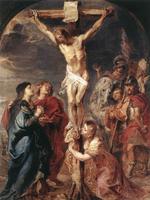
Christ on the Cross
Peter Paul Rubens
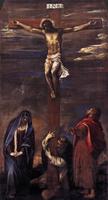
The crucifixion
Titian
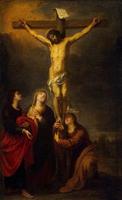
Crucifixion
Bartolome Esteban Murillo
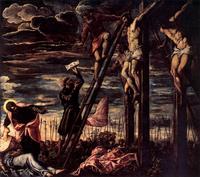
The Crucifixion of Christ
Tintoretto
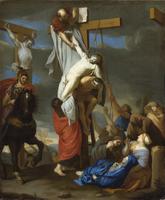
The Descent from the Cross
Charles Le Brun
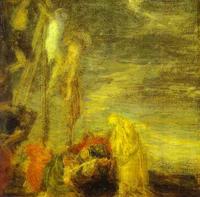
Golgotha (copy after Veronese)
Henri Fantin-Latour
Descent from the Cross
Maarten de Vos
The Descent from the Cross
Jan van Hemessen
The Descent from the Cross
Peter Paul Rubens
Crucifixion
Simon Vouet
Crucifixion with Mary Magdalene Kneeling and Weeping
Francesco Hayez
The Descent from the Cross
Salomon Koninck
Deposition from the Cross
Giorgio Vasari
Christ on the Cross
Eugene Delacroix
The Lamentation over the Dead Christ
Rembrandt