
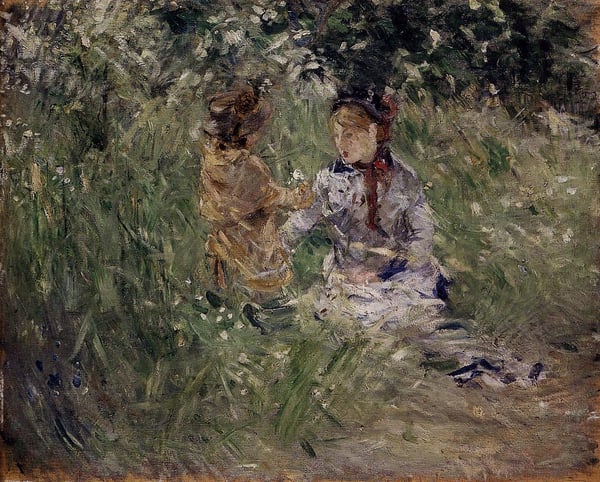
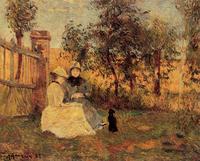
Julie with Pasie in the Garden at Bougival
Dettagli
Analisi esperta di Julie with Pasie in the Garden at Bougival di Berthe Morisot
Stile: Impressionism · Genere: genre painting
Expert Art Historical Analysis: Julie with Pasie in the Garden at Bougival
Berthe Morisot (1841–1895)
Context and Significance
Berthe Morisot was a founding member of the Impressionist movement and one of its few female core participants. Her work consistently challenged the era’s gendered boundaries by elevating domestic and familial subjects to the same level of artistic importance as landscapes or urban scenes. Julie with Pasie in the Garden at Bougival exemplifies this radical redefinition of genre painting, focusing on an intimate, everyday moment—her daughter Julie and a nursemaid (or playmate, “Pasie”) in the sun-dappled garden of the Morisot family’s summer home in Bougival.
Stylistic Hallmarks
- Light and Atmosphere: Morisot’s brushwork is characteristically loose and vibrant, capturing the dappled sunlight filtering through leaves. The garden setting becomes a shimmering tapestry of greens, whites, and soft blues, with figures dissolving into patches of color—a classic Impressionist treatment of plein-air immediacy.
- Intimacy and Gaze: Unlike the often-frigid formalism of academic portraiture, Morisot presents her subjects in unguarded, natural poses. Julie’s focus is absorbed in the moment, while Pasie appears as a gentle, caring presence. This warmth subverts the masculine gaze by offering a maternal, empathetic viewpoint.
- Composition and Cropping: The figures are placed off-center, with the garden foliage encroaching on the frame—a compositional choice influenced by Japanese prints and photography, suggesting a candid snapshot of fleeting time.
What Makes It Significant
- Feminine Modernity: Morisot transforms a “private” domestic scene into a subject worthy of the avant-garde. She asserts that the intimate, the maternal, and the everyday are as vital as the grand narratives of history painting.
- Impressionist Innovation: The painting epitomizes the movement’s core goal: capturing the transient effects of light and atmosphere. Morisot’s rapid, feathery strokes create a sense of movement—the rustle of skirts, the shift of shadows—that feels alive.
- Personal and Universal: By repeatedly painting her daughter Julie (who appears in many of her later works), Morisot creates a poignant autobiographical record. Yet the image resonates universally as a meditation on childhood, care, and the passage of time within nature.
In this work, Morisot not only solidifies her place within Impressionism but expands its emotional and social range, proving that a mother’s garden can be as revolutionary as a Parisian boulevard.
Visivamente simili
20 opere con composizione e palette affini
Young Girl in the Garden at Mezy
Pierre-Auguste Renoir
Young Woman in a Garden
Pierre-Auguste Renoir
Girl Gathering Flowers
Pierre-Auguste Renoir
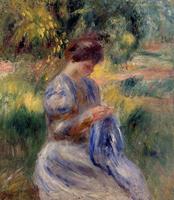
The Embroiderer (Woman Embroidering in a Garden)
Pierre-Auguste Renoir
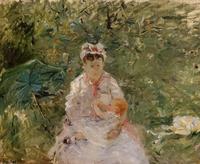
The Wet Nurse Angele Feeding Julie Manet
Berthe Morisot
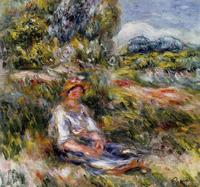
Young Girl Seated in a Meadow
Pierre-Auguste Renoir
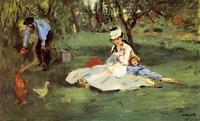
The Monet family in their garden at Argenteuil
Edouard Manet
A Girl in a White Kerchief
Sergiy Grigoriev
Girl in a Meadow
Elin Danielson-Gambogi
The Bowl of Milk
Berthe Morisot
Beneath the Lilac at Maurecourt
Berthe Morisot
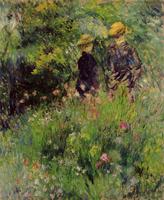
Conversation in a Rose Garden
Pierre-Auguste Renoir
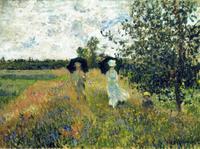
The Promenade near Argenteuil
Claude Monet
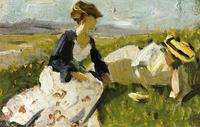
Two Women on the Hillside
Franz Marc
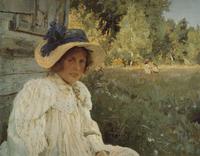
Summertime. Portrait of Olga Serova
Valentin Serov
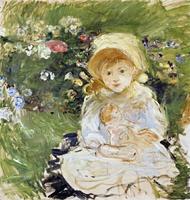
Young Girl with Doll
Berthe Morisot
Picking Flowers
Pierre-Auguste Renoir
Aline Charigot with a Dog
Pierre-Auguste Renoir
The Sisters
Frank W. Benson
Conversation
Paul Gauguin