
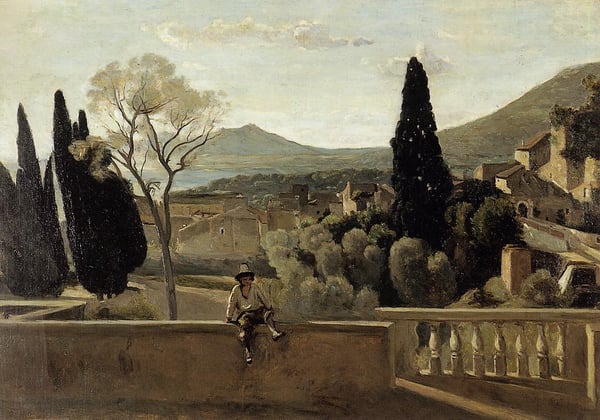
Berthe Morisot sanatçısının View of Tivoli (after Corot) eseri hakkında uzman analizi
Tarz: Impressionism · Tür: landscape
Expert Analysis of View of Tivoli (after Corot) by Berthe Morisot
Berthe Morisot’s View of Tivoli (after Corot) (c. 1850s–1860s) is a revealing early work that bridges her academic training with the nascent principles of Impressionism. Painted when Morisot was still a student of Camille Corot, the landscape demonstrates her masterful absorption of Corot’s lyrical, plein-air approach while already asserting her own gestural freedom.
Stylistic Significance within Impressionism
This painting is a testament to Morisot’s role as a pioneering female Impressionist who helped define the movement’s signature concerns: fleeting light, atmospheric immediacy, and the primacy of the artist’s perceptual moment. Morisot adopts Corot’s soft, silvery palette and his love of Italianate scenes, but she pushes beyond his classical restraint. The brushwork in View of Tivoli is remarkably loose for its time—dappled strokes of green, ochre, and pale blue dissolve architectural details and foliage into shimmering patches of light and air. This prefigures the broken-color technique that would become central to Impressionism.
Homage and Innovation
The subtitle “after Corot” signals Morisot’s respect for her mentor, yet the work is far from a mere copy. Corot’s Tivoli views often maintain a calm, structured composition with a clear foreground, middle ground, and distant cascade. Morisot, by contrast, softens contours and compresses space, allowing the midday haze to blur the distinction between the rocky cliffs and the sky. In doing so, she prioritises sensation over topography—a radical shift that aligns her with the Impressionist goal of capturing “the impression of the moment.”
Gender and Artistic Legacy
For an artist of Morisot’s era, working en plein air in the Roman Campagna was a bold assertion of professional ambition. View of Tivoli thus stands as both a technical apprenticeship and an early declaration of independence. Its delicate yet vigorous handling predicts the masterful domestic and feminine scenes for which Morisot would later be celebrated, but here she claims authority over the historically masculine genre of the Italian landscape. The painting’s significance lies in this dual achievement: it honours Corot’s foundational influence while charting a distinctly Impressionist path—one where the fleeting effect of light becomes the true subject.
Museum / Gallery
Görsel olarak benzer
İlişkili kompozisyon ve renk paletine sahip 20 eser
The Gardens of the Villa d'Este, Tivoli
Camille Corot
Olevano
Albert Bierstadt
A View of the Tiber with Rome in the Distance
Richard Wilson
Martigues Landscape
Andre Derain
Rome - View from the Farnese Gardens
Camille Corot
View Of The Gardens Of Villa D'este In Tivoli, near Rome
Oswald Achenbach
Italiaans Landschap
Pierre-Henri de Valenciennes
View of La Tour de Farges
Gustave Courbet
Sanary landscape
Moise Kisling
Tuscan Landscape
John Henry Twachtman
Landscape, Southern France
Amedeo Modigliani

Schirmpinie bei Frascati
George von Hoesslin

A Landscape Study at San Vigilio, Lake of Garda
John Singer Sargent

FIRENZE DAL VILLA MAGNA
Guido Agostini
House below hill
Rupert Bunny
Landscape
Karl Heinrich Jaeckel
Corfu
John Singer Sargent
Sketch for 'Sanary, France'
Rupert Bunny
View of Florence
Oswald Achenbach
Study from Spoleto, Italy
Anna Katarina Boberg