
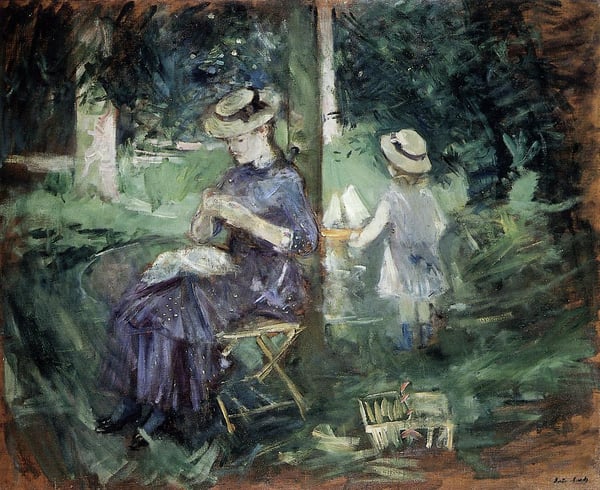
Expert analysis of Berthe Morisot’s Woman and Child in a Garden
Style: Impressionism · Genre: genre painting
Expert Analysis: "Woman and Child in a Garden" by Berthe Morisot
Berthe Morisot’s Woman and Child in a Garden is a quintessential example of Impressionist genre painting, yet its significance extends far beyond the movement’s typical concerns with light and atmosphere. Morisot, a core member of the Impressionist circle, consistently subverted the era’s artistic hierarchies by elevating intimate, domestic moments to the level of high art.
What makes this work significant:
-
A Female Perspective on Modern Life: Unlike many male Impressionists who painted Parisian boulevards, cafés, or brothels, Morisot focused on the private, domestic sphere—the world she knew intimately as a woman of her class. This painting transforms a seemingly ordinary scene of a mother and child into a profound study of maternal intimacy and quiet observation. It validates the everyday experiences of women as worthy of serious artistic attention, challenging the prevailing notion that only public, “masculine” subjects were significant.
-
Mastery of Impressionist Technique: Morisot’s brushwork here is exceptionally fluid and feathery—loose, rapid strokes of pastel-like colors that dissolve form into shimmering patches of light. The garden setting is rendered not as a literal backdrop but as a mosaic of greens, pinks, and whites, with the figures emerging through the dappled sunlight. This technique captures a fleeting, sensory moment: the rustle of leaves, the warmth of the sun, the softness of a child’s dress. The painting exemplifies the Impressionist goal of recording a transient visual impression filtered through personal perception.
-
Ambiguity of Space and Gaze: The woman’s face is turned away or obscured, and the child’s gaze is distant, creating a sense of private reverie rather than a posed narrative. This deliberate ambiguity invites the viewer into a shared, contemplative space. Morisot often avoided direct eye contact with the viewer, emphasizing an unmediated, almost voyeuristic glimpse into a real, untheatrical moment of domestic life.
-
Challenging Gender Roles: In the 1870s and 1880s, a female artist depicting domesticity risked being dismissed as merely “feminine” or decorative. Morisot, however, infused these scenes with psychological depth and technical boldness. Her loose brushwork and high-key palette were criticized by conservative critics as “unfinished” or “sketchy”—yet this very looseness was a radical assertion of artistic freedom, aligning her with the avant-garde.
In summary, Woman and Child in a Garden is significant not only for its exquisite Impressionist handling of light and color but for how it redefines the “everyday” as a site of modernist introspection. Morisot’s work quietly asserts that a woman’s vision—attuned to the delicate rhythms of the home and garden—is as deep and revolutionary as any scene of public spectacle.
Museum / Gallery
Visually similar
20 works with related composition and palette
Reading in the Garden
Ipolit Strambu

The Lane
Theodore Robinson
The Embroiderer (Woman Embroidering in a Garden)
Pierre-Auguste Renoir
In the Bois de Boulogne
Berthe Morisot
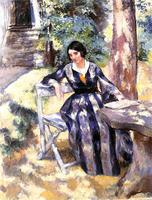
Artist's Wife in the Garden
Wojciech Weiss

The Layette
Theodore Robinson
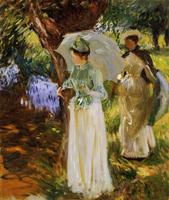
Two Girls with Parasols at Fladbury
John Singer Sargent
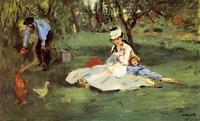
The Monet family in their garden at Argenteuil
Edouard Manet
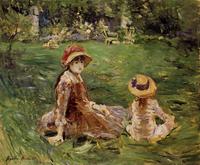
In the Garden at Maurecourt
Berthe Morisot
In the garden
Silvestro Lega

Young Woman Sewing in the Garden
Henri Martin

La Roche Guyon
Theodore Robinson
Woman with Parasol
Pierre-Auguste Renoir
Head of a Young Woman (Red Hat)
Pierre-Auguste Renoir
Young Woman Sewing in the Garden
Mary Cassatt
Young Girl in the Garden at Mezy
Pierre-Auguste Renoir
Girl Embroidering, Seated in a Garden
Albert Marquet
Beneath the Lilac at Maurecourt
Berthe Morisot
Woman with Needlework
Mary Cassatt

The Stroller (Suzanne Hoschede)
Claude Monet