Analisi esperta di At the foot of Mount Hermon di Vasily Polenov
Stile: Realism, Orientalism · Genere: landscape
Expert Analysis of At the Foot of Mount Hermon by Vasily Polenov
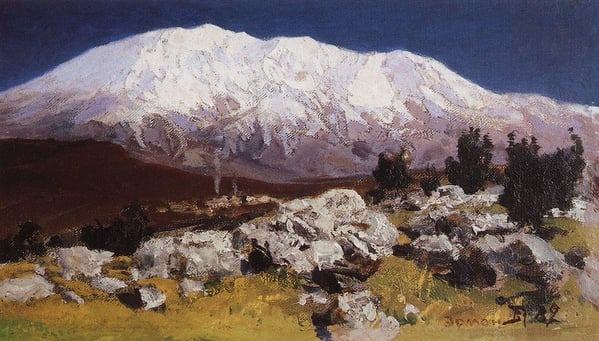
Vasily Polenov’s At the Foot of Mount Hermon is a landscape that bridges two significant stylistic currents of the late 19th century: Realism and Orientalism. Within the context of Russian art, Polenov was a leading figure in the shift away from academic idealism toward a more truthful, unembellished observation of nature—a core tenet of Realism. At the same time, his travels to the Middle East infused his work with an Orientalist sensibility, shaping how he depicted the Holy Land for a Russian audience.
Significance within Realism:
Polenov’s approach here is grounded in the Realist principle of fidelity to the visible world. The composition avoids theatrical drama, instead capturing the quiet, expansive presence of the mountain and the unassuming terrain at its base. The palette—likely composed of muted earth tones and soft atmospheric blues—reflects the actual light and climate of the region rather than an idealized Arcadia. This commitment to perceptual truth positions the painting as a genuine document of place, typical of Polenov’s mature landscape style in which he sought “truth before beauty.”
Significance within Orientalism:
Mount Hermon, located on the border of modern-day Syria, Lebanon, and the Israeli-occupied Golan Heights, was a site of deep biblical and historical resonance for 19th-century Europeans. By choosing this subject, Polenov participates in the Orientalist tradition of representing the “exotic” East—particularly the Holy Land—as an ancient, spiritually charged landscape. Yet unlike more fantastical or decorative Orientalist works, Polenov’s Realist lens prevents exoticism from tipping into caricature. The painting instead offers a meditative, almost ethnographic view of the landscape, aligning with Russian Orientalism’s interest in authentic travel-based imagery.
Stylistic Synthesis:
The genius of At the Foot of Mount Hermon lies in its fusion of these two modes. The Realist attention to atmospheric transparency and geological detail gives the Orientalist subject a palpable sense of place and time—not a mythical East, but a real corner of the world bathed in the quiet grandeur of daylight. This balance makes the work significant as an example of how Russian Realism could absorb and refine Orientalist themes without sacrificing its core commitment to verisimilitude. Polenov’s landscape thus stands as a mature statement of his belief that the most profound beauty emerges from unadorned truth, even when that truth is sought at the foot of a legendary mountain.
Visivamente simili
20 opere con composizione e palette affini
Elbrus in the daytime
Arkhyp Kuindzhi
Guadarrama
Alejandro Cabeza
Mountains
Arkhyp Kuindzhi
Aragats in clouds
Martiros Sarian
Ararat from Dvin
Martiros Sarian
ДОРОГА К ХРАМУ А4
Vlad Avanesov
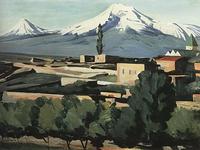
View of Ararat from Yerevan
Martiros Sarian
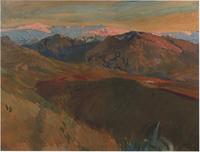
The cemetery at Sierra Nevada, Granada
Joaquín Sorolla
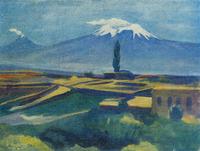
Ararat
Martiros Sarian
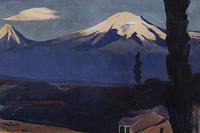
Sunrise over Ararat
Martiros Sarian
Elbrus in the Evening
Arkhyp Kuindzhi
Aragats
Gevorg Bashindzhagian
Kazbek
Arkhyp Kuindzhi
Ararat at spring
Martiros Sarian
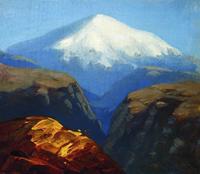
Elbrus in the daytime
Arkhyp Kuindzhi
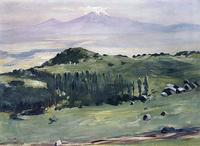
From the Aragats' slopes
Martiros Sarian
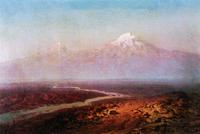
Araks River and Ararat
Ivan Aivazovsky
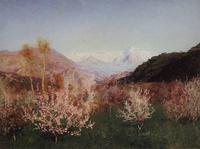
Springtime in Italy
Isaac Levitan
Mont Sainte-Victoire Seen from les Lauves
Paul Cezanne
Lake in the Mountains
Laszlo Mednyanszky