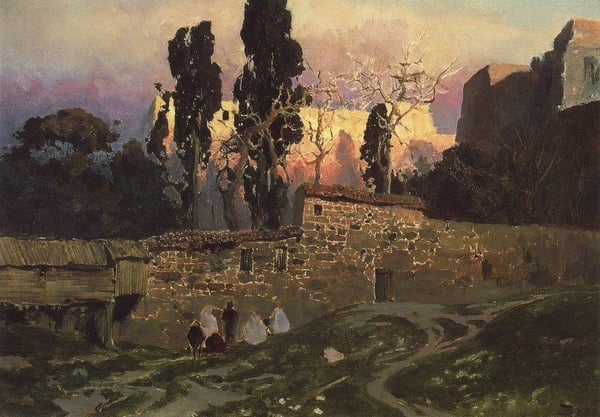
Expert analysis of Vasily Polenov’s Constantinople (Istanbul). Eski Sarayskiy garden.
Style: Realism, Orientalism · Genre: landscape
As an expert art historian, I can offer the following analysis of Vasily Polenov’s Constantinople (Istanbul). Eski Sarayskiy garden, based solely on the supplied facts.
The significance of this artwork lies in its deliberate fusion of two major nineteenth-century artistic currents—Realism and Orientalism—within the genre of landscape. Polenov applies the rigorous observational techniques of Realism—faithful attention to light, atmosphere, and natural detail—to a subject explicitly defined by its Eastern, Ottoman setting. This is not a fantastical Orientalist tableau; it is a specific, named location: the “Eski Sarayskiy garden,” or Old Palace garden in Constantinople (modern Istanbul).
By grounding the scene in a real, identifiable place, Polenov avoids the vague exoticism common to many Orientalist works. Instead, he treats the garden as a landscape to be studied with the same objectivity he would apply to a Russian countryside. This gives the painting a documentary quality, while simultaneously satisfying the Western (and specifically Russian) appetite for images of the “mysterious East.” The viewer is invited to see the garden not as a stage for imagined harems or bazaars, but as a peaceful, sun-drenched space—a testament to Polenov’s ability to find universal beauty in a culturally specific locale.
In the context of nineteenth-century Russian art, this work is significant because it exemplifies how Russian Realists engaged with Orientalist themes. Polenov was part of a generation of artists who traveled to the Middle East and beyond, bringing back authentic topographical views that merged academic skill with ethnographic curiosity. The painting thus stands as a key example of the period’s movement toward sincerity of representation, even within the often-romanticized genre of Orientalist landscape.
Visually similar
20 works with related composition and palette
Constantinople
Vasily Polenov
The ruin Lichtenstein at Mödling
Ferdinand Georg Waldmüller
Evening
Oswald Achenbach
Field with geese
Léon Augustin Lhermitte
The Monastery Behind the Trees
Camille Corot
Crimea. Landscape with a river.
Volodymyr Orlovsky
Am Brunnen in Olevano Romano
Karl Heinrich Jaeckel
Crimean summer landscape
Volodymyr Orlovsky
Entering The Village
Charles-Francois Daubigny
Wanderer in the Storm
Carl Julius von Leypold
Landscape
Lev Lagorio
The Ride of Death (The Fall and Death)
Arnold Böcklin
Italian Landscape
Maxim Vorobiev
Gurzuf
Ivan Aivazovsky
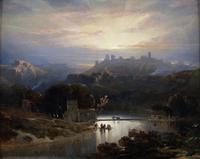
The Castle of Alcalá de Guadaíra
David Roberts
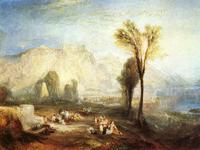
The Bright Stone of Honour (Ehrenbreitstein) and the Tomb of Marceau, from Byron's 'Childe Harold'
J.M.W. Turner
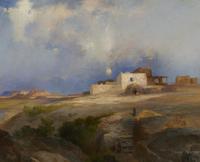
Laguna Pueblo
Thomas Moran
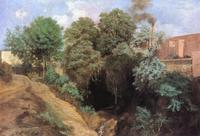
El cabrio de San Ángel
Jose Maria Velasco
Italian landscape
Carl Spitzweg
Lunar night at the spring
Ivan Aivazovsky