Natalia Goncharova sanatçısının Liturgy, The Seraph's costume eseri hakkında uzman analizi
Tarz: Art Nouveau (Modern), Naïve Art (Primitivism) · Tür: design
Expert Analysis of "Liturgy, The Seraph's Costume" by Natalia Goncharova
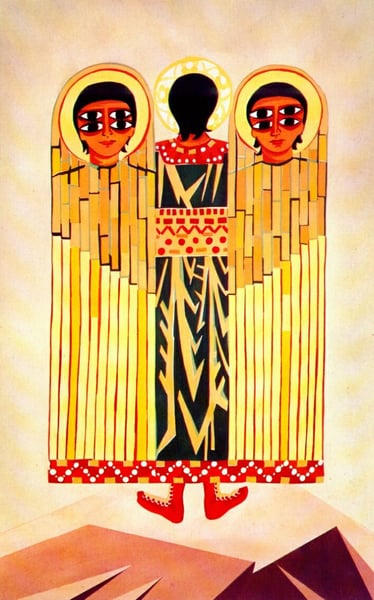
Natalia Goncharova’s Liturgy, The Seraph’s Costume (c. 1915) stands as a striking synthesis of Art Nouveau elegance and Naïve Primitivism, executed within the functional genre of theatrical costume design. The work’s significance lies in how it reimagines sacred imagery through a modernist lens, merging the ornate, flowing lines of Art Nouveau with the raw, folk-inspired simplicity of Primitivism—a dual aesthetic that defined Goncharova’s avant-garde practice.
Goncharova, a leading figure in the Russian avant-garde, was deeply influenced by traditional Russian icon painting, folk art, and Byzantine ecclesiastical forms. Here, the seraph—a six-winged celestial being from Orthodox liturgy—is rendered not with academic realism but with flattened, stylized forms and bold, decorative patterning. The costume’s silhouette echoes Art Nouveau’s sinuous curves, while the simplified facial features and abstracted wings recall the lubok (folk print) tradition and the “naive” quality of non-academic art. This blend of refined modernism and earthy primitivism challenges the boundary between high art and popular culture, sacred and secular.
As a design piece, the work reflects Goncharova’s pioneering role in the Ballets Russes and Russian theatrical modernism. She rejected naturalistic costume in favor of symbolic, visually immersive garments that transformed the performer into an iconographic presence. The seraph’s costume becomes a living icon—vibrant, hieratic, and charged with spiritual energy—while its Art Nouveau ornamentation (sinuous lines, stylized wings) anticipates the decorative abstraction of later 20th-century stage design.
Ultimately, Liturgy, The Seraph’s Costume is significant for its bold fusion of avant-garde aesthetics and religious traditionalism, demonstrating how Goncharova used theater design as a vehicle to reanimate ancient iconography within a modern, primitivist vocabulary. It exemplifies her commitment to “Russianness” as a source of innovation, making this work a key artifact in the development of modernist stagecraft and the cross-pollination of fine art, folk art, and liturgical imagery.
Görsel olarak benzer
İlişkili kompozisyon ve renk paletine sahip 20 eser
Liturgy six winged Seraph
Natalia Goncharova
L'Evangéliste Marc
Facundus
Archangels Michael and Gabriel
Orthodox Icons
La sixième Trompette. Les Anges prisonniers au bord de l'Euphrate. Apoc. IX
Facundus
L'Evangéliste Jean
Facundus
The Orders of the Church
Hildegard of Bingen
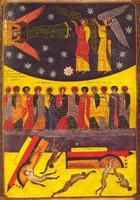
Les trois Anges. La chute de Babylone. Apoc. XIV
Facundus
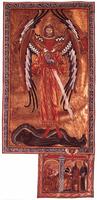
Vision of Divine Love
Hildegard of Bingen
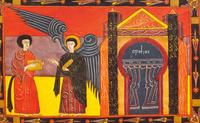
L'Ange remet à Jean la lettre pour l'Eglise d'Ephèse. Apoc. II
Facundus
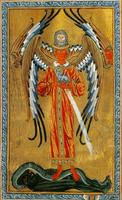
First Vision. Fiery life-force
Hildegard of Bingen
Untitled
Marin Gherasim
Archangels Michael and Gabriel
Orthodox Icons
Holy Wisdom
Orthodox Icons
Les sept Anges et les sept derniers fléaux. Apoc. XV
Facundus
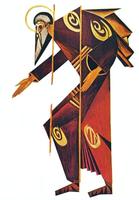
Mask
Natalia Goncharova
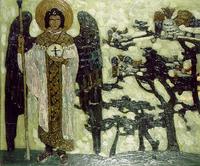
Archangel (Study to "Treasures of angels")
Nicholas Roerich
Les 144 000 Élus et les Anges retenant les Vents. Apoc. VII
Facundus
L'Ange répand la cinquième Coupe. Apoc. XVI
Facundus
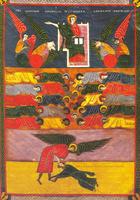
Adoration de Dieu. Les quatre Etres. Les quatre Sages. Jean. L'Ange. Apoc. XIX
Facundus
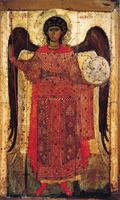
The Archangel Michael
Orthodox Icons