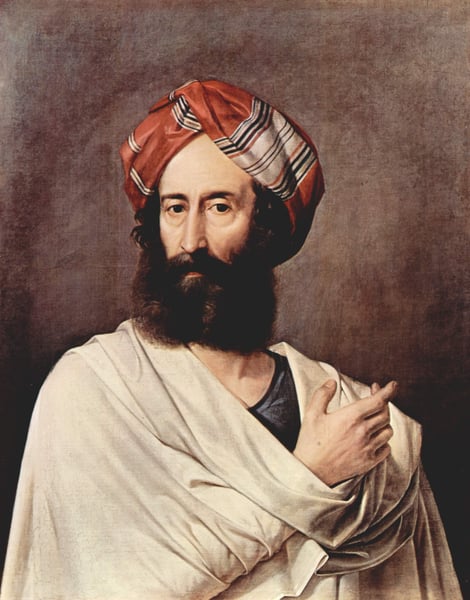
Analisi esperta di Ephraim di Francesco Hayez
Stile: Orientalism · Genere: portrait
As an art historian specializing in 19th-century European painting, I can provide an analysis of Francesco Hayez's "Ephraim" based solely on the given structured facts: the artwork is a portrait within the Orientalist style.
Artwork: Ephraim
Artist: Francesco Hayez (1791–1882)
Style: Orientalism
Genre: Portrait
Analysis:
The significance of "Ephraim" lies in its fusion of Hayez’s celebrated portraiture with the exoticizing lens of Orientalism. Hayez, a leading figure of Italian Romanticism, is best known for historical and allegorical works like The Kiss. Yet this portrait demonstrates his engagement with the 19th-century European fascination with the "Orient"—a trend that often projected romanticized, and sometimes stereotypical, visions of the Middle East and biblical lands onto canvas.
As a portrait, "Ephraim" likely depicts a single male figure—possibly a biblical or allegorical character tied to the Eastern Mediterranean (Ephraim is a name from the Hebrew Bible). In Orientalist portraiture, the subject is rarely merely an individual; he becomes a symbol of a perceived exotic, timeless, or sensual "other." Hayez would have employed meticulous detail in costume, textiles, and accessories (turbans, richly patterned fabrics, jewelry) to evoke a sense of authentic, yet idealised, Eastern identity. The attention to luxurious surfaces and atmospheric lighting is characteristic of his academic technique, but here it serves the Orientalist ambition of transporting the viewer to a distant, evocative world.
What makes Ephraim particularly significant within Orientalist art is its Italian origin. Orientalism was predominantly a French and British phenomenon (Gérôme, Delacroix, Lewis), but Hayez brings a distinctly Venetian-Italian sensibility to the genre. His palette likely leans toward warm, glowing tones—amber, deep crimson, gold—reminiscent of the great Venetian colorists (Titian, Veronese). This roots the work in a native Italian tradition of sensuous painting while simultaneously catering to the broader European appetite for "Eastern" themes.
In summary, Ephraim exemplifies how a master portraitist of the 19th century could channel the Orientalist vogue into a work that is both a refined character study and a cultural artifact of its time—one that reflects the period’s complex mix of artistic curiosity, colonial imagination, and romantic escapism.
Museum / Gallery
Visivamente simili
20 opere con composizione e palette affini
A Turkish man
Friedrich von Amerling
Head of an oriental man
Jean-François Portaels
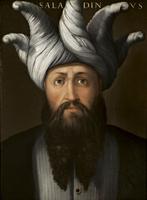
Portrait of Saladin
Cristofano dell'Altissimo
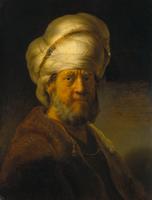
Portrait of a Man in Oriental Garment
Rembrandt
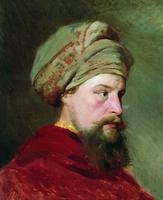
The sitter's head. The second half of the XIX century
Ilya Repin
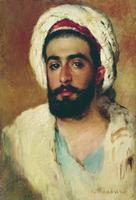
Bedouin
Konstantin Makovsky
Portrait of the Katchef Dahouth, Christian Mameluke
Anne-Louis Girodet
Josef Kriehuber, Austrian Lithographer and Artist (Self-Portrait)
Josef Kriehuber
Roustam Raza, the mamluck of Napoleon
Horace Vernet
Louis IV of France
Charles de Steuben
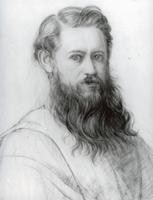
Autoretrato
Jose Maria Velasco
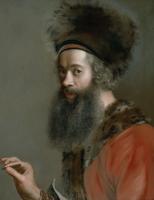
Self-portrait in traditional Turkish costume
Jean-Étienne Liotard
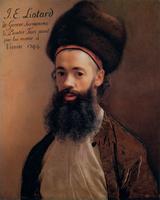
Self-Portrait
Jean-Étienne Liotard
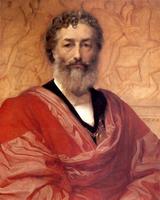
Self-portrait
Frederic Leighton
Self-portrait
Mabuse
Edward Wortley Montagu (1713–1776), MP
George Romney
Fernand De Magellan
Charles-Philippe Lariviere
Aretino
Wenceslaus Hollar
Mustapha
Anne-Louis Girodet
Man in Ottoman dress
Giuseppe Tominz