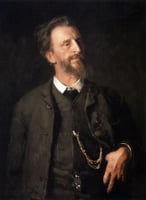
Analisi esperta di By happiness of others (Two fates) di Grigoriy Myasoyedov
Stile: Realism · Genere: genre painting
This analysis is based solely on the provided structured facts.
Artwork: By happiness of others (Two fates) by Grigoriy Myasoyedov
Style: Realism
Genre: Genre painting
Expert Analysis:
Grigoriy Myasoyedov’s By happiness of others (Two fates) is a quintessential example of Russian Realist genre painting, specifically aligned with the critical social consciousness of the Peredvizhniki (The Wanderers). Its significance lies in its stark moral and social commentary, executed through the unflinching directness that defines the Realist movement.
The title itself—By happiness of others (Two fates)—functions as a thesis. It announces a juxtaposition of two opposing lives, suggesting that one character’s prosperity is derived from or exists in stark contrast to another’s suffering. This was a hallmark of Myasoyedov’s work: using a single, everyday scene to expose the deep fissures of class and inequality in 19th-century Russia.
As a genre painting, the work moves beyond mere anecdote. Myasoyedov treats his subjects with the seriousness of history painting, elevating a commonplace encounter into a profound moral question. The composition likely forces the viewer to confront the physical and emotional distance between the two figures—perhaps a well-fed landowner and a starving peasant, or a prosperous merchant and a beggar. The “happiness” of one is rendered unsettling by the visible “fate” of the other.
The Realist style here is not passive observation but an active tool for critique. Myasoyedov would have avoided idealization, instead emphasizing telling details: the texture of worn fabric versus fine cloth, the pallor of hunger against the flush of satisfaction, the posture of deference versus dominance. By placing these “two fates” in a shared frame, the painter argues that neither exists in isolation. One fate is the price of the other.
In the context of Myasoyedov’s oeuvre and the broader Peredvizhniki movement, By happiness of others (Two fates) is significant for its unsparing, humanist clarity. It transforms the genre of everyday life into a mirror that reflects the moral cost of social inequality, challenging viewers to recognize that one person’s fortune can be built on another’s misfortune. It is a painting that refuses to let happiness remain innocent.
Museum / Gallery
Visivamente simili
20 opere con composizione e palette affini
The letter
Silvestro Lega
The embroidery lesson
Jules Trayer
Paris Interior
Mihaly Munkacsy
Heinrich Heine and Elise Krinitz
Heinrich Lefler
Interesting conversation
Umberto Veruda
All Happiness
Alfred Stevens
The recital
Gustave Léonard De Jonghe The Japanese Fan
Baby Visitors
Mihaly Munkacsy
The Governess
Emily Mary Osborn
A Family Group, The Artist's Wife and Children, 'Papa Painting!'
Solomon Joseph Solomon
The reluctant bride
Auguste Toulmouche
Madame Georges Charpentier and her Children
Pierre-Auguste Renoir
The conversation
Francesco Didioni
The crowning of the bride
Léon Augustin Lhermitte

Portrait of the Artist's Mother and Sister
Berthe Morisot
Salon
J.M.W. Turner
Poor Congratulations
Ferdinand Georg Waldmüller

The comforting words
Gustave Léonard De Jonghe The Japanese Fan
A Testing Question
Frederick Morgan
Miss Margaret Macfarlane
Edward Arthur Walton