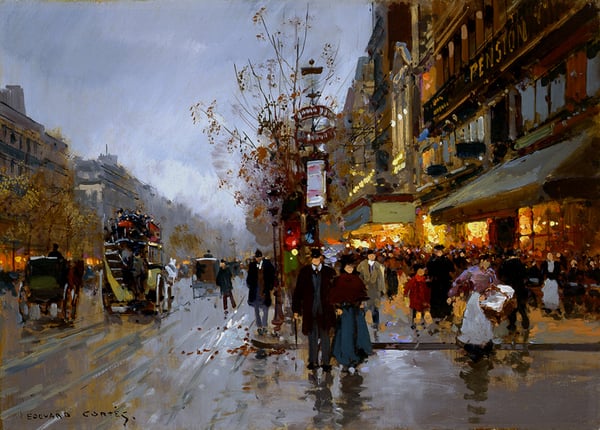
Les Grands Boulevards
Expertenanalyse zu Edouard Cortess Les Grands Boulevards
Stil: Post-Impressionism · Genre: cityscape
As an art historian specializing in Post-Impressionism, I can place Édouard Cortès's Les Grands Boulevards within a significant context. Cortès is often celebrated as the "poet of Parisian streets," and this work exemplifies his mastery of the urban cityscape genre during the post-impressionist period.
Significance within Post-Impressionism:
While Post-Impressionism encompassed diverse styles (from Seurat's pointillism to van Gogh's expressionism), Cortès focuses on a key preoccupation: capturing modern life with heightened sensory immediacy and emotional resonance. Unlike the Impressionists' emphasis on fleeting optical effects, Cortès infuses his scene with a meticulous, almost romanticized structure. He uses a rich, vibrant palette (typical of post-impressionist color) to convey the energy of the boulevard, but does so with a careful draftsmanship that gives the cityscape a narrative solidity.
What makes Les Grands Boulevards significant:
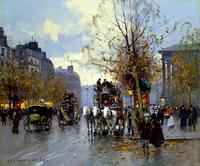
- Atmospheric mastery: Cortès excels at depicting the interplay of light, fog, and rain on wet pavement. In this work, the boulevard likely glows with the golden light of streetlamps reflected on damp cobblestones, creating a nostalgic, theatrical atmosphere. This treatment of light is not merely scientific (as with Impressionism) but evocative—it transforms a mundane city street into a luminous spectacle.
- Urban dynamism: The composition captures the bustling rhythm of Parisian life—horse-drawn carriages, early automobiles, and pedestrians—all moving in a carefully orchestrated flow. This represents a post-impressionist interest in the modern city as a living organism, a theme that would influence later urban realists.
- Technical precision: Cortès's brushwork is both delicate and deliberate. He combines soft, blurry edges for distant figures (suggesting atmospheric perspective) with sharper details in the foreground (such as ornate lampposts or café awnings). This method gives the painting a dreamlike clarity, balancing realism with a painterly touch.
In essence, Les Grands Boulevards is significant because it crystallizes the post-impressionist cityscape: a fusion of immediate sensory experience, careful composition, and nostalgic emotion. Cortès transforms a snapshot of Paris into a timeless icon of urban beauty.
Visuell ähnlich
20 Werke mit ähnlicher Komposition und Farbpalette
St.Denis
Edouard Cortes
Boulevard a Paris
Edouard Cortes
St.Denis
Edouard Cortes
Theatre du Vaudeville
Edouard Cortes
Boulevard des Capucines
Antoine Blanchard
Café de la Paix
Antoine Blanchard
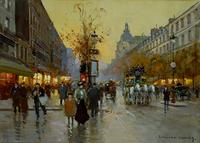
Les Grands Boulevards
Edouard Cortes
The Grands Boulevards
Edouard Cortes
Boulevard Haussmann
Antoine Blanchard
Theatre des Varietes Large
Antoine Blanchard
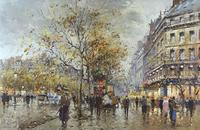
Le boulevard Paris
Antoine Blanchard
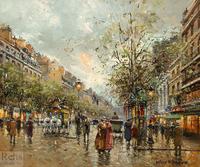
Theatre des Varietes Large
Antoine Blanchard
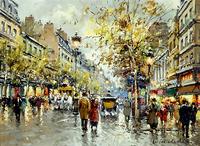
Theatre des Varietes Large
Antoine Blanchard
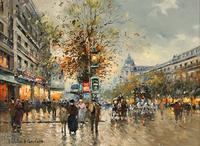
Les Grands Boulevards
Antoine Blanchard
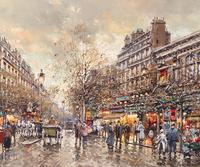
Theatre du Gymnase, Boulevard Bonne Nouvelle
Antoine Blanchard
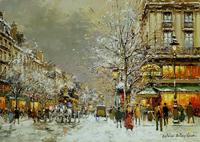
Boulevard des Capucines
Antoine Blanchard
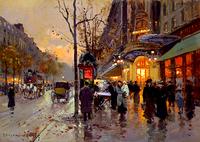
Theatre du Vaudeville
Edouard Cortes
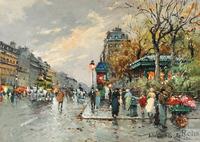
La Rue Lafayette et le Square Montholon
Antoine Blanchard
Omnibus on the Place de la Madeleine
Edouard Cortes
Place de la Madeleine
Antoine Blanchard