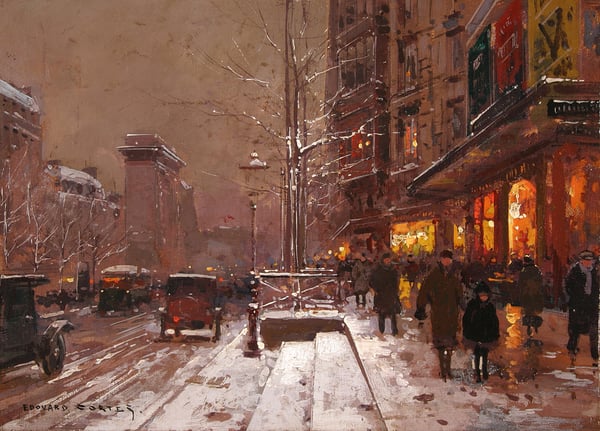
St.Denis, Winter
Analisi esperta di St.Denis, Winter di Edouard Cortes
Stile: Post-Impressionism · Genere: cityscape
Expert Analysis: "St. Denis, Winter" by Édouard Cortès
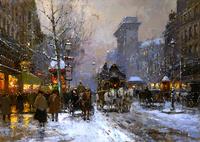
Édouard Cortès (1882–1969) is celebrated as the "Poet of Parisian Streets," and St. Denis, Winter exemplifies his mastery of the post-impressionist cityscape. Painted in a style that bridges Impressionism's preoccupation with light and Post-Impressionism's structured composition, this work captures the quiet grandeur of a winter day in the historic suburb of Saint-Denis, just north of Paris.
Significance within Post-Impressionism and the Cityscape Genre
Cortès belongs to the later generation of Post-Impressionists who focused on urban scenes rather than rural landscapes. Unlike the more avant-garde experiments of Seurat or van Gogh, Cortès refined a lyrical realism that emphasizes atmospheric effects and the daily rhythm of city life. In St. Denis, Winter, the artist’s significance lies in his ability to render the subtle interplay of cold winter light on stone, snow, and sky. The painting is not merely a topographical record but a study in mood—the muted golds, silvers, and lavender-greys create a hushed, almost nostalgic tranquility.
Winter Atmosphere and Color Palette
Cortès’s winter palette is deliberately restrained yet luminous. The snow-covered streets and rooftops reflect a pale, diffused sunlight, while the basilica of Saint-Denis—a Gothic masterpiece and burial site of French kings—emerges as a dark, solemn silhouette. The artist uses short, broken brushstrokes typical of the post-impressionist manner to depict the texture of slush, the haze of cold air, and the delicate frost clinging to bare trees. This technique infuses the scene with movement and life, even as the subject itself is still.
Narrative and Cultural Context
The painting’s significance also stems from its subject. Saint-Denis was a working-class suburb with deep historical roots, and Cortès elevates an ordinary winter day into a timeless tableau. Figures bundled in coats hurry along the street, their forms simplified to dark accents that anchor the composition. This human touch—small yet essential—connects the viewer to the lived experience of a Parisian winter, making the painting both a document of its time and an enduring meditation on light, season, and place.
In summary, St. Denis, Winter is a quintessential example of Cortès’s contribution to post-impressionist cityscape painting. Its significance lies in its delicate synthesis of atmospheric realism and structured charm, capturing the fleeting beauty of a winter moment while anchoring it in the grandeur of French architectural heritage.
Visivamente simili
20 opere con composizione e palette affini
St.Denis, Winter
Edouard Cortes
St.Denis
Edouard Cortes
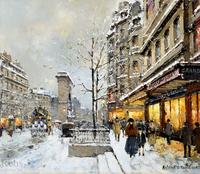
Porte St. Denis, Winter
Antoine Blanchard
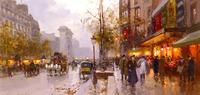
Boulevard Bonne-Nouvelle, Paris
Edouard Cortes
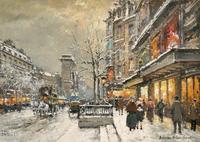
Grands Boulevards
Antoine Blanchard
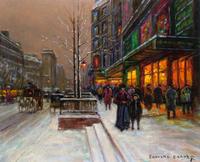
St.Denis
Edouard Cortes
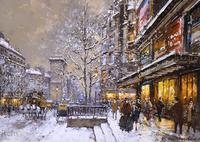
Grands Boulevard et Porte St. Denis, Sous la Neige
Antoine Blanchard
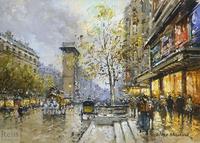
Porte St. Denis
Antoine Blanchard
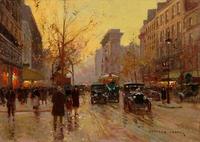
St.Denis
Edouard Cortes
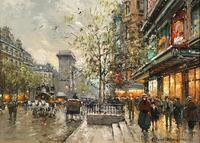
Porte St. Denis
Antoine Blanchard
St.Denis, Winter
Edouard Cortes
St.Martin
Edouard Cortes
St.Martin
Edouard Cortes

Place de Clichy in winter
Edouard Cortes
Place de la Madeleine
Edouard Cortes

Place de Clichy in Winter
Edouard Cortes
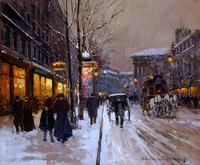
Boulevard de la Madeleine, Winter
Edouard Cortes
Paris, Place de la Republique
Edouard Cortes
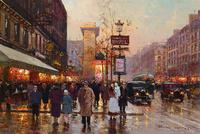
Boulevard Bonne Nouvelle, Porte St. Denis
Edouard Cortes
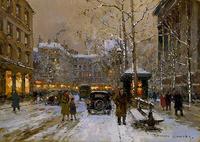
La Madeleine, winter
Edouard Cortes