Expertenanalyse zu Jan Matejkos Bohdan Khmelnytsky with Tugai Bey near Lviv
Stil: Romanticism · Genre: history painting
Expert Analysis:
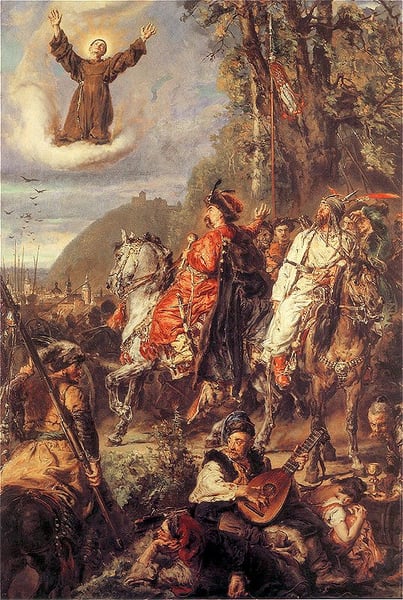
Jan Matejko’s Bohdan Khmelnytsky with Tugai Bey near Lviv (1885) stands as a masterful example of Romantic history painting, deeply embedded in the 19th‑century Polish national revival. The work captures a pivotal yet fraught moment from the Khmelnytsky Uprising (1648–1657), when Cossack Hetman Bohdan Khmelnytsky allied with Crimean Tatar commander Tugai Bey against the Polish-Lithuanian Commonwealth. Matejko, working in the Romantic tradition, does not merely chronicle an event; he transforms it into a dramatic, emotionally charged tableau that interrogates themes of leadership, betrayal, and the tragic cost of war.
Significance within Romanticism:
- Historical Nationalism: Matejko was the preeminent painter of Poland’s past, and this canvas exemplifies Romanticism’s fixation on national identity. By depicting a controversial alliance (Orthodox Cossacks with Muslim Tatars), he provokes reflection on Poland’s historical divisions and the complexity of its struggle for sovereignty—a resonant theme for a partitioned nation in the 19th century.
- Dramatic Narrative & Symbolism: The composition thrusts the two protagonists into the foreground, their postures and gazes laden with tension. Khmelnytsky, often seen as a tragic hero, is shown here as both a rebel and a pragmatic statesman. Tugai Bey’s presence underscores the uneasy partnership between Cossack and Tatar forces. Matejko uses color, light, and stormy skies to heighten the atmosphere of impending conflict, a hallmark of Romantic drama.
- Technical Virtuosity: The painting is crowded with meticulously rendered figures, armor, and banners—each element grounded in historical research yet arranged with theatrical flair. This blend of archaeological precision and emotional intensity defines Matejko’s unique contribution to European Romanticism, influencing subsequent generations of history painters.
Why it matters:
The work is significant not only for its artistic excellence but also for its role in shaping Polish historical consciousness. Matejko rejected simple hero worship; instead, he presented history as a morally complex, cautionary tale. Bohdan Khmelnytsky with Tugai Bey near Lviv remains a crucial artifact of Romanticism’s power to transform political memory into enduring visual drama.
Visuell ähnlich
20 Werke mit ähnlicher Komposition und Farbpalette
Halt vor dem Gasthaus
Heinrich Schonfeld
Allegory of Catherine II's Victory over the Turks
Stefano Torelli

The Dutch Ambassador on his Way to Isfahan
Jan Weenix
The Abduction of Rebecca
Eugene Delacroix
The Stoning of St. Stephen
Adam Elsheimer
Congress of the Kings
Jan Matejko
Combat Between the Giaour and the Pasha
Eugene Delacroix

Oldřich and Božena
Frantisek Zenisek
Battle of Arab Horsemen Around a Standard
Theodore Chasseriau

Choc de cavalerie
Pieter Meulener
Zrínyi’s Charge From The Fortress Of Szigetvár
Johann Peter Krafft
Battle of Arsur
Éloi Firmin Féron
The battle of Putaha
Éloi Firmin Féron
Scenes
Pieter Meulener
The death of Leszek the White
Jan Matejko
Reitertreffen Zwischen Kaiserlichen Und Schweden
Adam van der Meulen
The Triomph of the Amazons
Claude Deruet
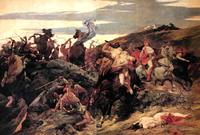
Pentesilea
Arturo Michelena
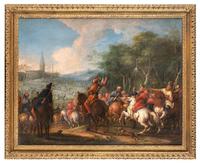
Scena di battaglia
Karel Breydel
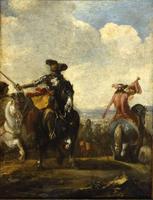
Cavalieri in Marcia
Salvator Rosa