Empress Rejtan
Analisi esperta di Empress Rejtan di Jan Matejko
Stile: Romanticism · Genere: genre painting
Artwork Analysis: "Empress Rejtan" by Jan Matejko
Note: The provided title appears to be a variant of Matejko’s celebrated historical painting "Rejtan – Upadek Polski" (Rejtan – The Fall of Poland), completed in 1866. The term "Empress" may be a confusion with another work, as no painting of that exact title exists in Matejko’s oeuvre. However, based on the given facts—Romanticism and genre painting—the analysis below applies to the well-known work featuring Tadeusz Rejtan, a Polish nobleman who famously protested the First Partition of Poland.
Significance within Romanticism and Genre Painting
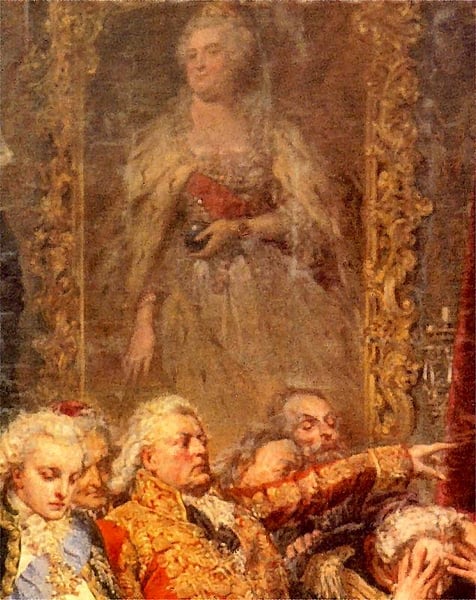
Jan Matejko’s Rejtan stands as a quintessential example of Romantic historical painting, blending the emotional intensity of the Romantic movement with the meticulous detail of a genre scene. The work captures a single, dramatic moment from Polish history: the 1773 Sejm (parliament) where Tadeusz Rejtan, in a desperate act of defiance, threw himself across the doorway of the chamber to prevent the ratification of the First Partition of Poland.
-
Emotional and Moral Weight: Romanticism prized strong emotion, individual heroism, and national identity. Matejko portrays Rejtan not merely as a historical figure but as a tragic, almost Christ-like martyr—his arms outstretched, his body a barrier against corruption. The painting’s theatrical lighting, with a stark beam illuminating Rejtan’s face and bare chest, heightens the pathos and symbolic sacrifice.
-
Genre Painting’s Narrative Power: Though classified as history painting, Rejtan functions as a genre scene by focusing on a crowded interior filled with distinct character types: corrupt deputies turning away, foreign ambassadors smirking, and a weeping onlooker. Each figure tells a micro-story—greed, cowardice, or despair—making the larger political tragedy intensely human and immediate.
-
Patriotic Allegory: Created after the failed January Uprising (1863–1864), the painting served as a rallying cry for a partitioned Poland. Matejko’s decision to paint Rejtan’s futile but noble protest resonated deeply with a nation yearning for independence. The composition forces viewers to confront moral choice: Rejtan’s heroism versus the deputies’ betrayal.
-
Technical Mastery: Matejko’s style—rich colors, detailed costumes, and a claustrophobic, stage-like space—anchors the Romantic drama in verisimilitude. The chaotic yet purposeful arrangement of bodies mirrors the disorder of the political moment, while the central diagonal of Rejtan’s form directs the eye toward the dark, forced exit—symbolizing Poland’s lost sovereignty.
In sum, "Empress Rejtan" (interpreted as Matejko’s Rejtan) is significant for merging Romantic idealism with genre painting’s realism to create a powerful national allegory. It remains a landmark of 19th-century Polish art, embodying the Romantic belief that art could shape collective memory and inspire resistance against oppression.
Visivamente simili
20 opere con composizione e palette affini
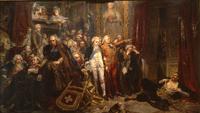
The Fall of Poland
Jan Matejko
Lomonosov in Germany. The scientific Debate.
Eugene Lanceray
The Marriage Contract
William Hogarth
A.D. McCormick
Arthur David McCormick
Court Scene
Antonio Zoppi
Kaiserin Maria Theresia mit Kaiser Franz Stephan und dem jungen Joseph II. im Kreise ihrer Berater
Julius Schmid
Assembly of Peter I
Klavdy Lebedev
Rake's Progress' The Gaming House
William Hogarth
Washington Family
Thomas Sully
The Geography Lesson
Pietro Longhi
Charles Surface Selling His Ancestors
John Pettie
Willibald von Glueck at the Clavecin Composing the Score of his Armide
Eugene Delacroix
The chamber orchestra
Vincenzo Irolli
The Beaumont Family
George Romney
The heir
William Hogarth
Sir Peter Teazle
Laslett John Pott
A difficult audition
Johann Hamza
The Ball
William Hogarth
In the Studio
Charles Giron
Gaspar Melchor de Jovellanos
Francisco Goya