Expert analysis of Joaquín Sorolla’s Boy on the Sand
Style: Impressionism · Genre: genre painting
Expert Analysis: Boy on the Sand by Joaquín Sorolla
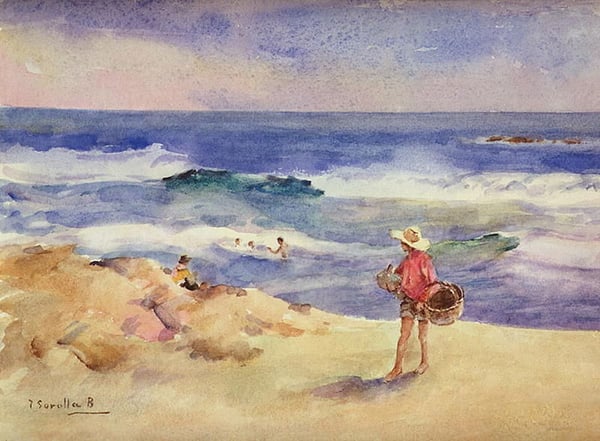
Joaquín Sorolla’s Boy on the Sand is a quintessential example of Impressionism applied to the genre painting tradition, yet it transcends both categories through the artist’s unparalleled ability to capture the fleeting effects of Mediterranean light. Painted during Sorolla’s most celebrated period—the early 1900s—the work depicts a solitary child on a sun-drenched beach, a subject that became a hallmark of his Valencian coastal scenes.
Significance within Impressionism: Sorolla is often called the “painter of light,” and this work exemplifies his departure from French Impressionism’s cooler, more analytical approach. Instead, he infuses the canvas with a warmth and luminosity specific to Spain’s eastern coast. The brushwork is energetic but controlled—rapid strokes of white, ochre, and turquoise suggest the shimmer of sunlight on wet sand and the play of shadows. Unlike Monet’s serial studies, Sorolla’s beach scenes are immediate, capturing a single, unposed moment of childhood leisure.
Significance as Genre Painting: Sorolla elevates the everyday into the extraordinary. The boy is not a portrait of a specific individual but an archetype of innocence and freedom. By focusing on a simple, unremarkable action—a child standing or playing on the sand—Sorolla transforms the genre painting from anecdotal narrative into a meditation on light, atmosphere, and the sensory experience of a seaside summer. The figure is integrated into the environment; the sand and sea are as much protagonists as the child.
Art Historical Context: Finished in 1910, this work belongs to Sorolla’s series Vision of Spain, but its true significance lies in how it bridges Impressionist technique with a distinctly Spanish sensibility. While his contemporaries in Paris often painted urban leisure, Sorolla’s beach scenes are more primal, focusing on the elemental relationship between human and nature. Boy on the Sand is notable for its almost photographic immediacy, achieved through Sorolla’s mastery of plein air painting and his revolutionary use of reflected light.
In short, the artwork stands as a masterclass in capturing the ephemeral—the glint of sun on a child’s skin, the warmth of sand, the vastness of the sea—making it a landmark of Spanish Impressionism and a poignant celebration of life by the shore.
Museum / Gallery
Visually similar
20 works with related composition and palette
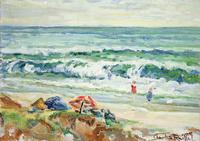
Beach at Del Mar
Charles Reiffel
Rowing off the coast
Henry Scott Tuke
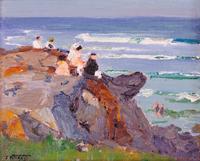
By the New England Seashore
Edward Henry Potthast
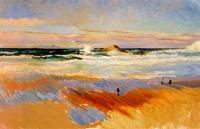
Beach of Biarritz, France
Joaquín Sorolla
ДАВАЙ ПОИГРАЕМ
Vlad Avanesov
Caspian sea
Boyukagha Mirzazade
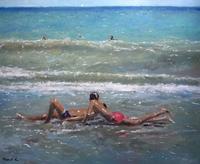
Niños jugando en la playa
Rubén de Luis
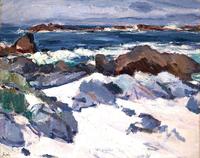
A Rocky Shore, Iona
Samuel Peploe
Marine
Alejandro Cabeza
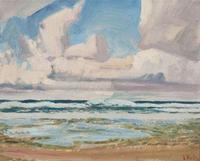
Barbados, B.W.I., Winter
J. E. H. MacDonald
Stormy Weather, Iona
Samuel Peploe
Rocks at Barra
Samuel Peploe
Marina del Mar Mediterráneo
Rubén de Luis
Seapoint
James Yates
The Sea near La Spezia
Lovis Corinth
On the Brittany Coast
Childe Hassam
Figures on a Rocky Beach
Algernon Talmage
Onda
Antonio Carneiro
Nags Head, Cape Hatteras
Ivan Albright
Antakya-Istanbul-Antakya XXXIV
Artin Demirci