Expertenanalyse zu Jan Steens Wedding Feast at Cana
Stil: Baroque · Genre: religious painting
Expert Analysis: "Wedding Feast at Cana" by Jan Steen
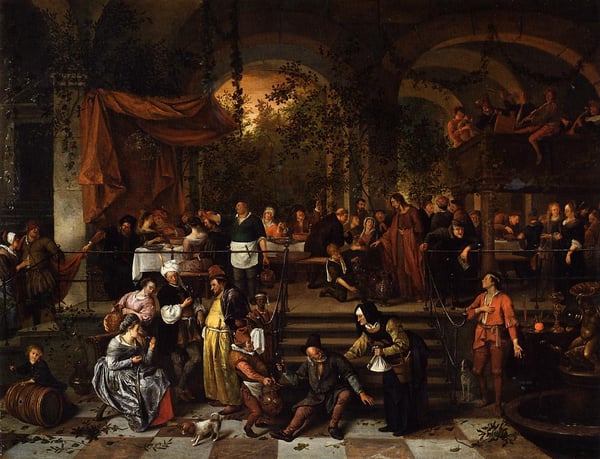
Jan Steen’s Wedding Feast at Cana is a masterful example of Dutch Baroque religious painting, distinguished by the artist’s signature blend of sacred narrative with lively, contemporary domestic realism. While the subject—Christ’s first miracle of turning water into wine—is drawn from the Gospel of John, Steen transposes the scene into a bustling, chaotic 17th-century Dutch wedding feast. This approach marks a significant departure from more solemn, hieratic treatments of the same theme by Italian or Flemish Baroque painters.
Key elements of significance:
-
Genre-infused religiosity: Steen treats the biblical miracle not as a distant, holy event but as an everyday occurrence embedded in a raucous, cluttered interior. The viewer is drawn into a scene of merriment, overindulgence, and human folly—children playing, servants bustling, guests flirting, and a dog scavenging scraps. This reflects the Dutch Baroque fascination with moral allegory and the vanitas tradition: the miracle is almost an aside amid the worldly chaos.
-
Stylistic hallmarks: Steen employs a warm, naturalistic palette and meticulous attention to textiles, ceramics, and food, typical of Dutch genre painting. The composition is dense and dynamic, with multiple vignettes unfolding simultaneously—a hallmark of Steen’s “disorderly household” mode. Light streams from a window on the left, highlighting Christ’s modest gesture at the table, while the surrounding revelry remains in softer illumination.
-
Theological twist: By situating the miracle in a tavern-like setting, Steen underscores the accessibility of divine grace amid human imperfection. The water jars (the vessels of the miracle) are pushed to the foreground, rendered with trompe-l’oeil precision, reminding the viewer that the sacred coexists with the profane. This is a distinctly Protestant Baroque sensibility—neither pompous nor mystical, but earthy and didactic.
Significance within Baroque and Dutch art:
Steen’s Wedding Feast at Cana is significant because it collapses the boundary between “history painting” and “genre scene,” challenging the academic hierarchy of subjects. It demonstrates how Dutch Baroque painters reinterpreted religious themes through a lens of observational humor and moral ambiguity, making the divine feel palpably present in ordinary life. The painting stands as a vivid document of 17th-century Dutch culture and a testament to Steen’s skill in packing narrative, irony, and craftsmanship into a single, boisterous tableau.
Museum / Gallery
Visuell ähnlich
20 Werke mit ähnlicher Komposition und Farbpalette
Samson and Delilah
Jan Steen
Egg Dance
Jan Steen
A Village Wedding Feast with Revellers and a dancing Party
Jan Steen
Life of Man
Jan Steen
Revelry at an Inn
Jan Steen
Leaving the Tavern
Jan Steen
Der Winter
Jan Brueghel the Elder
Wedding of Tobias and Sarah
Jan Steen
A Village Wedding
Jan Steen
Children playing in a street outside a cobbler's shop
Matthijs Naiveu
Baptism
Jan Steen
Absaloms servants slaying Amnon
Jacob Jansz van Velsen
Merry Company on a Terrace
Jan Steen
Family holiday
Jan Steen
Wedding of Tobias and Sarah
Jan Steen
The Purification of the Temple
Jacopo Bassano
A village wedding
Jan Steen
The morning post
Francois-Auguste Biard
The Quack
Gerrit Dou
Peasant Wedding
Jan Steen