Description
Style : Baroque · Genre : religious painting
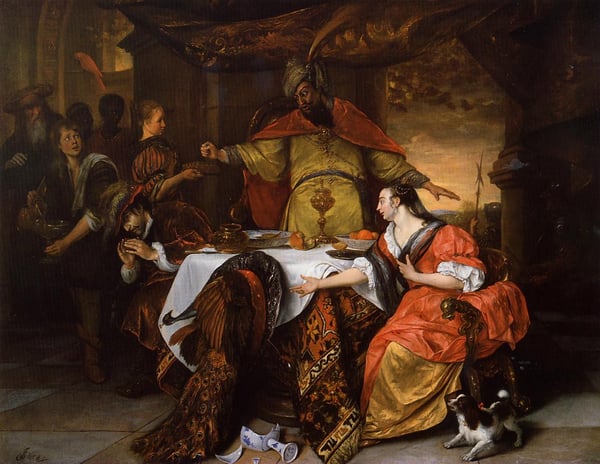
Although Jan Steen is primarily known for portraying lively scenes of peasant life, he produced at least 60 paintings that dealt with biblical, mythological and historical subjects. Wrath of Ahasuerus refers to the story of Esther in the Old Testament. Esther, was a Jewish queen and wife of Ahasuerus, the King of Persia. Ahasuerus, captivated by Esther’s beauty, selected her for his wife, but did not know that she was Jewish. At the same time, Ahasuerus’s chief minister, Haman, plotted to annihilate the Jews in the Persian Empire. Esther, determined to save her people, prepared a banquet for Ahasuerus and Haman, with the intention of exposing Haman to the King. In the end, Esther was triumphant, Haman was sentenced to death and Esther secured a decree from Ahasuerus that allowed the Jews to defend themselves against their enemies. The painting depicts the most dramatic moment, after Esther reveals her Jewish identity and accuses Haman of plotting against her and her people.
In Steen’s time, there was a renewed interest in stories from the Old Testament, especially in the story of Esther. The subject was explored by Jan Steen and other artists, like Rembrandt in Ahasuerus, Haman and Esther (1660). As the country was engaged in continuous war throughout most of the 16th and 17th century, there were parallels between the Dutch and the Jews and their fight for liberation. In this manner, the story of Esther appealed to the Dutch because it represented the unyielding struggle for freedom against a foreign power.
Wrath of Ahasuerus closely relates to another painting by Steen, Esther, Ahasuerus and Haman (ca. 1668). Wrath of Ahasuerus is a version of the central image in Esther, Ahasuerus and Haman, except that the artist switches the positions of Esther and Haman. In style, the painting embodies the spirit of Baroque in its extravagance and richness of detail. Steen dramatized the moment through the gestures of the main figures in the forefront and the servants in the backdrop; as well as the peacock pie falling from the table, which symbolizes the humiliation and fall of Haman. At the same time, the artist brings to the painting familiar aspects of Dutch life and art, such as the appearance of the furniture, the tableware and, most importantly, the composition of still life on the table.
Jan Steen, like many of his contemporaries, was also influenced by the theater. In many cities the Rederijkers, the Dutch guild of Rhetoricians, had very close relationships with painter’s guilds. This resulted in a fruitful exchange of ideas between the two organizations. There is evidence that Steen was closely connected to members of the Rederijkers, and this theatrical influence comes through in many of his paintings, especially in depictions of biblical subjects. In Wrath of Ahasuerus, Ahasuerus’s theatrical gesture can correspond with the speech on stage: “Shame on thee, Haman, now curse the hour of thy birth”. In the same way, Haman is cowering humiliated, crying in despair: “Where shall I hide myself? I dare not look upon the face of the king”.
Museum / Gallery
Visuellement similaire
20 œuvres à la composition et à la palette proches
Esther's Banquet
Salomon Koninck
Esther, Ahasuerus, and Haman
Jan Steen
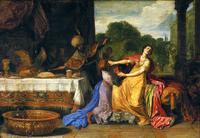
Haman
Pieter Lastman
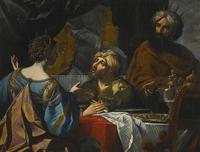
The intercession of Esther with King Ahasuerus and Haman
Pietro Paolini
Feast of Herod
Mattia Preti
Jacob Reproaching Laban
Hendrick Terbrugghen
The Banquet of Cleopatra
Jan de Bray
The Prodigal Son
Gabriel Metsu
King David Handing the Letter to Uriah
Pieter Lastman
All-testament scene in lushly draped interior with view of architecture
Constantijn Netscher
The Parable of the Prodigal Son. The Fatted Calf
Luca Giordano
The Feast of Herod
Peter Paul Rubens
The Parable of the Prodigal Son. Riotous Living
Luca Giordano
ZACHARIAS WRITING THE NAME OF SAINT JOHN THE BAPTIST
Hendrik Heerschop
The Supper at Emmaus
Tintoretto
The Supper at Emmaus
Tintoretto
Dives and Lazarus
Luca Giordano
Consistency of Scipio
Pompeo Batoni
Marriage at Cana
Giorgio Vasari
Artemisia Receives the Ashes of Mausolus
Willem de Poorter