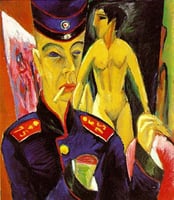
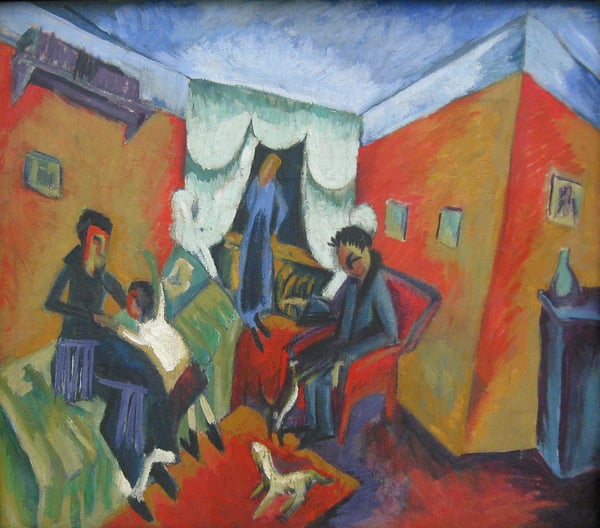
Экспертный разбор работы «Interieur» художника Ernst Ludwig Kirchner
Стиль: Expressionism · Жанр: genre painting
As an expert art historian, I will analyze “Interieur” by Ernst Ludwig Kirchner based solely on the provided structured facts: the artwork is an Expressionist genre painting by a leading figure of the movement. This context alone makes the work significant on several levels.
First, Kirchner’s “Interieur” embodies the core tenets of German Expressionism, a style that deliberately broke with naturalistic representation to convey raw emotional and psychological states. As a genre painting—a scene from everyday life—the work takes a mundane, domestic subject and transforms it into a charged, subjective vision. The interior space is not depicted realistically; instead, it is distorted through Kirchner’s signature angular lines, jarring perspectives, and bold, often dissonant color contrasts. This approach reflects the Expressionist goal of portraying the inner turmoil and alienation of modern urban existence, even within the privacy of one’s home.
The significance of “Interieur” lies in how it exemplifies the Expressionist rejection of Impressionist surface charm and academic conventions. By focusing on the interior as a psychological space, Kirchner suggests that the home is not a sanctuary but a site of anxiety, claustrophobia, or tense human interaction. His use of abbreviation—sharp brushstrokes, flattened forms, and spatial compression—pushes the scene toward abstraction while maintaining recognizable objects (furniture, figures, or decorative elements). This tension between reality and emotional distortion is a hallmark of the artist’s work and the broader Die Brücke (The Bridge) group, which Kirchner co-founded.
In the context of Expressionist genre painting, “Interieur” is significant because it elevates a private, seemingly trivial moment into a universal commentary on the human condition. It challenges the viewer to look beyond the surface and experience the restless energy and psychological intensity that defined early 20th-century modernist sensibilities. Without specific visual details, we can nonetheless assert that the work represents a radical shift in how artists approached representation—prioritizing inner truth over outer likeness—and remains a powerful example of Kirchner’s lasting influence on the development of modern art.
Museum / Gallery
Визуально похожие
20 работ с близкой композицией и палитрой
The Doctor's Visit
L. S. Lowry
Untitle
Bela Czobel
Birth
Marc Chagall
Untitled
Paul Ranson
My Room at the Bindendorfs
Endre Balint
Evening Reading
Philip Evergood
Group of Three
Albert Bloch
Birth
Marc Chagall
In the Nursery
Konstantin Somov
The Murderess
Edvard Munch
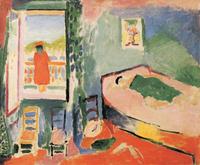
Collioure Interior
Henri Matisse
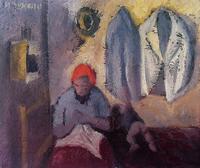
WOMAN WITH BABY
Gerard Sekoto
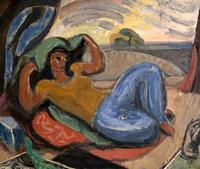
Mexican Idyll
Leon Underwood
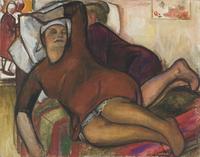
Wedding in Latgale, Housekeepers
Biruta Baumane
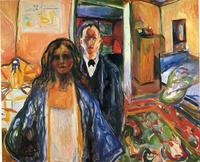
The Artist and His Model
Edvard Munch
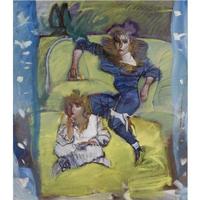
Mother and child
Dimitris Mytaras
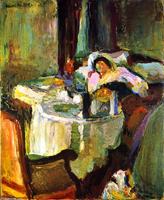
The Invalid
Henri Matisse
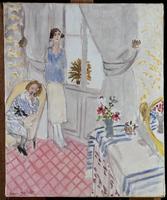
Boudoir
Henri Matisse
Girl Reclining
Elmer Bischoff
Self-Portrait as an Invalid
Ernst Ludwig Kirchner