Analisi esperta di KG Brücke di Ernst Ludwig Kirchner
Stile: Expressionism · Genere: poster
Expert Analysis: "KG Brücke" by Ernst Ludwig Kirchner
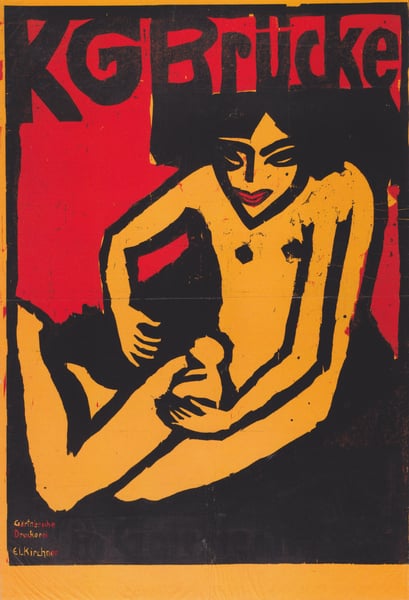
As a defining artifact of German Expressionism, Ernst Ludwig Kirchner’s poster KG Brücke (standing for Künstlergruppe Brücke or "Artists' Group Bridge") is far more than a promotional graphic—it is a visual manifesto. Created for the first exhibition of the Dresden-based collective Die Brücke, the work encapsulates the group’s revolutionary aims: to break with academic convention, channel raw emotion, and forge a new, authentic art “bridging” the past and the future.
Significance within Expressionism and the Poster Genre
At the time, posters were emerging as a modern, democratic medium, and Kirchner seized this opportunity to broadcast the group’s ideals directly to the public. The composition employs the hallmarks of Expressionist printmaking—bold, jagged lines, compressed space, and a deliberately crude, almost primitive vocabulary. The figure, likely a stylized woman or allegorical muse, is rendered with angular limbs and a mask-like face, echoing both African and Oceanic art (which Kirchner admired) and medieval woodcut traditions. This melding of "exotic" and "vernacular" sources was central to Die Brücke’s philosophy, rejecting the polished naturalism of the academy.
Color here is not descriptive but expressive: the flat fields of red, black, and ochre (typical of Kirchner’s early woodcut-style posters) create a sense of urgency and raw energy. The stark contrast and lack of shading force the viewer to confront the image directly—a visual “shock” that anticipates the psychological intensity of later Expressionist painting. The lettering, hand-drawn and integrated into the design rather than placed separately, underscores the Gesamtkunstwerk (total work of art) ideal; every element, from typography to pictorial form, is part of a unified, subjective vision.
Role as a Founding Document
KG Brücke is significant as one of the earliest printed statements of the group’s identity. It visually articulates the word “Brücke” itself—a bridge between the young artists and a future free of convention, and a bridge from the perceived decadence of the 19th century to a more primal, spiritual expression. The poster’s awkward, almost childlike draughtsmanship is deliberate: it proclaims that authenticity and emotional truth are more important than technical polish. This ethos would come to define Die Brücke’s contribution to German Expressionism, and the poster remains an icon of the movement’s rebellious, self-consciously avant-garde spirit. In its brash, confrontational simplicity, KG Brücke is not just an advertisement—it is a declaration of war against bourgeois taste and a battle cry for modern art.
Visivamente simili
20 opere con composizione e palette affini
Three Nudes and Reclining Man
Ernst Ludwig Kirchner
Three Nudes in the Forest
Ernst Ludwig Kirchner
The Luncheon on the Grass
Pablo Picasso
Mutter Und Kind
Otto Mueller
Fränzi Reclining
Erich Heckel
Three Nudes in the Forest
Ernst Ludwig Kirchner
Idyll
Francis Picabia
Zwei Sitzende Mädchen Mit Halskette
Otto Mueller
Dialogue
Max Pechstein
Der Mord
Otto Mueller
Female Nude with Red Hair Seated on Pillows
William H. Johnson
Zwei Mädchenakte Im Atelier
Otto Mueller
Three Nudes in the Forest
Ernst Ludwig Kirchner
The rescue
Pablo Picasso
Liebespaar
Otto Mueller
Nacked Couple on a Couch
Ernst Ludwig Kirchner
Reclining Nude
Pablo Picasso
In Love (Verliebt)
Christian Rohlfs
And lead us not into temptation
Max Pechstein
Untitled (The notebooks idealistic)
Ossip Zadkine