Expert analysis of Ernst Ludwig Kirchner’s Mountains in Winter
Style: Expressionism · Genre: landscape
Expert Analysis of Mountains in Winter by Ernst Ludwig Kirchner
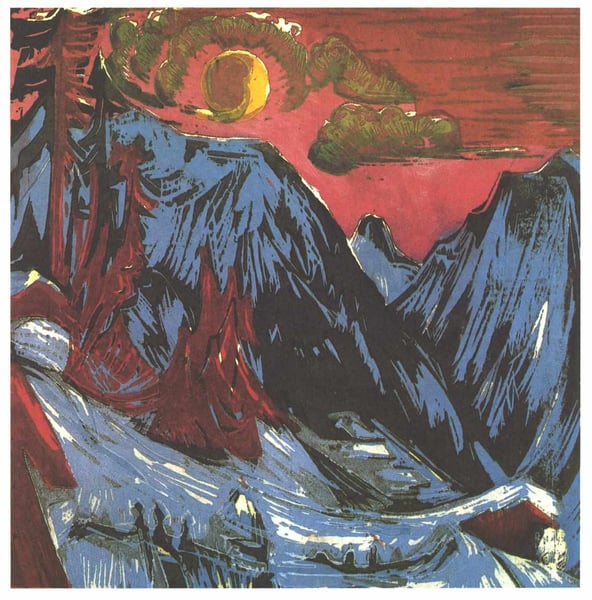
As a seminal work of German Expressionism, Mountains in Winter exemplifies Kirchner’s radical departure from naturalistic landscape painting. Within the context of the Die Brücke movement, which he co-founded, Kirchner prioritized emotional and psychological truth over optical accuracy. Here, the alpine scene is not a faithful topographical record but a turbulent inner vision—a hallmark of Expressionist ethos.
Formal Innovation & Expressive Distortion:
Kirchner’s signature jagged, angular brushstrokes and acidic, unnatural colors (e.g., deep purple shadows against stark white snow, hot orange tree trunks) create a sense of anxiety and dynamism. The mountain forms seem to tilt and press forward, compressing depth and dissolving the horizon line. This deliberate flattening of space, borrowed from African and Oceanic art, rejects Renaissance perspective in favor of raw visual impact.
Emotional Charge:
Wilderness in Kirchner’s winter landscape is not serene but charged with a primal, almost threatening energy. The twisting, skeletal trees and fractured slashes of paint evoke a psyche under strain—reflecting Kirchner’s own struggles with mental health after his wartime trauma. Unlike Romantic winter scenes (e.g., Caspar David Friedrich), this is a landscape of inner crisis, where nature mirrors modernist alienation.
Significance within Expressionism:
Mountains in Winter epitomizes the Expressionist belief that art must be a “cry of distress” (Kirchner’s own words, later echoed by Edvard Munch). It pushes landscape beyond mere subject matter into a vehicle for subjective truth. The work also marks a transition: Kirchner’s later Swiss landscapes (after fleeing Nazi persecution) would soften into calmer, more rhythmic compositions, making this earlier mountain scene a peak of his confrontational, fractured style.
In essence, the painting’s significance lies in its fusion of violent formalism and raw emotion—a template for how Expressionism could transform even the quietest subject (snow-covered mountains) into an existential statement.
Visually similar
20 works with related composition and palette
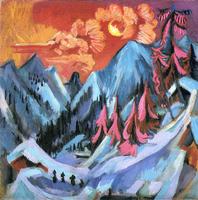
Winter Landscape in Moonlight
Ernst Ludwig Kirchner
Junkerboden
Ernst Ludwig Kirchner
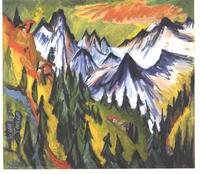
Mountain Top
Ernst Ludwig Kirchner
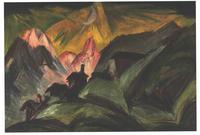
Stafelalp at Moon Light
Ernst Ludwig Kirchner
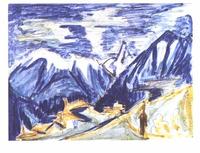
Staffelalp in the Autumn
Ernst Ludwig Kirchner
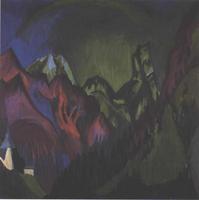
Trains Gorge near Monstein
Ernst Ludwig Kirchner
Forest Cemetery
Ernst Ludwig Kirchner
Taklamakan, Chinese Turkestan
Nicholas Roerich
Snow at the Staffelalp
Ernst Ludwig Kirchner
Study for autumn
Wassily Kandinsky
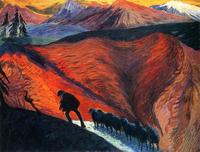
Untitled
Marianne von Werefkin
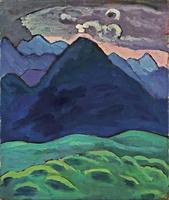
BLAUER KEGELBERG
Gabriele Munter
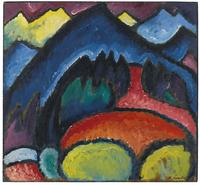
Oberstdorf - Mountains
Alexej von Jawlensky
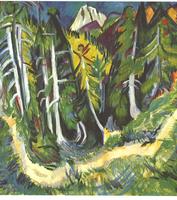
Forest Gorge
Ernst Ludwig Kirchner
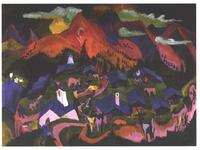
Return of the Animals
Ernst Ludwig Kirchner
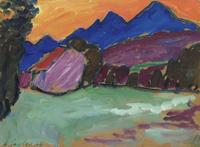
Roter Abend - Blaue Berge
Alexej von Jawlensky
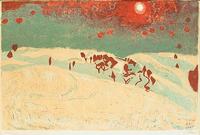
Sunset in a snowy landscape
Cuno Amiet
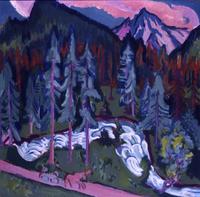
Sertigweg
Ernst Ludwig Kirchner
Moon Rising at the Staffelalp
Ernst Ludwig Kirchner
The Mountain
Ernst Ludwig Kirchner