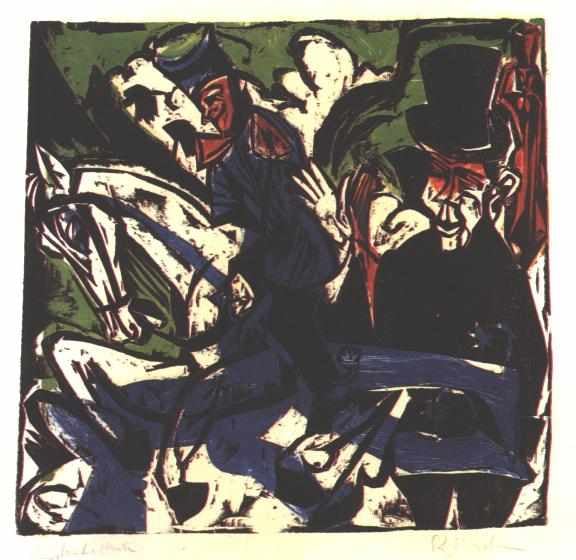
Schlemihls Entcounter with Small Grey Man
Analisi esperta di Schlemihls Entcounter with Small Grey Man di Ernst Ludwig Kirchner
Stile: Expressionism · Genere: genre painting
Expert Analysis of Schlemihls Entcounter with Small Grey Man by Ernst Ludwig Kirchner
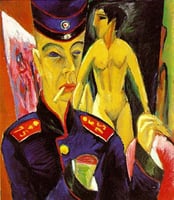
As a landmark work within the Expressionist movement, this genre painting by Ernst Ludwig Kirchner exemplifies the core artistic principles of early 20th-century German Expressionism. Though the artwork depicts a seemingly ordinary narrative scene—the encounter between the protagonist Schlemihl and a mysterious small grey man—Kirchner transforms this genre subject into a charged psychological tableau.
Significance within Expressionism:
- Emotive Distortion: Kirchner abandons naturalistic proportions in favor of jagged, angular lines and deliberately skewed perspectives. This distortion serves to externalize the protagonist’s inner anxiety, a hallmark of the Expressionist aim to convey subjective emotional truth over objective reality.
- Color as Emotion: The palette is characteristically vivid and non-naturalistic — likely featuring high-contrast, jarring hues that heighten the sense of unease and supernatural tension inherent in the encounter. Such color choices were pioneered by Kirchner and his fellow Die Brücke artists as a direct means of communicating raw feeling.
- Psychological Depth: The painting’s title references Peter Schlemihl, a literary figure who trades his shadow—an allegory of identity and alienation. By casting this literary reference into a genre painting, Kirchner elevates everyday life into a stage for existential drama, a key Expressionist strategy.
Genre Painting Reimagined: Where traditional genre painting recorded mundane life, Kirchner’s version operates as a portal to a distorted, inner world. The “Small Grey Man” is likely rendered with minimal, ghostly strokes, contrasting sharply with Schlemihl’s more solid presence—a visual metaphor for the elusive, threatening forces that haunt modern consciousness.
Art-Historical Importance: In this work, Kirchner demonstrates how Expressionism could transform even a seemingly simple narrative into a radical statement on human vulnerability and the uncanny. It stands as a testament to the movement’s power to subvert conventional genre boundaries while maintaining direct, visceral impact—a quality that makes Kirchner one of the most influential figures in pre-World War I avant-garde art.
Visivamente simili
20 opere con composizione e palette affini
Circus Rider
Ernst Ludwig Kirchner
Riding School
Franz Marc
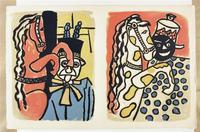
The album "Circus"
Fernand Leger
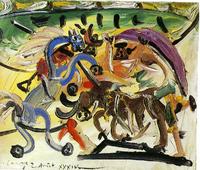
A bullfight
Pablo Picasso
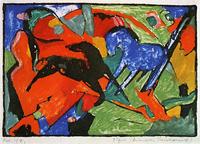
Two Horses
Franz Marc
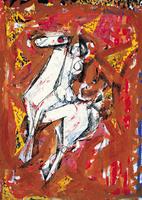
Cavaliere
Marino Marini
Untitled (Heralds)
Emiliano Di Cavalcanti
The album "Circus"
Fernand Leger
The rape of Bigarschol
David Bowie
The Horseman of the Apocalypse
Salvador Dali
Polo
Louis Schanker
Composition
Bela Kadar
The red horseman
Roy Lichtenstein
Bortnyik Sándor, Lovas
Sandor Bortnyik
Sun Ra
David Michael Hinnebusch
Nocturne
Constantin Piliuta
Trumpeter (Trompeter)
Lyonel Feininger
Marino from Shakespeare II/VI
Marino Marini
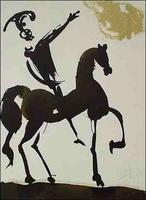
Iosue fortis in bello (Joshua 10:12)
Salvador Dali
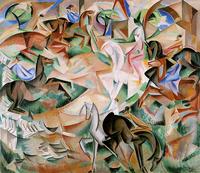
Equestrian Fantasy with Pink Lady
Alice Bailly