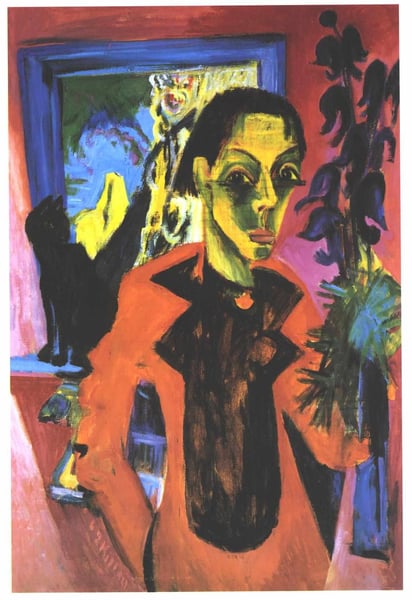
Self Portrait with Cat
Analisi esperta di Self Portrait with Cat di Ernst Ludwig Kirchner
Stile: Expressionism · Genere: self-portrait
Expert Analysis: "Self Portrait with Cat" by Ernst Ludwig Kirchner
This work is a quintessential example of early 20th-century Expressionism, a movement that rejected naturalistic representation in favor of emotional and psychological intensity. Kirchner, a founding member of the Dresden-based group Die Brücke (The Bridge), used self-portraiture as a vehicle for exploring his own fractured psyche and the anxieties of modern urban life.
Significance within Expressionism and the Self-Portrait Genre
- Radical distortion and symbolic color: Kirchner employs jarring, non-naturalistic hues—often acidic greens, yellows, and deep blues—and angular, almost jagged brushwork. This deliberate visual discord mirrors the artist’s internal agitation and aligns with Expressionism’s goal of conveying subjective experience over objective reality.
- The cat as psychological double: The inclusion of the cat is not merely decorative; in Expressionist iconography, animals frequently embody primal instincts or the artist’s own unsettled nature. Here, the cat’s sleek, watchful presence alongside Kirchner’s tense, wide-eyed gaze suggests a dialogue between the civilized self and untamed impulses—a core tension in the Brücke ethos.
- Rejection of academic portraiture: Unlike traditional self-portraits that aim for likeness or status, Kirchner’s work is aggressively anti-naturalistic. The simplified, almost mask-like face and abbreviated forms prioritize raw emotion over anatomical accuracy, making the painting a manifesto of Expressionist principles.
Art-Historical Context
Created during a period of intense personal and societal upheaval (pre-World War I Germany), this self-portrait captures the alienation and introspection that defined the Brücke group. Kirchner’s use of clashing colors and distorted space predates and influences later developments in German Expressionist painting, from Max Beckmann to Emil Nolde. The work remains a powerful testament to how self-portraiture can transcend mere appearance to become a record of inner turmoil—a hallmark of Expressionism’s enduring legacy.
Visivamente simili
20 opere con composizione e palette affini
Portrait of Gerda
Ernst Ludwig Kirchner
The Model
Matthew Smith
Japanese Girl
Hans Hofmann
Portrait of Frank Haviland Burty
Amedeo Modigliani
The Painter. Self-portrait
Ernst Ludwig Kirchner
Portrait of a Woman
Ernst Ludwig Kirchner
Czóbel Béla Györgyike 1974
Bela Czobel
Polish Woman
Chaim Soutine
Tora Vega Holmström
Maria Blanchard
Woman with a Bag
Karl Schmidt-Rottluff
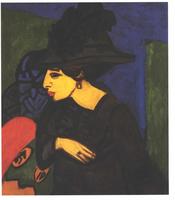
Dodo with a Big Feather Hat
Ernst Ludwig Kirchner
Anna Margit, Önarckép 1941,
Anna Margit
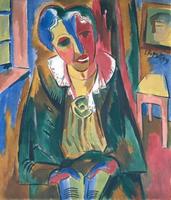
Dr Rosa Schapire
Karl Schmidt-Rottluff
Pros Felsős Lány
Bela Czobel
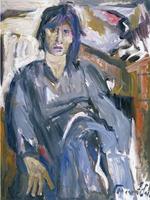
Portrait of Nina
George Mavroides
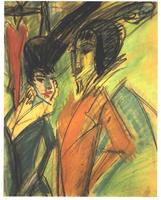
Two Cocottes
Ernst Ludwig Kirchner
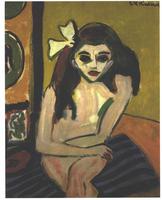
Marcella
Ernst Ludwig Kirchner
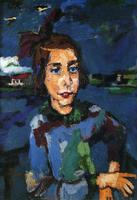
Gitta Wallerstein
Oskar Kokoschka
Russian Woman
Ernst Ludwig Kirchner
Portrait of Marika Rebók
Endre Bartos