Expertenanalyse zu Ernst Ludwig Kirchners Study on Red Tart
Stil: Expressionism · Genre: sketch and study
Expert Analysis of "Study on Red Tart" by Ernst Ludwig Kirchner
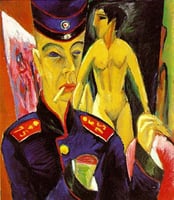
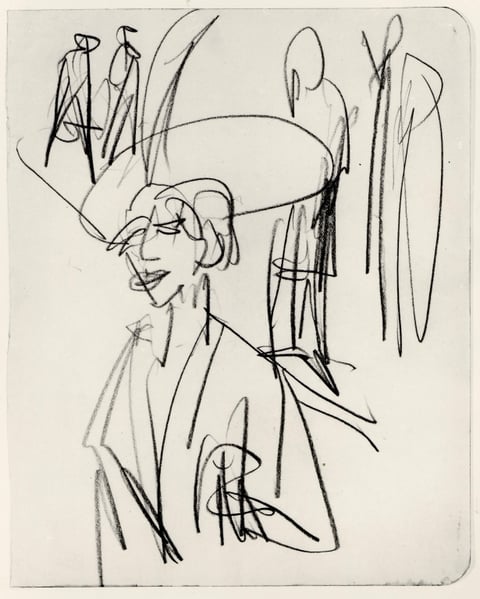
As a sketch and study from the height of German Expressionism, Kirchner’s "Study on Red Tart"" is significant not as a finished masterpiece, but as a revealing glimpse into the artist’s working process and his fundamental expressive goals. The work exemplifies the core tenets of the Die Brücke (The Bridge) movement, which Kirchner co-founded: a raw, spontaneous approach that prioritizes emotional intensity over naturalistic representation.
The “study” format here is crucial. In Expressionist practice, the sketch was not merely a preparatory step but a site of authentic, unmediated creation. Kirchner’s rapid, angular lines and the titular emphasis on “Red” demonstrate his use of color as a direct carrier of psychological and sensory experience. The color red—likely applied in broad, unmodulated strokes—does not simply describe the tart but translates its visual impact into a visceral, almost jarring sensation. This reflects the Expressionist goal of Ausdruckskunst (art of expression), where the artist’s inner feeling about the subject is more important than its optical appearance.
The work’s significance lies in its distillation of Kirchner’s signature style: a rejection of academic finish in favor of dynamic, often aggressive mark-making. The “sketch” quality preserves the moment of creation—the artist’s hand moving in response to a fleeting perception. Even within a small study, Kirchner compresses space and distorts form, flattening the tart and its surroundings into a symbolic, emotionally charged composition.
Ultimately, "Study on Red Tart" is a key document of Expressionist methodology. It shows how Kirchner transformed an ordinary object (a tart) into a conduit for heightened color and psychological tension, demonstrating that even the most modest subject could become a vehicle for the movement’s revolutionary aim: to reject bourgeois conventions and reconnect art with raw, unvarnished life.
Museum / Gallery
Visuell ähnlich
20 Werke mit ähnlicher Komposition und Farbpalette
Personnages
Aurel Cojan
Street Scene in Berlin
Ernst Ludwig Kirchner
Untitled
Roberto Matta
Jane Avril Seen from the Back
Henri de Toulouse-Lautrec
Study to "Exodus"
Marc Chagall
A Montparno study
Theophile Steinlen
Recto. Green Eyes, Verso. Untitled
Pierre Alechinsky
Two Cocottes
Ernst Ludwig Kirchner
The French are Sitting on the Couch
Ernst Ludwig Kirchner
DONDI WHITE
Dondi
The Autumn
Aurel Cojan
Untitled
Egon Schiele
Airmen
Frances Hodgkins
Encounter
Ernst Ludwig Kirchner
Dancer and Audience
Ernst Ludwig Kirchner
Proust: Illustration 5.
Maria Bozoky
Three Women in a Cafe
Ernst Ludwig Kirchner
Torso
Anton Heyboer
Sketch of the painting Girls on the Volga
Kuzma Petrov-Vodkin
Portrait of Madame Dr. Horak
Egon Schiele