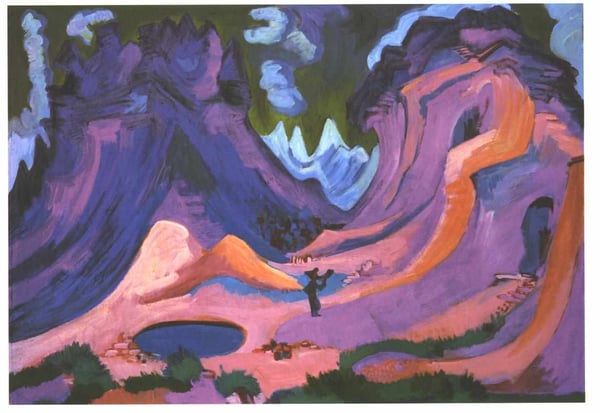
The Amselfluh
Expertenanalyse zu Ernst Ludwig Kirchners The Amselfluh
Stil: Expressionism · Genre: landscape
Expert Analysis: "The Amselfluh" by Ernst Ludwig Kirchner
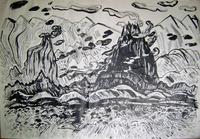
Ernst Ludwig Kirchner’s The Amselfluh stands as a powerful example of early 20th-century Expressionist landscape painting, created during the artist’s most formative period with the Dresden-based group Die Brücke. As a landscape, it departs radically from naturalistic representation, instead using the external scene of the Amselfluh mountain (in the Swiss Alps, near Davos, where Kirchner later lived) as a vehicle for intense emotional and psychological expression.
Significance within Expressionism:
Kirchner distorts topography with jagged, angular lines and a dynamic, almost violent brushstroke. The mountain is not rendered with smooth contours but with sharp, fractured forms that convey a sense of inner turmoil or heightened vitality. This technique reflects the Expressionist credo of projecting subjective feeling onto the landscape—nature becomes a mirror of the artist’s psyche.
Stylistic Hallmarks:
Typical of Kirchner’s work, The Amselfluh employs a dissonant, non-naturalistic color palette. Bold blues, greens, and yellows clash and vibrate, creating a sense of raw energy rather than atmospheric harmony. The composition pushes the mountain aggressively forward, compressing space and eliminating traditional perspective, forcing the viewer into an immediate, confrontational engagement with the scene.
Why It Matters:
This painting exemplifies how Kirchner and the Brücke artists redefined landscape genre: not as a tranquil retreat, but as a site of existential struggle and emotional release. The Amselfluh anticipates Kirchner’s later Swiss landscapes, where the Alpine environment becomes both a haven and a source of psychological tension. Its aggressive formal language—the angularity, the clashing hues, the expressive distortion—makes it a landmark of Expressionist art, demonstrating that even a “simple” mountain view could be transformed into a raw, visceral statement about modern anxiety and the search for authenticity.
Visuell ähnlich
20 Werke mit ähnlicher Komposition und Farbpalette
Three Jewels
Nicholas Roerich
The Mountain
Ernst Ludwig Kirchner
Himalayas
Nicholas Roerich
Rond rocks
Nicholas Roerich
Homenagem a Fernão Mendes Pinto
Antonio Areal
Burning the Darkness
Nicholas Roerich
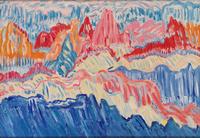
Nakchivan mountains
Sattar Bahlulzade
Postbefordring Paa Maanen
Theodor Severin Kittelsen
Scene design for "Peer Gynt"
Nicholas Roerich
Penitentes
Xul Solar
Untitled
Minas Avetisyan
Himalayas
Nicholas Roerich
Black Place, Grey and Pink
Georgia O'Keeffe
Phosphate Mines
Mahmoud Saiid
Fire paternoster
Nicholas Roerich
Le Chiffonnier
Marianne von Werefkin
Great spirit of Himalayas
Nicholas Roerich
Untitled
Marianne von Werefkin
Laza
Sattar Bahlulzade
Shahnabad mountains
Sattar Bahlulzade