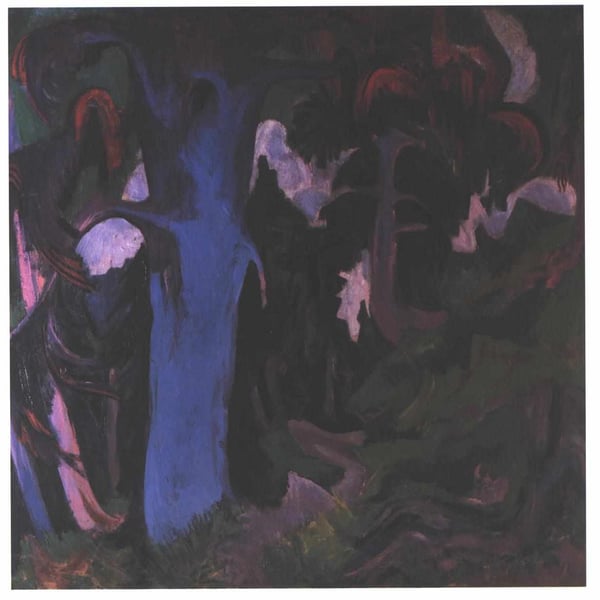
The Blue Tree
Analisi esperta di The Blue Tree di Ernst Ludwig Kirchner
Stile: Expressionism · Genere: landscape
Expert Analysis of "The Blue Tree" by Ernst Ludwig Kirchner
Ernst Ludwig Kirchner’s The Blue Tree stands as a quintessential example of German Expressionist landscape painting, reflecting the movement’s radical break from naturalistic representation in favor of emotional and psychological intensity. As a founding member of the Dresden-based artist group Die Brücke (The Bridge), Kirchner championed a raw, subjective approach that sought to channel inner experience directly onto the canvas.
Key Significance
-
Non-Naturalistic Color as Emotional Conduit
The titular “blue tree” immediately signals Expressionism’s core tenet: color is liberated from descriptive function. By rendering a tree in vivid, unnatural blue, Kirchner prioritizes mood over mimesis. Blue often conveys melancholy, distance, or the sublime—here it may reflect the artist’s own turbulent mental state or a desire to evoke the spiritual and the primordial. Such chromatic distortions align with Kirchner’s belief that art should express “the inner necessity” of the artist, a concept later codified by Wassily Kandinsky. -
Subversion of Traditional Landscape
Instead of a harmonious, composed vista, Kirchner presents a landscape that is fragmented, angular, and aggressively simplified. Forms are outlined in thick, black contours—a hallmark of the woodcut aesthetic that Kirchner also practiced—and flattened into a dynamic, almost claustrophobic composition. This rejection of perspectival depth and atmospheric perspective forces the viewer to confront the scene’s emotional charge rather than its spatial credibility. -
Expressionist Anxiety and Urban Influence
Though The Blue Tree is a landscape, it carries the restless, jagged energy typical of Kirchner’s city scenes (e.g., Street, Berlin). The distorted, swaying trunks and the jarring juxtaposition of blue and acidic greens/yellows create a sense of unease. This reflects the Expressionist fascination with modern alienation—even nature is no longer a refuge but a mirror of psychic turmoil. -
Die Brücke’s Primitivist Aesthetic
Kirchner’s deliberate awkwardness—the blunt brushwork, the uneven application of paint—echoes the group’s turn to “primitive” art (African, Oceanic, and folk) as an antidote to academic refinement. The tree becomes a totemic, almost anthropomorphic presence, stripped of botanical accuracy to evoke raw vitality.
Contextual Importance
Painted during Kirchner’s most productive phase (c. 1908–1914), The Blue Tree exemplifies the Expressionist landscape as a vehicle for subjective truth. It defies the tradition of pastoral serenity (e.g., Impressionism’s plein air idylls) and instead forecasts the decade’s growing existential dread. The work’s aggressive color and form would influence later movements like Abstract Expressionism, cementing Kirchner’s legacy as a pioneer who used landscape not to depict nature, but to translate inner crisis into visual form.
In sum, The Blue Tree is significant because it encapsulates Expressionism’s revolutionary mission: to make visible the invisible—emotion, anxiety, the subconscious—through liberated color and distorted form.
Visivamente simili
20 opere con composizione e palette affini
Trivaux Pond
Henri Matisse
Paysage aux deux figures
Pablo Picasso
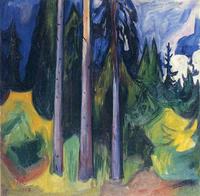
Forest
Edvard Munch
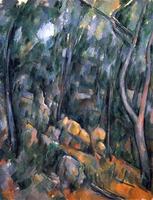
Forest near the rocky caves above the Chateau Noir
Paul Cezanne
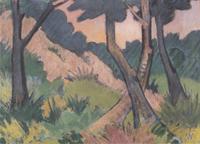
Landschaft Iii
Otto Mueller
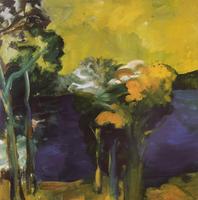
Bay
Elmer Bischoff
The White Tree
Jan Sluyters
View of monte Acuto
William Balthazar Rose
Waldlandschaft
Otto Mueller
In the Crimea
Arkhyp Kuindzhi
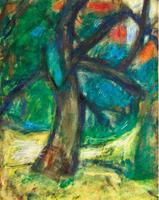
Czóbel Béla , Grosrouvres 1927
Bela Czobel
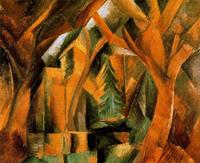
The Park at Carrières-Saint-Denis
Georges Braque
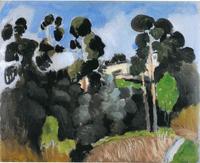
Landscape
Henri Matisse
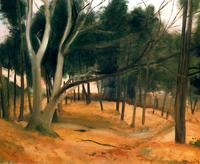
The Path of forest
Andre Derain
Landscape (mountains)
Umberto Boccioni
Olive trees
Konstantinos Maleas
Under the Trees - Monhegan
Robert Henri
Summer Landscape
Dorrit Black
Arbutus Tree
Emily Carr
Guillaumin by the Road
Paul Cezanne