Analisi esperta di The Dance between the Women di Ernst Ludwig Kirchner
Stile: Expressionism · Genere: genre painting
Expert Analysis:
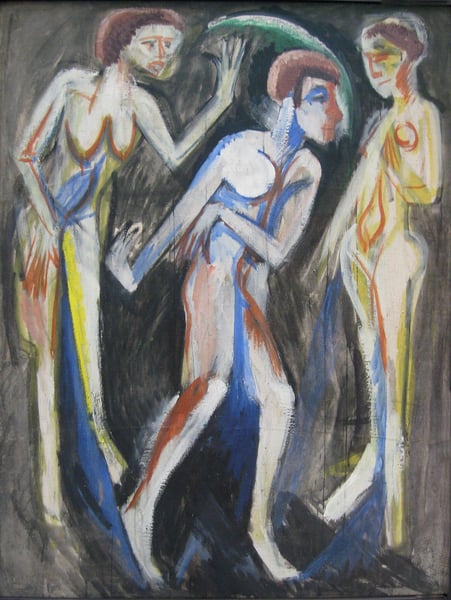
Ernst Ludwig Kirchner’s The Dance between the Women is a quintessential example of German Expressionism, a movement Kirchner helped define as a founding member of the Dresden-based group Die Brücke (The Bridge). This genre painting—depicting an intimate or public dance scene—embodies the Expressionist commitment to conveying raw emotional states over naturalistic representation.
Significance within Expressionism:
-
Energetic Distortion & Color: Typical of Kirchner’s mature style, the composition likely features bold, non-naturalistic colors and angular, elongated figures. The “dance” motif is a recurring Expressionist device for capturing primal energy, urban frenzy, or social alienation. Here, the interaction between women may suggest themes of modern urban camaraderie, performance, or liberation—common tropes in Kirchner’s Berlin street scenes.
-
Psychological Intensity: The painting’s significance lies in its ability to project inner tension through form. Kirchner strips away academic perspective and modeling, instead using flattened planes and rough brushwork. This technique forces the viewer to engage with the emotional charge of the moment rather than a literal narrative.
-
Break from Tradition: As a genre scene (everyday life), the work subverts traditional genre painting (often calm, moralizing) by injecting agitation and subjectivity. It reflects the Expressionist desire to “express” the artist’s inner vision of a fragmented modern world—a hallmark of Kirchner’s pre-war oeuvre.
In short, The Dance between the Women is significant not for its subject alone, but for how Kirchner translates a simple social encounter into a vibrating, unsettling emblem of early 20th-century psychological modernity. It stands as a powerful document of Die Brücke’s radical break with impressionism and naturalism.
Museum / Gallery
Genere
Stile
Visivamente simili
20 opere con composizione e palette affini
Loneliness for Two
George Stefanescu
Nudes in a Meadow
Ernst Ludwig Kirchner
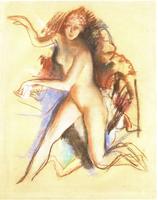
Nude
Zinaida Serebriakova
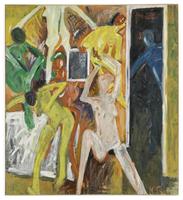
From James Joyce’s ‘Ulysses’
Allan Kaprow
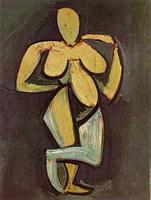
Standing female nude
Pablo Picasso
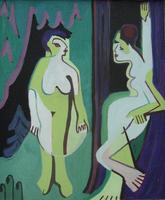
Naked Women on Meadow
Ernst Ludwig Kirchner
Effloration
Austin Osman Spare
Four people in a village
Ossip Zadkine
Drei Weibliche Akte
Otto Mueller
Untitled (Three Nudes)
Mark Rothko
Illustration for V. Voiculescu's "Last Shakespearean Sonnets"
Margareta Sterian
Landscape and bathers
Ossip Zadkine
The judgment of Paris
Joan Tuset
Zwei Mädchen
Otto Mueller
Nu Cubista N°1
Anita Malfatti
Three Nudes in the Forest
Otto Mueller
Internal
Paul F. Yount
Bathing women
Andre Derain
Les Dlemoilselles D'Avignon (The Girls of Avignon)
Salvador Dali
Drie Naakten in Landschap
Otto Mueller