Expert analysis of Lorenzo Lotto’s Sleeping Apollo, Muses and Fama
Style: High Renaissance · Genre: mythological painting
Expert Analysis: "Sleeping Apollo, Muses and Fama" by Lorenzo Lotto (High Renaissance)
Lorenzo Lotto’s Sleeping Apollo, Muses and Fama stands as a compelling counterpoint to the idealized harmony typically associated with the High Renaissance. While his contemporaries—Raphael, Leonardo, Michelangelo—pursued classical balance and divine proportion, Lotto injected a vein of psychological complexity, eccentric composition, and emotional ambiguity that makes this mythological work both fascinating and significant.
Departure from High Renaissance Conventions
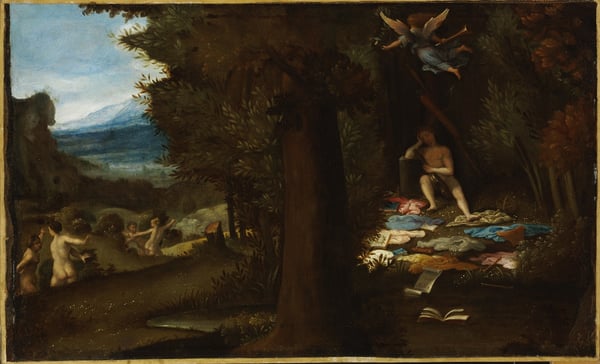
In standard High Renaissance treatment, Apollo would be depicted awake, radiant, and in command—the god of music, poetry, and light. Lotto subverts this expectation by showing Apollo asleep, rendered vulnerable and inert. This choice immediately introduces a tension between the mythological ideal and a more human, even fragile, state. The sleeping god becomes a passive center, while the Muses and Fama (allegory of Fame/Rumor) surround him in an almost restless configuration. This is not the serene, ordered cosmos of Raphael’s Parnassus; it is a space of latent drama and psychological weight.
Lotto’s Signature Psychological Realism
Lotto was renowned for his ability to capture inner life through gesture, expression, and unusual spatial relationships. Here, the Muses do not simply attend Apollo—they seem caught in varied states of attention, distraction, or whispered intrigue. Fama, traditionally a herald of glory, may be either trumpeting Apollo’s fame or, ironically, disturbing his rest. This interplay suggests deeper narrative layers: Are the Muses guarding the sleeping god? Are they restless without his guidance? Lotto leaves the scene open to interpretation, inviting the viewer to read the painting as a meditation on inspiration, sleep, and the precarious nature of renown.
Use of Color and Light
Lotto’s palette—cool blues, warm ochres, and surprising accents of orange and green—reflects his northern Italian sensitivity to color as an emotional tool. Unlike the atmospheric sfumato of Leonardo or the clear tonal structure of Raphael, Lotto’s light falls in irregular, almost nervous patches, highlighting certain faces and limbs while leaving others in shadow. This chiaroscuro creates a sense of intimacy and immediacy, as if the viewer has stumbled upon a private, dreaming moment.
Significance Within the High Renaissance
The work’s significance lies in its challenge to the era’s dominant aesthetic. Where High Renaissance art often sought universal truth through ideal forms, Lotto embraced the particular, the idiosyncratic, and the psychologically ambiguous. Sleeping Apollo, Muses and Fama shows that the High Renaissance was not a monolithic style but a field of individual approaches. Lotto’s mythological painting refuses to be simply a beautiful, static frieze; it is a narrative puzzle that prioritizes human (and divine) interiority over outward grandeur.
In short, this painting matters because it reveals an alternative High Renaissance—one where gods can be vulnerable, fame can be restless, and the most significant story is the one left untold.
Museum / Gallery
Visually similar
20 works with related composition and palette
Diana dormida
Frans Wouters
Salmacis and Hermaphroditus
Ludovico Carracci
Landscape with Ceres (Allegory of Earth)
Jan Brueghel the Younger
Nymphs And Children In a Landscape With Shepherds
Giorgione
The Triumph of Silenus
Nicolas Poussin
Landscape with the sacrifice of Isaac
Annibale Carracci
LE PARADIS TERRESTRE
Frans Pourbus the Elder
Competition between Apollo and Pan
Bartholomeus Spranger
Landscape with a Man Killed by a Snake
Nicolas Poussin
Landscape with the Toilet of Venus
Annibale Carracci
La Mer Et Ses Productions
Jan Brueghel the Elder
Mars and Venus
Nicolas Poussin
The Four Elements
Jan Brueghel the Younger
Treated by the Muses
Jacob Jordaens
The golden age
Franz Ludwig Catel
King Midas Turns An Oak Branch to Gold
Nicolas Poussin
Landscape with bathing nymph
Adam Elsheimer
The Four Elements, Water
Jan Brueghel the Younger
The Judgment of Paris
Joachim Wtewael
Allegory (Allegory of Prudence and Wisdom)
Lorenzo Lotto