
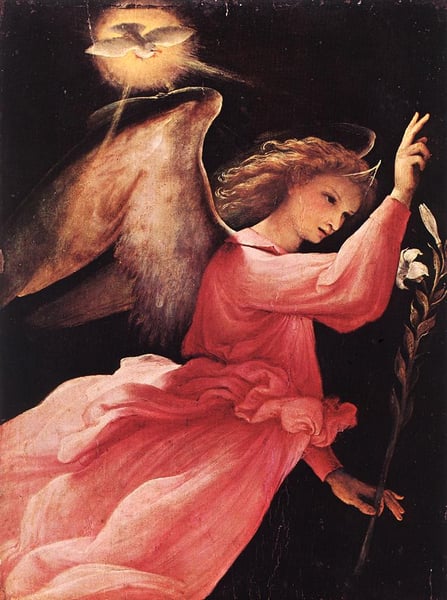
Expertenanalyse zu Lorenzo Lottos The Angel of the Annunciation
Stil: High Renaissance · Genre: religious painting
Expert Analysis: "The Angel of the Annunciation" by Lorenzo Lotto
Lorenzo Lotto’s The Angel of the Annunciation stands as a compelling, often overlooked masterpiece of the High Renaissance. While his contemporaries—Titian, Raphael, and Michelangelo—pursued idealized harmony and monumental grandeur, Lotto forged a more intimate, psychologically charged path. This work exemplifies his unique contribution to religious painting: a deeply human, almost theatrical reading of sacred narrative.
Style and Composition
Painted in the High Renaissance tradition, the piece focuses on the angel Gabriel, the divine messenger. However, Lotto abandons the static, symmetrical Annunciation scenes typical of the era. Instead, he captures a fleeting moment of arrival. The angel’s dynamic pose—perhaps alighting or gesturing with urgency—suggests movement and immediacy. Lotto’s use of color is distinctive: rich, cool blues against warm, golden light, creating a vivid contrast that heightens the supernatural yet intimate atmosphere.
Psychological Depth
What makes this work significant is Lotto’s shift from external drama to inner experience. The angel’s expression is not one of serene confidence but of tender urgency, almost as if aware of the weight of the message. This psychological nuance was rare in High Renaissance religious painting, which often prioritized idealized beauty. Lotto’s figures feel vulnerable, making the divine-human encounter more relatable and emotionally resonant.
Unique Lighting and Texture
Lotto employs a subtle chiaroscuro—not as dramatic as Caravaggio’s later tenebrism, but softer, more diffused. Light catches the angel’s wings and drapery, giving them a brittle, almost tangible quality. The meticulous rendering of fabric folds and feather textures reveals Lotto’s Northern Italian attention to detail, blending Venetian color with Lombard naturalism.
Significance within the Period
In an era dominated by classical idealism, Lotto’s Angel of the Annunciation reminds us that the High Renaissance also harbored a vein of devout, narrative intimacy. His work anticipates the Mannerist and Baroque interest in emotional immediacy, yet remains rooted in Renaissance perspective and composition. For art historians, this painting is a key example of how individual artistic temperament could reinterpret a standard religious subject, proving that even within a single style, diversity of vision thrives.
Visuell ähnlich
20 Werke mit ähnlicher Komposition und Farbpalette

The Angel of the Annunciation
Lorenzo Lotto

Angel
Titian
Annunciation the Angel
Tintoretto

Angel of the Annunciation
Guido Reni
Archangel Gavriil
Vladimir Borovikovsky

The Angel of the Annunciation
Elisabetta Sirani

Pala di Sant Agostino (Arcangel Gabriel)
Pietro Perugino

Song
Jan Matejko

Annunciation, after Leonardo Da Vinci
Magnus Enckell

A Soul Taken away by an Angel
Jean-Leon Gerome

HEAD OF AN ANGEL
Michel Dorigny

Allégorie De La Renommée
Sebastiano Conca

The Annunciation
Giorgio Vasari

The Annunciation
Giorgio Vasari
The Annunciation
Josefa de Obidos

The Angel of Peace
Walter Crane
Vallombrosa Altar (detail)
Pietro Perugino
Angel
Edward Burne-Jones

The Angel of the Annunciation
Gerard David

The Guardian Angel
Pietro da Cortona