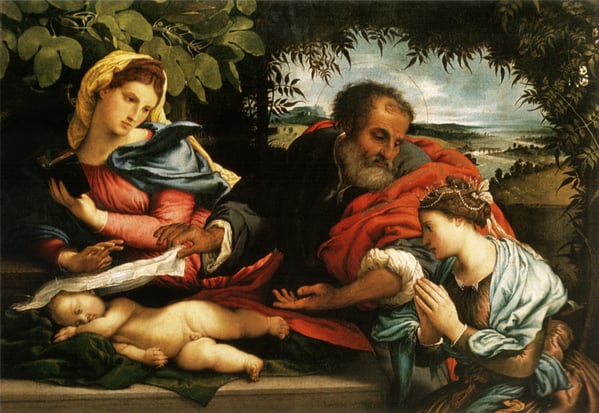
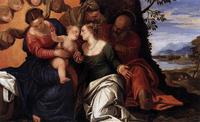
The Holy Family with St. Catherine of Alexandria
Details
Expert analysis of Lorenzo Lotto’s The Holy Family with St. Catherine of Alexandria
Style: High Renaissance · Genre: religious painting
Expert Analysis: "The Holy Family with St. Catherine of Alexandria" by Lorenzo Lotto
This religious painting, executed during the High Renaissance, exemplifies Lorenzo Lotto’s distinctive departure from the era’s dominant ideals of balanced harmony and idealized perfection. While contemporaries like Raphael and Leonardo strove for calm grandeur, Lotto infused his sacred subjects with psychological tension, intimate emotion, and a subtle narrative complexity.
Significance within the High Renaissance:
- Idiosyncratic composition: Lotto arranges the Holy Family and St. Catherine in a compact, almost crowded grouping that disrupts the typical serene pyramid. The figures interact with a palpable sense of connection—the Christ Child reaching toward St. Catherine’s wheel (her attribute), while the Virgin and Joseph exchange glances. This creates a moment of lived, human intimacy rather than remote piety.
- Psychological depth: St. Catherine’s inclusion—symbolizing wisdom and faith—adds a layer of spiritual dialogue. Lotto emphasizes her gaze and gesture, suggesting a personal, contemplative engagement with the divine. The artist’s interest in individual expression (notably the slightly anxious or tender expressions) foreshadows Mannerist sensibilities.
- Color and light: Lotto employs a rich, somewhat cooler palette than typical High Renaissance golden warmth, with vivid blues, deep reds, and sharp highlights that lend a crisp, almost enameled quality. This chromatic intensity enhances the sacred narrative while making the scene feel present and tangible.
- Symbolic layering: The depiction of St. Catherine with her broken wheel alludes to her martyrdom, blending the domestic Holy Family with a reminder of sacrifice. Lotto’s choice to feature a female saint in such proximity to the Holy Family highlights the era’s growing veneration of saintly intercession and personal devotion—a hallmark of his regional practice in the Veneto and Marche.
Why it matters:
Lotto’s work challenges the High Renaissance stereotype of seamless monumentality. This painting reveals a more introspective, emotionally charged strand of the period—one that prioritizes individual spiritual experience over formal idealism. It stands as a testament to Lotto’s unique voice: a master of quiet drama, subtle color harmonies, and an almost novelistic approach to sacred history.
Museum / Gallery
Visually similar
20 works with related composition and palette
The Mystic Marriage of Sr Catherine
Paolo Veronese
Holy Family with St Barbara and the Infant St John
Paolo Veronese
The Madonna of Saint Jerome (after Correggio)
John Graham-Gilbert
Mary with the Child and Saints
Titian
Madonna with St. Jerome (The Day)
Correggio
Holy Family (known as the Grande Famille of Francois I)
Raphael
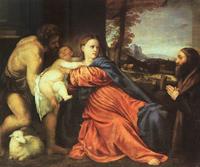
Holy Family and Donor
Titian
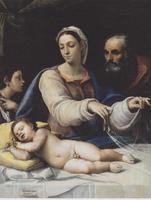
Madonna with the Veil
Sebastiano del Piombo
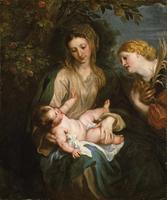
Virgin and Child with Saint Catherine of Alexandria
Anthony van Dyck
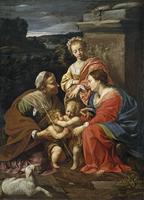
La Virgen Y El Niño, Con Santa Isabel, San Juan Bautista Y Santa Catalina
Simon Vouet
VIRGIN AND CHILD WITH SAINT PETER
Jacopo Amigoni
The Holy Family with a Shepherd
Titian
La Madonna di San Girolamo
Francisco Preciado
The Holy Family
Jacopo Pontormo
RUHE AUF DER FLUCHT NACH ÄGYPTEN
Pacecco de Rosa
The Madonna of Loreto
Raphael
Suffer the Little Children to Come Unto Me
Jacob Jordaens
Holy Family with Elizabeth and Child John the Baptist
Jacob Jordaens
Mystic Marriage of St Catherine
Paolo Veronese
The Holy Family of the Oak Tree
Raphael