Expert analysis of Lorenzo Lotto’s Virgin and Child with Two Donors
Style: High Renaissance · Genre: religious painting
This analysis focuses exclusively on the structured facts provided—Lorenzo Lotto's Virgin and Child with Two Donors, a High Renaissance religious painting—and its significance within that style and period.
Expert Analysis
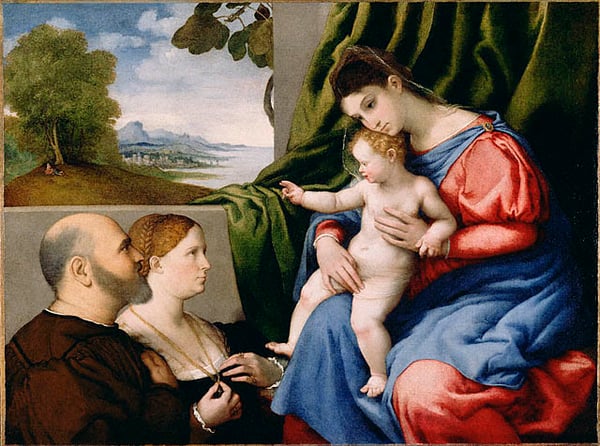
Lorenzo Lotto’s Virgin and Child with Two Donors stands as a significant, if somewhat idiosyncratic, expression of the High Renaissance. While the era is often defined by Raphael’s harmonious idealism and Leonardo’s balanced naturalism, Lotto offers a more psychologically penetrating and nervously sensitive alternative, and this work is a prime example of that divergence.
Within the High Renaissance Style: The painting adheres to the period’s conventions of a sacra conversazione (sacred conversation) format, placing the Madonna and Christ Child in a shared space with earthly donors. However, Lotto subverts the typical serene unity. Instead of a placid, centralized pyramid, he introduces a palpable tension. The Virgin’s pose and the Child’s restless energy (often seen in Lotto’s infants) shift the focus from static monumentality to dynamic, fleeting interaction. His use of chiaroscuro is not merely for volumetric modeling, as in Leonardo, but for dramatic, almost spotlight-like effects that isolate figures and heighten emotional urgency. The rich, atypical color palette—often featuring sharp contrasts of cool blues, acid greens, and deep reds—further distinguishes his approach from the more classically balanced tones of his contemporaries.
Significance as a Religious Painting: Lotto’s significance lies in his emphasis on personal devotion and palpable human connection over divine abstraction. The two donors are not passive, generic worshippers; their specific, individualized features and their deeply engaged, slightly anxious expressions draw the viewer into a private, contemplative moment. The Christ Child, often rendered as an alert, even agitated infant, seems to initiate a direct, un-idealized exchange with the donors, breaking the fourth wall of the sacred space. This creates an intimate, almost claustrophobic sense of piety that feels more like a private devotional diary entry than a public, rhetorical statement.
Ultimately, the work’s significance within the High Renaissance is that of a lyrical counterpoint. It demonstrates that the period’s genius was not monolithic. Lotto replaces Raphael’s divine grace with a tremulous, earthly realism, and Leonardo’s soft sfumato with sharp, psychological clarity. Virgin and Child with Two Donors is a masterpiece of introspective faith, proving that High Renaissance art could be just as powerful when it whispers as when it declaims.
Museum / Gallery
Visually similar
20 works with related composition and palette
The Holy Family
Raphael
The Aldobrandini Madonna or The Garvagh Madonna
Raphael
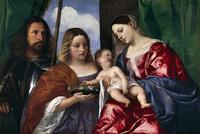
Madonna and Child with Sts Dorothy and George
Titian
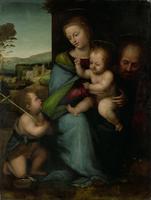
The Holy Family with John the Baptist
Fra Bartolomeo
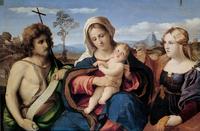
Madonna and Child with Saint John the Baptist and Magdalene
Palma Vecchio
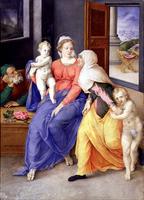
Holy Family with Santa Isabel and San Juanito
Giulio Clovio
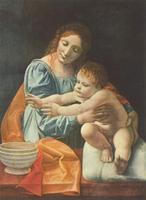
Madonna and Child
Giovanni Antonio Boltraffio
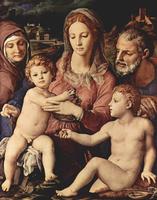
Holy Family with St. Anne and the infant St. John the Baptist
Agnolo Bronzino
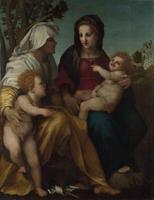
The Madonna and Child with Saint Elizabeth and Saint John the Baptist
Andrea del Sarto
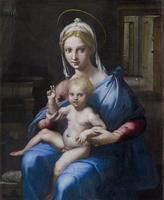
Madonna Hertz
Giulio Romano
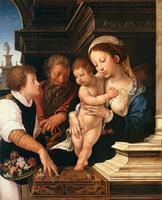
Holy Family
Bernard Van Orley
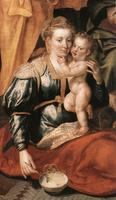
The Family of St Anne
Maarten de Vos
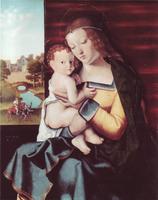
Madonna Con Il Bambino 1
Bartolomeo Veneto
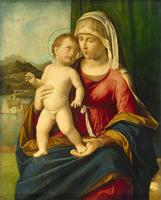
Madonna and Child
Cima da Conegliano
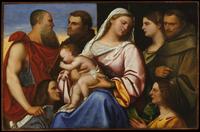
Madonna and Child with Saints and Donors
Sebastiano del Piombo
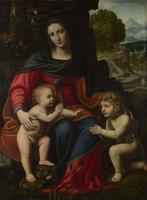
The Virgin and Child with Saint John
Bernardino Luini
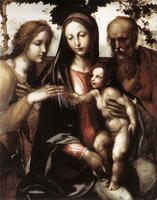
The Mystic Marriage of St Catherine
Il Sodoma
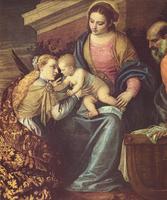
Mystic Marriage of St Catherine
Paolo Veronese
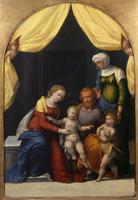
Holy Family with the Infant Saint John and Saint Elizabeth
Benvenuto Tisi
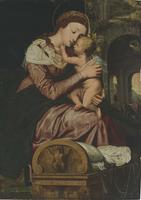
Mary with Child
Adam van Noort