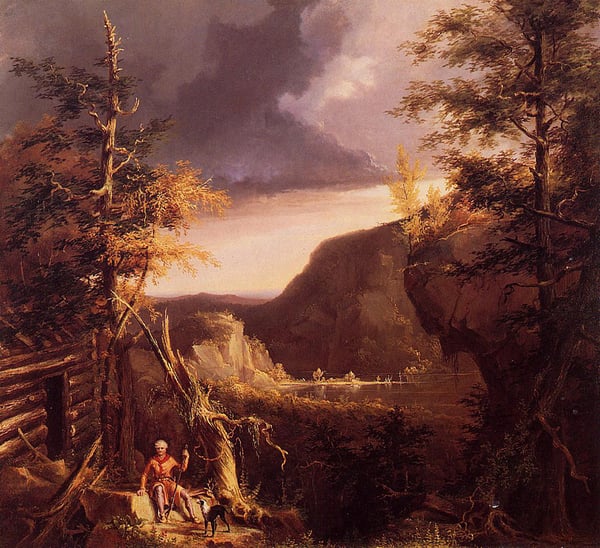
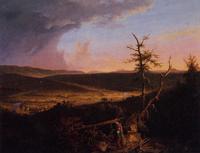
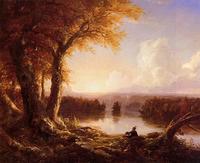
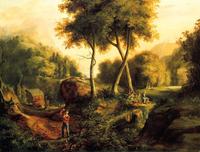
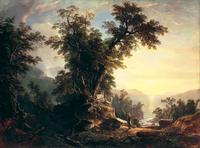
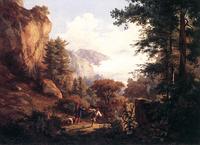
Thomas Cole’s Daniel Boone Sitting at the Door of His Cabin on the Great Osage Lake (1826) occupies a pivotal place in American Romanticism, merging the Hudson River School founder’s signature landscape vision with a distinctly nationalistic genre scene. Here, Cole does not simply paint a wilderness vista; he stages an allegory of Manifest Destiny and the frontier hero as a Romantic recluse.
Genre and Style as Ideology
As a genre painting, the work humanizes the vast landscape—Boone is not a generic trapper but a real-life folk icon, linking the scene to America’s expansionist narrative. Simultaneously, as a landscape, it epitomizes the Romantic sublime: towering storm clouds, deep shadowed forests, and the placid lake create a dramatic contrast between untamed nature and human settlement. Cole’s composition deliberately places Boone at the threshold—a liminal space between the dark interior of the cabin (civilization’s fragile shelter) and the luminous exterior (the raw continent).
Significance within Romanticism
What makes this work significant is its synthesis of two key Romantic tenets: individualism and the sublime. Boone is isolated, contemplative, and self-reliant—a Jeffersonian ideal framed by Cole’s atmospheric lighting. The cabin door functions as a pictorial device to emphasize the solitary human figure against overwhelming natural scale, echoing Caspar David Friedrich’s Wanderer Above the Sea of Fog but translated into American vernacular. Moreover, Cole elevates a frontier anecdote to mythic status, prefiguring the Hudson River School’s later devotion to portraying America as a new Eden ripe for spiritual and material conquest.
Legacy
This painting stands as an early manifesto for the Romantic celebration of the American wilderness, where landscape and human history are fused into a single moral lesson—the necessity of preserving both heroic memory and pristine nature. It remains a key document of how 19th-century artists used Romanticism to forge a national identity out of geography and legend.