Description
Style: Romanticism · Genre: religious painting
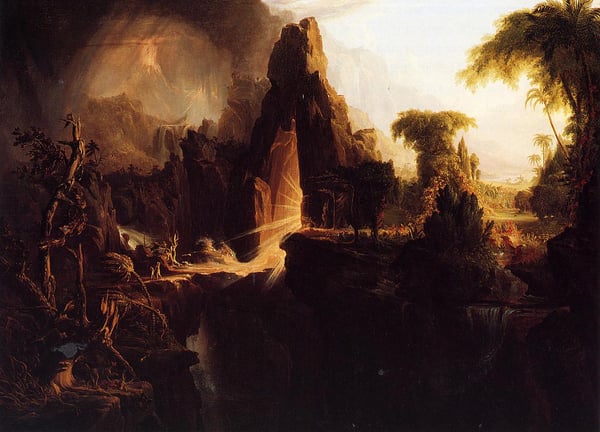
This painting depicts the moment in the Book of Genesis when God expels Adam and Eve from the Garden of Eden. Rather than focusing on the naked humanity of the couple, Cole dwarfs them within a natural setting whose scale and majesty symbolize divine power. Counterintuitively, the painting should be read from right to left, since the Garden of Eden was traditionally located in the east: from where fierce shards of light seem to evacuate the couple forcibly. The surrounding landscape is highly allegorical, a visual expression of Pathetic Fallacy, with the bright, cloudless skies of Eden offset against the brooding, stormy skies to the right.
This relatively early work exemplifies Cole's interest in religious themes, and his desire to equate the unspoiled beauty of the American landscape with the manifestation of God's will. If works such as Lake with Dead Trees (1825) indicate the Romantic infusion in Cole's painting style, this work shows his affinity with the allegorical, Neoclassical landscape works of 17th-century European painters such as Claude Lorrain and Gaspard Dughet. Rather than depicting a version of a natural landscape, in this case, an imaginative landscape based on the American wilds forms the backdrop for a scene from mythical antiquity, each element of which is highly symbolically loaded. The framing and miniaturization of human activity within that larger scene is reminiscent of Neoclassical landscapes such as Nicholas Poussin's Landscape with a Man Killed by a Snake (1648).
Expulsion from the Garden of Eden and similar works were not well-received when they debuted, perhaps because the American public was not yet ready to embrace Cole's apparent departure from the Romantic landscape style for which he was already well-known. Some commentators also criticized this painting as being too similar to an engraving produced by John Martin for an edition of Milton's Paradise Lost (1667). Nonetheless, the painting demonstrates the breadth of Cole's historical influences and was revealing in bringing to the surface the significant religious undercurrent in his work. Cole would return to religious painting towards the end of his life after joining the Episcopal Church.
Visually similar
20 works with related composition and palette
Indian Sacrifice
Thomas Cole
Landscape Composition. St John in the Wilderness
Thomas Cole
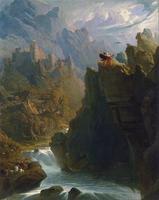
The Bard
John Martin
Landscape with St. Jerome and rocky crag
Paul Bril
Grotto with Cascades
Salvator Rosa
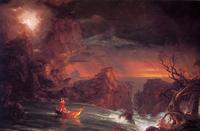
The Voyage of Life: Manhood
Thomas Cole
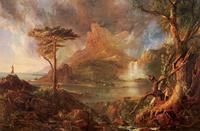
A Wild Scene
Thomas Cole
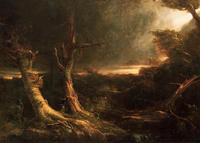
A Tornado in the Wilderness
Thomas Cole
Promeneurs et ermite devant une cascade
Michael Wutky
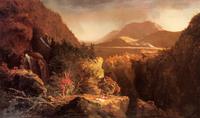
Landscape with Figures A Scene from The Last of the Mohicans
Thomas Cole
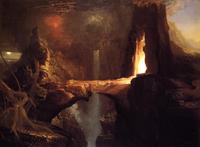
Expulsion. Moon and Firelight
Thomas Cole
The Indian's Vespers
Asher Brown Durand
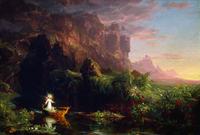
The Voyage of Life: Childhood
Thomas Cole
The Indian's Vespers
Asher Brown Durand
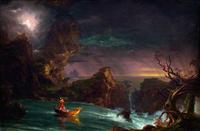
The Voyage of Life: Manhood
Thomas Cole
The Voyage of Life: Childhood (detail)
Thomas Cole
Stormy Landscape
Peter Paul Rubens
Lovro Janša
Lovro Jansa
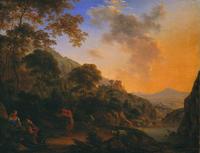
Mountain Landscape with Dancing Shepherd
Henry Anderton
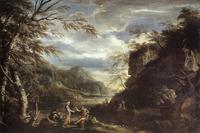
River Landscape with Apollo and the Cumean Sibyl
Salvator Rosa