Analyse experte de Fabulous Beast II de Franz Marc
Style : Cubism · Genre : animal painting
Expert Analysis: "Fabulous Beast II" by Franz Marc
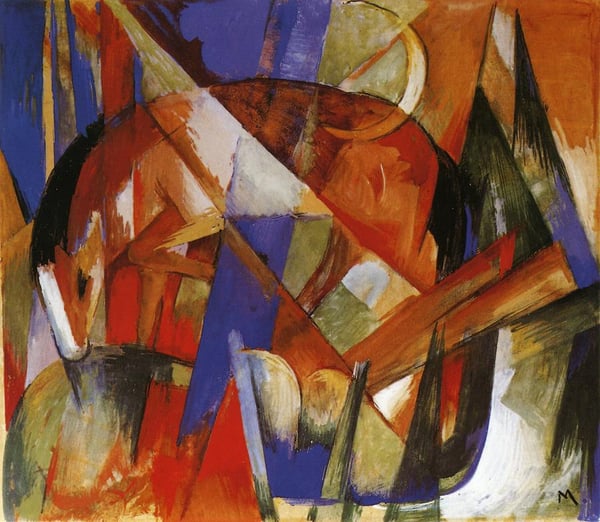
In "Fabulous Beast II," Franz Marc applies the formal language of Cubism to a subject that was central to his career: the animal. While Cubism—pioneered by Picasso and Braque—typically deconstructed still lifes, portraits, and urban scenes, Marc reorients its fractured planes and shifting perspectives toward the natural world. This move is significant because it merges the intellectual rigor of Cubist geometry with the emotional and symbolic resonance of animal imagery, a hallmark of Marc’s Expressionist background.
The work’s title, "Fabulous Beast," hints at a mythological or archetypal creature, but Marc renders it through the Cubist lens: the animal’s body is broken into interlocking facets, ambiguous spatial planes, and a restrained palette. Rather than depicting a specific species, he distills the essence of animality—power, grace, otherness—into a composition that hovers between abstraction and figuration. The "fabulous" quality emerges not from narrative details, but from the tension between the recognizable (a creature) and the radical reduction (Cubist fragmentation).
Within the broader Cubist movement, Marc’s animal painting stands out for its fusion of avant-garde technique with a romantic, almost pantheistic reverence for nature. While most Cubist works evacuated emotion in favor of formal analysis, "Fabulous Beast II" retains a sense of wonder and spiritual connection. This hybrid approach—Cubist structure leavened by Expressionist feeling—makes the artwork a pivotal bridge between two major modern movements, demonstrating that Cubism could be adapted to express not just the geometry of things, but the life of them.
Museum / Gallery
Visuellement similaire
20 œuvres à la composition et à la palette proches
Dancer + Sailing + Sea = Bouquet
Gino Severini
L'Acrobate
Jacques Villon
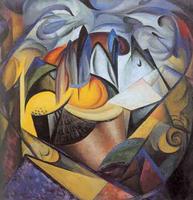
Memories of the Caucasus
Oleksandr Bogomazov
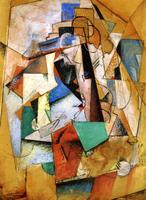
Composition
Georges Valmier
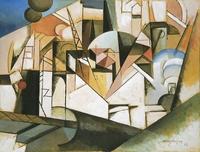
Paysage
Albert Gleizes
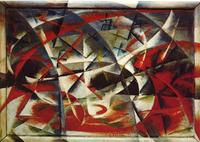
Abstract Speed + Sound
Giacomo Balla
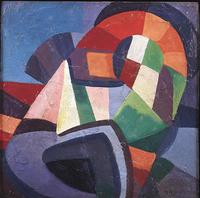
Synchromy
Morgan Russell
Composition-64
Chaldin Alex
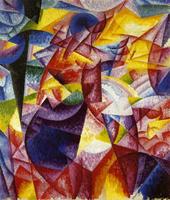
Simultaneity of Centrifugal and Centripetal Groups (Woman at a Window)
Gino Severini
Disjunction of forms
Olga Rozanova
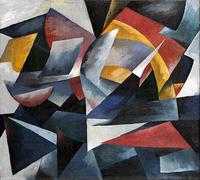
Futuristic composition
Aleksandra Ekster
Untitled
Gogi Khutsishvili
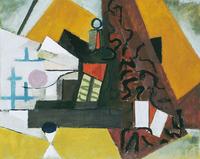
Cin-Zin
Karl Knaths
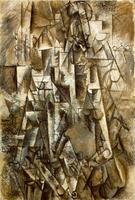
Poet
Pablo Picasso
Початок Сну (The beginning of a dream)
Артемій Присяжнюк
Equilibrium
André Merez
Kuřák
Emil Filla
Dynamism of a Cyclist
Umberto Boccioni
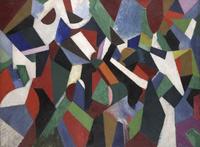
Composition II
Patrick Henry Bruce
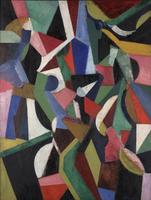
Composition I
Patrick Henry Bruce