Description
Style : Cubism · Genre : symbolic painting
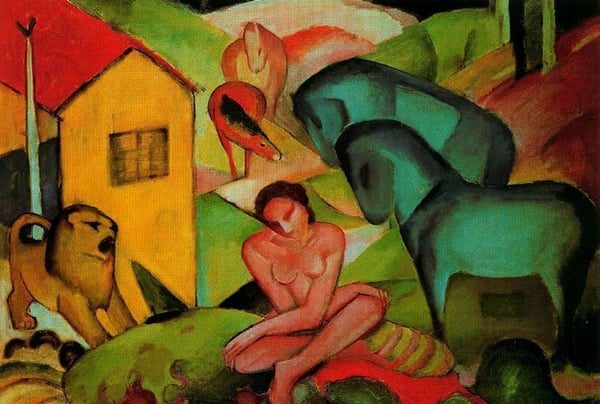
The Dream demonstrates Franz Marc’s artistic evolution and the development of his symbolist color theory. Marc’s creative development was influenced by his meeting of German Expressionist painter August Macke in 1910, and Russian artist and theorist, Wassily Kandinsky in 1911. Marc gifted The Dream to Kandinsky shortly after its completion, and in return, Kandinsky gave Marc his painting, Improvisation 12 (Rider) (1910).
Marc painted The Dream in Sindelsdorf, a small village near the Bavarian Alps, which the artist moved to in 1909. Marc showed disdain for city life; he wished to reconnect with nature, which was significant to his artistic thinking. The idyllic scenery brought him closer to his new spiritual vision that expressed the harmony between man and nature. In the painting, the woman surrounded by animals symbolizes the balance between the human and the animal world. Marc merged dream and reality: the central female figure is nude and asleep, surrounded by manifestations of her dream. The black sky in the background indicates nighttime and the dream state of the female character. Marc’s color no longer mimicked the real world; instead, the artist applied his color theory where each color had a symbolic function; for example, blue represented masculinity, severity, and spirituality, while yellow represented femininity, cheerfulness, and sensuality.
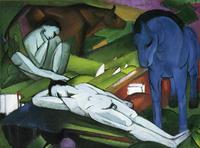
There are several recognizable influences in The Dream. It has similar elements to Marc’s painting, Shepherds (1912), which depicts a nude couple in nature. Even though the female figure in Shepherds is positioned at a different angle, the pose is reminiscent of the one in The Dream. Both paintings also feature blue horses, which is probably the most recognizable motif in Marc’s art. The blue horse could also be identified with The Blue Rider, the Expressionist group of which Marc was a key member, along with Kandinsky and Macke. Marc was fascinated with the Italian futurist group and their signature ‘lines of force’ that described the motion of objects and injected dynamism into futuristic compositions.
Similarly, Marc’s lines radiate from the female figure and give the composition rhythm and structure. Another noteworthy influence is French Post-Impressionist Paul Gauguin, mainly works from Gauguin’s Tahitian period, such as Sacred Spring (1894) and Day of the Gods (1894). Much like Gauguin, who was enamored with Tahitian life and nature, Marc’s images aimed to show a more primal and essential state of being.
After Marc’s death in 1916, the painting was featured in commemorative exhibitions held in Munich and Wiesbaden. Years later, while Kandinsky taught at the famous experimental art school Bauhaus, he was visited by Katherine Sophie Drier, an art patron and co-founder of the art organization Société Anonyme. The Dream was selected to be part of the International Exhibition of Modern Art organized by Société Anonyme, which toured New York and other American cities. Today, it is part of the Thyssen-Bornemisza Museum collection in Madrid, Spain.
Museum / Gallery
Visuellement similaire
20 œuvres à la composition et à la palette proches
Shepherds
Franz Marc
The Waterfall
Franz Marc
The Swimmers
Albert Gleizes
Two Girls in Landscape
Otto Mueller
In the Rain
Franz Marc
Berény Róbert, IV Jelenet
Berény Róbert
Resting Among Flying Colors
Sandro Chia
Zwei in Dünen Sitzende Mädchen
Otto Mueller
Bathers at Sea
Ernst Ludwig Kirchner
Three Nudes in a Forest
Max Weber
Bereny Robert 1912
Berény Róbert
Scene villageoise
Grégoire Michonze
Reflecting pool
Marcel Gromaire
Summer
Max Weber
Return of the Prodigal
Godfrey Blow
Drei Akte in Landschaft
Otto Mueller
Three nude women
Rafael Zabaleta
The Myth of Orpheus
Marc Chagall
Winter
Albert Bloch
Paradise
Marc Chagall