
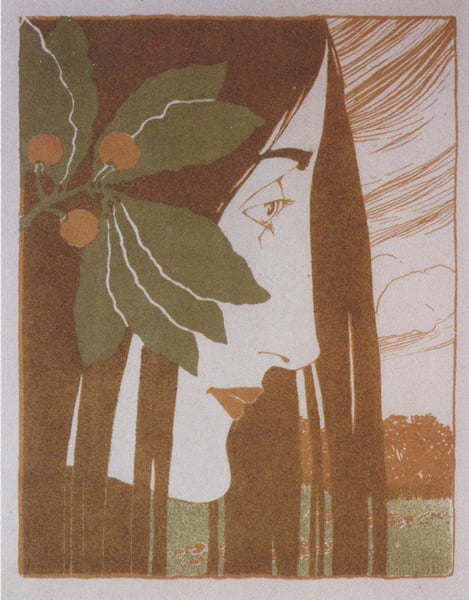
Analisi esperta di A decorative stain in red and green di Koloman Moser
Stile: Art Nouveau (Modern) · Genere: design
Expert Analysis: Koloman Moser’s A decorative stain in red and green (Art Nouveau / Modern, Genre: Design)
Koloman Moser stands as a pivotal figure in the transition from the organic, floral excesses of high Art Nouveau toward the geometric clarity and functional simplicity that would define early Modernism. As a founding member of the Vienna Secession and co-founder of the Wiener Werkstätte, Moser championed the Gesamtkunstwerk—the total work of art—in which every object, from architecture to a teacup, deserved aesthetic integrity.
A decorative stain in red and green exemplifies this ethos. Despite its humble title (“stain” suggests the accidental or the painterly), the work is a rigorously composed design that balances the two complementary colors—red and green—to achieve maximum visual tension and harmony. Moser here moves away from the sinuous, nature-derived curves typical of Art Nouveau (the “whiplash” line of Henri de Toulouse-Lautrec or Alphonse Mucha) and instead reduces form to abstract, geometric blocks or biomorphic blots. The piece is significant because it demonstrates how Moser and the Secessionists redefined “decoration” as an intellectual, almost architectural exercise, not mere ornament.
The choice of red and green is deliberate: as complements, they create vibrant dynamism while retaining a sense of unity. Moser’s handling of color fields prefigures the color-blocking of later modern designers and even the expressive abstraction of Egon Schiele (whom Moser mentored). The work’s flatness, lack of perspective, and emphasis on surface pattern align it with the Jugendstil desire to break down hierarchies between fine art and applied art.
In the context of art history, A decorative stain in red and green marks a crucial moment when Art Nouveau’s decorative impulse began to shed its narrative and organic references in favor of a more abstract, purely visual language—a step that directly paved the way for the Vienna Secession’s own Wiener Werkstätte style and, ultimately, for the geometric abstraction of the 1920s. Moser’s “stain” is not an accident; it is a manifesto for a modern decorative art rooted in color theory and formal balance.
Visivamente simili
20 opere con composizione e palette affini
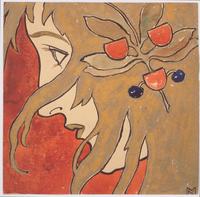
Profile of a girl. Preparatory work for a decorative stain in red and green.
Koloman Moser
The House of Trees and Other Poems
Ethel Reed
Girl's Head. Cover design Ver Sacrum, 204, 1899.
Koloman Moser
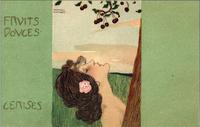
Sweet Fruits
Raphael Kirchner
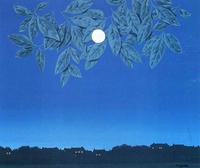
The blank page
Rene Magritte
Bonne nouvelle
Eugène Grasset

Field Flowers
Ethel Reed
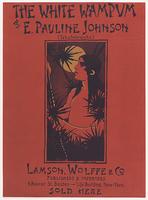
The White Wampun
Ethel Reed
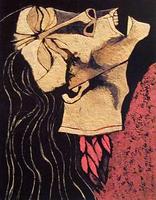
Rosa Zárate, Decapitated Flower
Oswaldo Guayasamin

Exlibris Adele Bloch - Bookplate with princess and frog
Koloman Moser
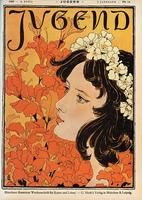
The weekly magazine Jugend No. 14
Otto Eckmann
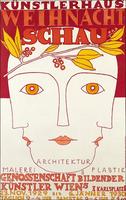
Künstlerhaus Weihnacht Schau
Bertold Löffler
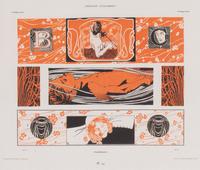
Head strips
Koloman Moser
Askeladdens adventure. Golden Bird
Theodor Severin Kittelsen
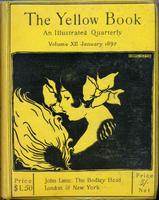
Yellow Books Cover
Ethel Reed

Illustration for Oscar Wilde's 'Salome'
John Vassos
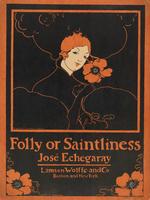
Folly or Saintless
Ethel Reed

Face of a Woman
Francis Picabia
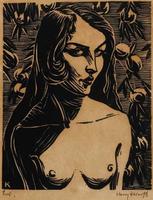
Eve
Harry Aaron Kernoff
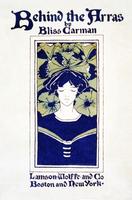
Behind the Arras
Ethel Reed