Analisi esperta di Drafts for metal relief di Koloman Moser
Stile: Art Nouveau (Modern) · Genere: design
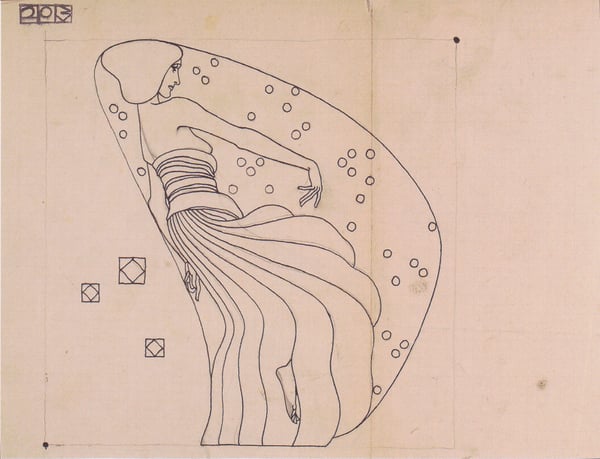
Expert Analysis: "Drafts for metal relief" by Koloman Moser
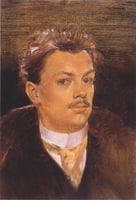
Koloman Moser (1868–1918) was a pivotal figure in the Vienna Secession and a founding member of the Wiener Werkstätte. This work, categorized as design within the Art Nouveau (Modern) style, exemplifies the Secessionist pursuit of Gesamtkunstwerk—a total work of art that unifies fine and applied arts.
Significance within the Art Nouveau (Modern) Style:
-
Transitional Abstraction: Unlike the more floral, naturalistic tendrils of international Art Nouveau (e.g., Mucha or Horta), Moser’s drafts reveal a move toward geometric rigor. His forms are often distilled into stark, rhythmic patterns—square spirals, interlocking circles, or symmetrical grids—foreshadowing the geometric abstraction of early Modernism and the later Art Deco movement. The "Drafts for metal relief" likely balance organic whiplash curves with disciplined, almost architectural structuring.
-
Craftsmanship and Utility: As a designer, Moser treated metal relief as a medium bridging sculpture and decorative function. These drafts would have been intended for applied objects—furniture inlays, jewelry, picture frames, or architectural panels—reflecting the Secessionist creed that "to every age its art, to art its freedom." The significance lies in elevating industrial materials (silver, brass, copper) through high-art compositions.
-
Line as Structure: In Art Nouveau, line defines energy. Moser’s draftsmanship here likely emphasizes dynamic, continuous contours that carve negative space, creating a rhythmic tension. The term "drafts" suggests a serial exploration—an iterative process where Moser refined synthetic motifs, moving away from literal nature toward symbolic, stylized form.
What Makes It Stand Out:
Moser’s metal relief designs are historically crucial for demonstrating how the Vienna Secession differed from other Art Nouveau centers. While Paris and Brussels favored voluptuous organicism, Moser injected a cooler, more intellectual geometry—a "modern" impulse within the style. His drafts represent the precise moment when decorative Art Nouveau began to mutate into the functionalist, abstract language that would define 20th-century design. The work is thus a bridge between ornament and structure, nostalgia and innovation.
Visivamente simili
20 opere con composizione e palette affini
Drafts for metal relief
Koloman Moser
Dancer
Koloman Moser
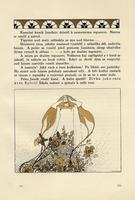
Illustration for King Mouselet And Prince Youth and The Bold Dwarfs' Adventures
Artuš Scheiner
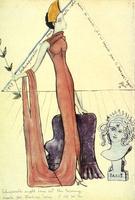
Elsa Schiaparelli gown in Harper's Bazaar
Jean Cocteau
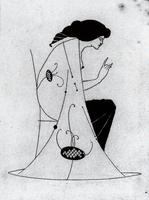
Seated Lady
Aubrey Beardsley
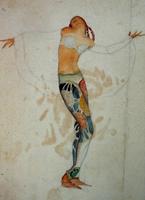
Whites
Petre Otskheli
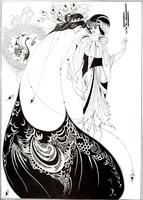
The Peacock Skirt
Aubrey Beardsley
Drawing for fashion magazine 'Elegance'
Carlos Saenz de Tejada
Chanel Haute Couture
Jean Cocteau
Birth of Birds
Andre Masson
Mann und Frau
Paul Wunderlich
Miss May Milton, from Le Rire
Henri de Toulouse-Lautrec
Poster of Girl and a Bookshop
Aubrey Beardsley
Queen Marie Antoinette on the way to her execution
Jacques-Louis David
Costume Design
Aleksandra Ekster
Dancing Mary Wigman
Ernst Ludwig Kirchner
Homage to Rimbaud
Alfred Kubin
Mrs Patrick Campbell
Aubrey Beardsley
Costumes Parisiens. Petite Robe De Jardin
George Barbier
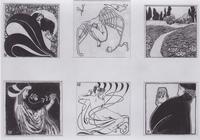
Vignettes for the catalog Secessionausstellung, 1898
Koloman Moser