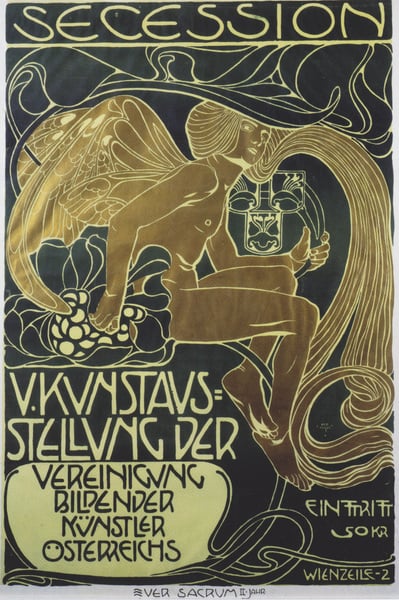
Poster of five art exhibition of the Association of Austrian Artists of Secession
Details
Expert analysis of Koloman Moser’s Poster of five art exhibition of the Association of Austrian Artists of Secession
Style: Art Nouveau (Modern) · Genre: poster
Expert Analysis: Koloman Moser’s Poster of the Fifth Exhibition of the Association of Austrian Artists of Secession
Context and Significance
This poster, created by Koloman Moser in 1899 for the Vienna Secession’s fifth exhibition, stands as a quintessential example of the movement’s radical break from academic tradition. Moser, a founding member of the Secession alongside Gustav Klimt and Josef Hoffmann, here distilled the group’s core principles: the unity of art and craft, the rejection of historical ornament, and the embrace of geometric abstraction as a modern visual language.
Composition and Style
Moser employed a starkly simplified composition that anticipates later modernist poster design. The poster features a central circular emblem—a stylized tree with five branches, symbolizing the exhibition’s number—flanked by vertical bands of bold, flat color (deep red, black, and ochre). The lettering, clean and sans-serif, is integrated into the design rather than superimposed, reflecting the Secession’s belief in the Gesamtkunstwerk (total work of art). The use of negative space and geometric symmetry reveals Moser’s mastery of the Vienna Secession’s signature aesthetic: a synthesis of natural forms and rectilinear order.
Significance within Art Nouveau and Modernism
While Art Nouveau often relied on flowing, organic curves, Moser’s poster demonstrates a crucial Viennese variant—one that gravitated toward strict geometry and symbolic clarity. This work prefigures the shift from decorative floralism to the rigorous abstraction of the Wiener Werkstätte (founded by Moser and Hoffmann in 1903). It also exemplifies the Secession’s mission to elevate graphic design to fine art, using the poster as a tool for public education and cultural reform. The poster’s bold color blocks and reductive imagery directly influenced later modernist movements, from Constructivism to the Bauhaus, making it a foundational artifact of early 20th-century visual communication.
Final Assessment
Moser’s poster is not merely an announcement; it is a manifesto. Its confident simplicity and integration of text, symbol, and negative space mark a turning point in poster art—away from narrative illustration and toward pure graphic power. For the Vienna Secession, it encapsulated a new faith in the artist as a designer of modern life.
Visually similar
20 works with related composition and palette
Poster for 'Prince Richard Metternich'
Koloman Moser
Head strips
Koloman Moser
Three Nudes and Reclining Man
Ernst Ludwig Kirchner
Time and the Hour
Ethel Reed
Cover for 'Psyche' by Louis Couperus
Jan Toorop
Girl's Head. Cover design Ver Sacrum, 204, 1899.
Koloman Moser
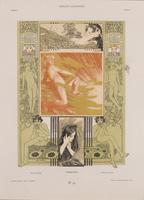
Spring morning
Koloman Moser
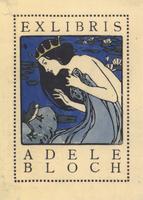
Exlibris Adele Bloch - Bookplate with princess and frog
Koloman Moser
Takarazuka, Grand Revue
Tadanori Yokoo
Suzy Deguez
Eugène Grasset
Trilby the Fairy of Argyle
Ethel Reed
Cover composed by Mucha for the french literary and artistic Review La Plume
Alphonse Mucha
Poster to the IX Exhibition of the Vienna Secession
Alfred Roller
Simplicissimus, Kiss of Peace
Thomas Theodor Heine
Cover for 'Babel' by Louis Couperus
Jan Toorop
Cover for 'God en goden' by Louis Couperus
Jan Toorop
Three Nudes in the Forest
Ernst Ludwig Kirchner
Poster Sketch
Alfred Roller
Illustration to Volodymyr Narbut's poem 'Before the Easter'
Heorhiy Narbut
Antarctica Company Poster
Eliseu Visconti