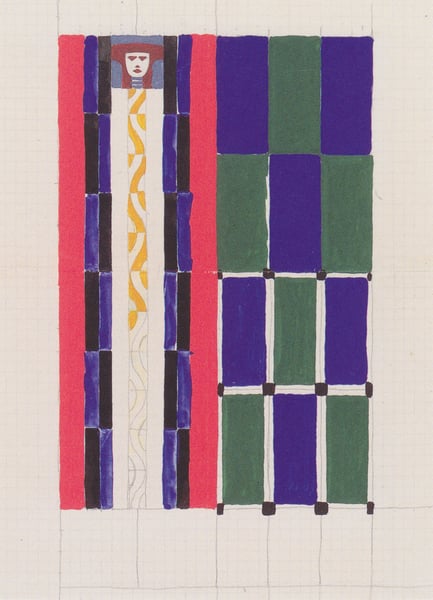
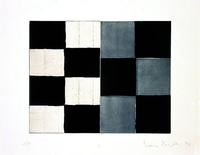
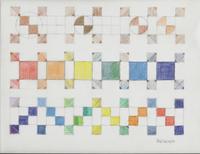
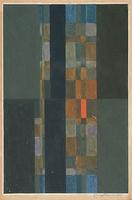
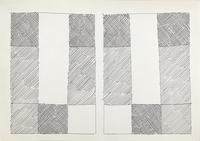
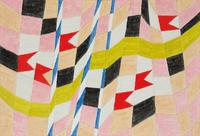
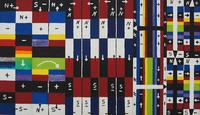
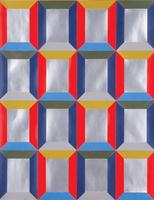
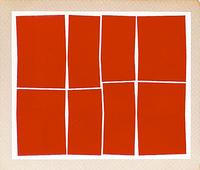
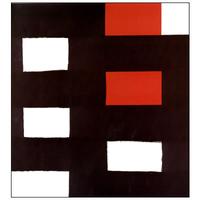
This sketch by Koloman Moser holds significance as a pivotal document of the transition from the organic, flowing lines of Art Nouveau toward the disciplined geometry of early Modernism. As a study for a poster of the Vienna Workshop (Wiener Werkstätte), it embodies the workshop’s core philosophy of Gesamtkunstwerk—the total work of art—applied to commercial design.
Moser’s sketch reveals the artist’s working process: the immediate, unpolished lines capture the essence of his compositional thinking, emphasizing the interplay between negative space and bold, simplified forms. The Vienna Workshop, co-founded by Moser and Josef Hoffmann in 1903, rejected mass production in favor of handcrafted, high-quality objects. This poster study reflects that ethos by prioritizing clarity, balance, and abstracted ornament—hallmarks that would later influence the Bauhaus and modern graphic design.
Stylistically, the sketch is significant for its reduction of decorative excess. While still rooted in Art Nouveau’s flattened perspective and stylized natural motifs, Moser introduces a proto-modern economy of line. The work demonstrates how the Vienna Secessionists adapted international Art Nouveau into a distinctly Viennese, rational aesthetic. As a study, it offers unique insight into Moser’s creative decision-making, showing how he distilled complex ideas into a clear, iconic image for mass communication—a key step in the evolution of the modern poster.