Koloman Moser の Wotan and Brunhilde の専門的な分析
スタイル:Art Nouveau (Modern), Symbolism · ジャンル:mythological painting
Expert Analysis of "Wotan and Brunhilde" by Koloman Moser
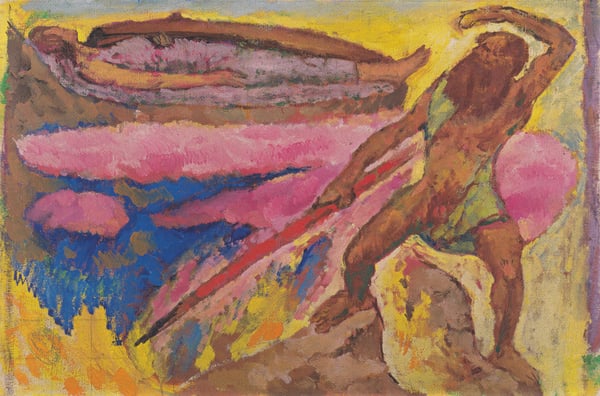
Koloman Moser's "Wotan and Brunhilde" stands as a compelling synthesis of Art Nouveau elegance, Symbolist depth, and mythological reimagining. The work’s significance lies in how Moser translates a monumental Norse legend into the distinctive visual language of the Vienna Secession, emphasizing decorative linear rhythms and allegorical meaning over naturalistic depiction.
As a mythological painting, the subject—Wotan (Odin) confronting his valkyrie daughter Brunhilde—draws from Richard Wagner’s Der Ring des Nibelungen, a source that resonated deeply with Symbolist artists seeking archetypal themes of fate, sacrifice, and divine conflict. Moser does not illustrate the narrative literally; instead, he distills it into a symbolic encounter. Wotan’s angular, elongated figure and Brunhilde’s curved, flowing form create a dynamic tension between rigid authority and yielding spirit, a hallmark of Art Nouveau’s emphasis on stylized, decorative curves and counter-curves.
The painting’s significance is further rooted in its formal innovation. Moser, a founding member of the Vienna Secession and later a key figure in the Wiener Werkstätte, championed a modern approach that rejected historicism in favor of flat, ornamented surfaces. Here, the background—likely a stylized rocky landscape or cosmic void—functions as a pattern of sinuous lines and muted tones, echoing the Jugendstil preference for integrated design. The figures themselves are contoured with bold, rhythmic outlines, their drapery and armor merging into abstract floral or geometric motifs that blur the boundary between figure and ground.
Symbolically, the painting explores the tension between paternal authority and filial rebellion, law and love, fate and freedom. Brunhilde’s recumbent pose and Wotan’s commanding stance suggest a moment of tragic pause before her punishment (being placed into an enchanted sleep) and his relinquishment of power. Moser’s use of color—likely subdued earth tones punctuated by accents of gold or blue—enhances the melancholic, introspective mood.
In the context of Art Nouveau and Symbolism, "Wotan and Brunhilde" is significant as a quintessential example of how mythological narrative could be reframed through a modern, decorative lens. It demonstrates Moser’s ability to merge Wagnerian drama with the aesthetic ideals of the Secession: a harmonious, total work of art where line, pattern, and symbolic content unite to create a visually arresting and emotionally resonant composition.
視覚的に類似
構図やパレットが近い作品 20 件
Szene Aus Wagners Ring
Hermann Hendrich
Les Temps Nouveaux
Theophile Steinlen
Three Pierrots and Harlequin
Albert Bloch
Cain
Lovis Corinth
Funeral Symphony (V)
Mikalojus Konstantinas Ciurlionis
Bathers at Sea
Ernst Ludwig Kirchner
Egry József, Horgász a Balatonnál
Egry József
Egry József,Szent Kristóf a Balatonnál
Egry József
La danse: Projet de décoration pour le hall du Palais de Chaillot
Ker-Xavier Roussel
Bathers at Rest
Paul Cezanne
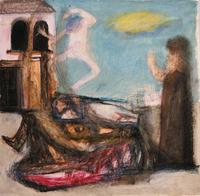
Kondor Béla. Parvoszláv Földről
Kondor Béla
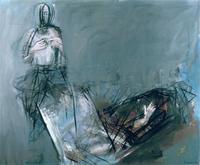
La bague
Mario Comensoli
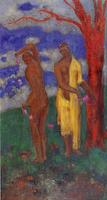
Two Women under a Red Tree
Odilon Redon
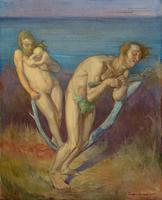
The End
Georgi Mashev
The Passing of the Chieftain
Richard Jack
Indiscreet servant (back)
Eduardo Zamacois
Untitled
Paul Ranson
Heat of the Earth
Nicholas Roerich
Carrying the Cross
Vilmos Aba-Novak
Ideas for Composition of Miners Drilling in a Confined Stope
Graham Sutherland