Expertenanalyse zu Gerard Terborchs Messenger
Stil: Baroque · Genre: genre painting
Expert Analysis: "Messenger" by Gerard Terborch
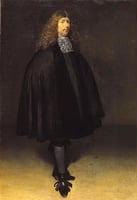
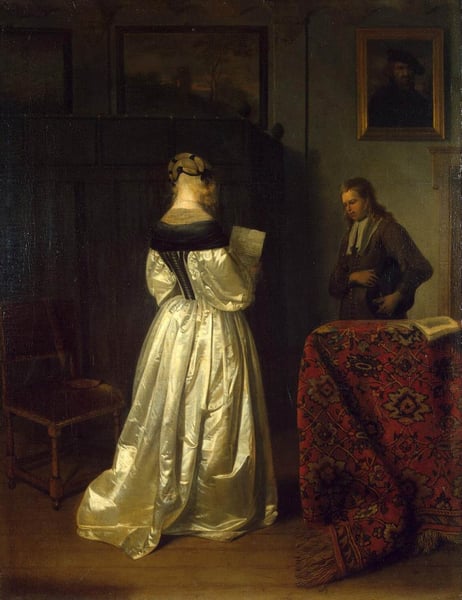
Gerard Terborch’s Messenger stands as a quintessential example of Dutch Baroque genre painting, a style that elevated everyday domestic life to a subject of profound artistic scrutiny. In this work, Terborch demonstrates the hallmarks that make his contribution to the genre significant: a masterful command of light and texture, an intimate psychological narrative, and an almost silent tension that invites the viewer into a private moment.
Baroque Sensitivity and Genre Refinement
Within the broader Baroque style—known for its dramatic contrasts, emotional intensity, and grand religious or mythological scenes—Terborch represents a quieter, more contemplative strand. Unlike the dynamic compositions of Caravaggio or Rubens, Terborch’s Messenger relies on subtlety. The significance lies in his ability to capture a fleeting, internal drama: the arrival of a letter (a common motif in 17th-century Dutch genre painting) becomes a vehicle for exploring curiosity, expectation, or even social protocol. The work’s power emerges from what is not said, the ambiguous interaction between the messenger and the recipient.
Technical Virtuosity and Atmosphere
Terborch’s reputation rests heavily on his unparalleled rendering of textures—particularly satin, velvet, and paper. In Messenger, this technical skill serves the narrative: the gleam of fabric, the crisp folds of a letter, or the soft illumination of a face all direct the viewer’s gaze and heighten the sense of immediacy. The composition is typically balanced, with figures placed in a shallow interior space, a hallmark of Dutch genre painting. The muted, harmonious palette and controlled lighting create an atmosphere of refined domesticity, yet the slight asymmetry of poses or the direction of glances suggests a story unfolding.
Significance within Terborch’s Oeuvre and Baroque Genre Painting
What makes Messenger significant is its demonstration of how Terborch refined the genre. While earlier Dutch painters like Jan Steen relied on boisterous anecdote, Terborch introduced a subtle narrative economy. His figures are not simply performing an action; they are thinking—their gestures and expressions are restrained, implying complex social or emotional undercurrents. This psychological depth, combined with supreme technical polish, influenced later artists, notably Johannes Vermeer. In Messenger, Terborch proves that Baroque genre painting need not shout to be powerful; sometimes a whisper carries the most weight.
Museum / Gallery
Visuell ähnlich
20 Werke mit ähnlicher Komposition und Farbpalette
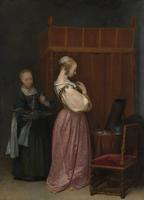
A Young Woman at Her Toilet with a Maid
Gerard Terborch
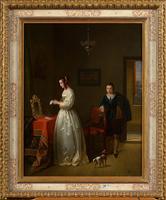
La lecture de la lettre
Alexis Van Hamme
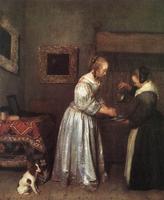
Woman Washing Hands
Gerard Terborch
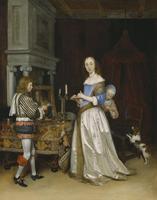
Lady at her Toilette
Gerard Terborch
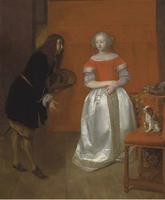
The Visit
Jacob Ochtervelt
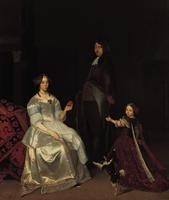
Family Portrait
Jacob Ochtervelt
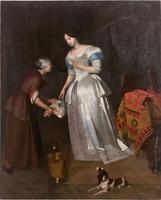
The return of the market
Jacob Ochtervelt
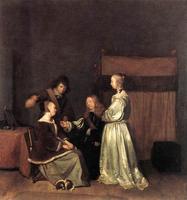
The Visit
Gerard Terborch
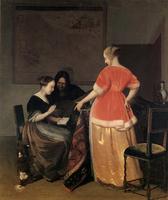
The Music Lesson
Jacob Ochtervelt
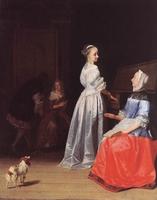
Rehearsing the Song
Jacob Ochtervelt
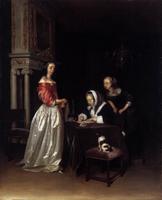
Curiosity
Gerard Terborch
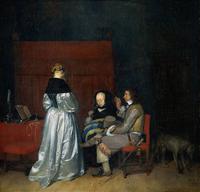
Gallant Conversation (The Paternal Admonition)
Gerard Terborch
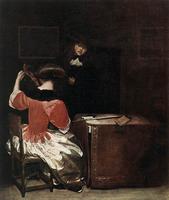
Music Lesson
Gerard Terborch
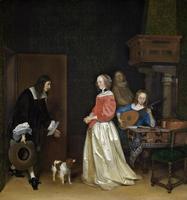
The Suitor's Visit
Gerard Terborch
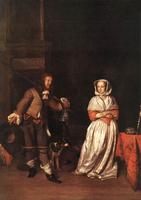
The Huntsman and the Lady
Gabriel Metsu
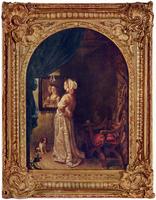
Lady in Front of a Mirror
Frans van Mieris the Elder
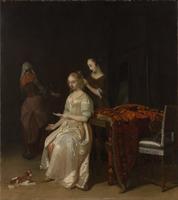
The Love Letter
Jacob Ochtervelt
Columbus and Isabella
Anton Romako
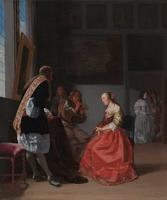
A Musical Company
Jacob Ochtervelt
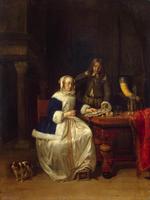
Breakfast
Gabriel Metsu