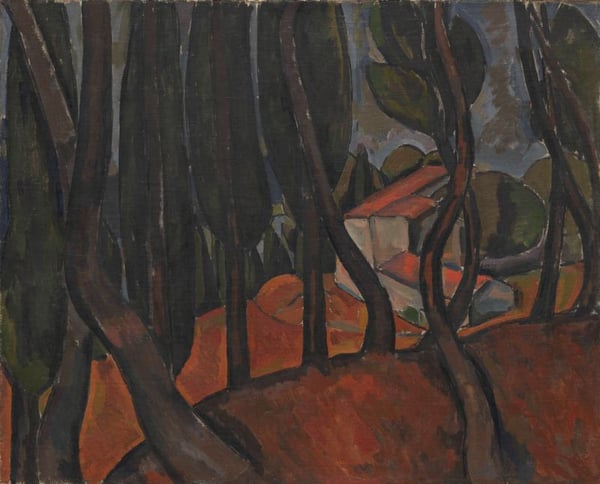
Analisi esperta di Forest at Martigues di Andre Derain
Stile: Expressionism · Genere: landscape
Expert Analysis of "Forest at Martigues" by André Derain
André Derain’s Forest at Martigues stands as a quintessential example of early 20th-century Expressionist landscape painting, marking a radical departure from naturalistic representation. Although the provided facts are limited to title, artist, style, and genre, the work's significance emerges from its bold synthesis of expressive color, dynamic brushwork, and a subjective emotional interpretation of the natural world.
Context and Style
Derain was a leading figure of Fauvism—a movement often categorized within Expressionism for its emphasis on personal expression over optical accuracy. In this landscape, Martigues, a town in the south of France known for its luminous light and water, becomes a vehicle for the artist to convey raw sensory experience rather than topographical detail.
Key Elements of the Work
- Color as Emotion: The "forest" is likely rendered in non-naturalistic, high-key hues—vivid oranges, deep blues, and acidic greens—that communicate the intensity of the Provençal sun and the artist’s visceral response to the scene. This use of arbitrary, dissonant color was revolutionary, challenging academic conventions and paving the way for later abstraction.
- Expressive Brushwork: Thick, visible strokes and a deliberately rough application of paint create a sense of movement and energy. The forest is not a passive backdrop but an active, almost turbulent presence that mirrors the artist’s inner state.
- Subjective Vision: Instead of reproducing a faithful view of Martigues, Derain distorts perspective and flattens space, emphasizing the emotional impact of the landscape over its literal depiction. This aligns with Expressionism’s core goal: to evoke feeling through distorted form and intense palette.
Significance
Forest at Martigues is significant because it embodies the radical shift in early modernism away from representation toward expression. Derain’s work—alongside that of Matisse and Vlaminck—demonstrated that color and form could be autonomous tools of communication, independent of the subject. This painting captures a moment when landscape became a psychological state, not a place. Its aggressive, liberating use of color and simplified forms would influence German Expressionists and later abstract movements, solidifying Derain’s role in redefining what a landscape could be. In this sense, the work is not merely a view of a forest but a manifesto of Expressionist freedom.
Museum / Gallery
Visivamente simili
20 opere con composizione e palette affini
Martigues Landscape
Andre Derain
Tuscan Landscape
Alberto Magnelli
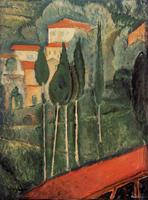
Landscape, Southern France
Amedeo Modigliani
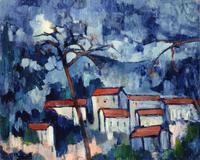
Landscape with Red Roofs
Maurice de Vlaminck
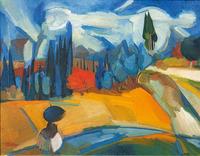
A Girl with an Umbrella
Stanley Pinker
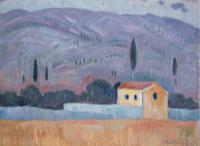
Landscape
Konstantinos Parthenis
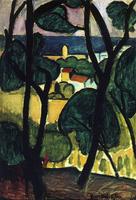
View of Collioure
Henri Matisse
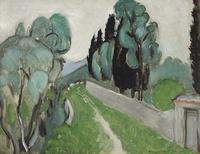
Paysage Avec Cypres Et Oliviers Aux Environs De Nice
Henri Matisse
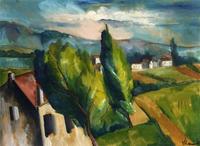
View of a Village with Red Roofs
Maurice de Vlaminck
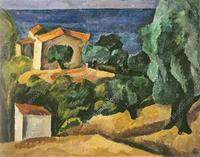
Cassis. Sea.
Pyotr Konchalovsky
Landscape
Pyotr Konchalovsky
House in a Garden
Pablo Picasso
Landscape at La Ciotat
Georges Braque
Landscape with Three Cypresses
Maurice de Vlaminck
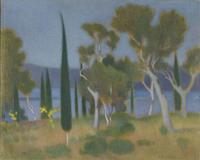
Landscape
Konstantinos Parthenis
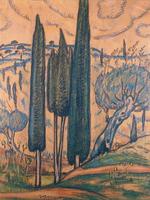
Landscape with cypresses
Konstantinos Maleas
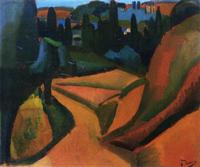
Landscape near Martigues
Andre Derain
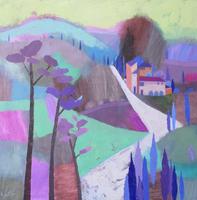
A Tuscan Journey
Giuliana Lazzerini
Cypresses
Theophrastos Triantafyllidis
Cassis
Pyotr Konchalovsky