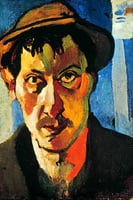
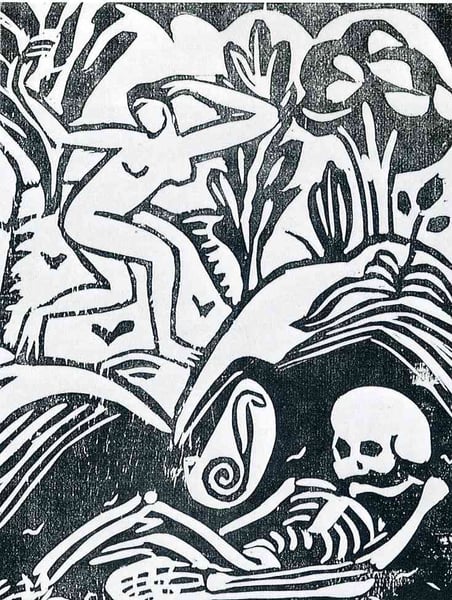
L'Enchanteur pourrissant, Guillaume Apollinaire
Analisi esperta di L'Enchanteur pourrissant, Guillaume Apollinaire di Andre Derain
Stile: Expressionism · Genere: illustration
Based on the supplied facts, here is an expert analysis of Andre Derain’s L'Enchanteur pourrissant, Guillaume Apollinaire.
This illustration is a significant work within the Expressionist movement, not merely as an independent image, but as a crucial element in a groundbreaking artistic and literary collaboration. Its importance lies in how Derain translates the dense, symbolic, and decaying world of Guillaume Apollinaire’s poem into a visual language of raw, psychological intensity.
The artwork’s genre—illustration—is key to its significance. Derain is not creating a passive, decorative accompaniment; he is an active interpreter, forging a unified aesthetic with the text. His style, defined as Expressionism, is applied here with a focus on primal, distorted forms and stark contrasts, likely achieved through woodcut or a similarly graphic technique. This method strips the image down to its essential expressive elements, mirroring the poem's themes of enchantment, decay, and the grotesque. The title, referencing "the decaying enchanter," finds a powerful visual corollary in Derain's probable use of jagged lines, unsettling proportions, and a sparse, almost brutal composition.
What makes this work especially significant is its historical moment and the artist’s evolution. Derain was a founding figure of Fauvism, a movement centered on vibrant, liberated color. His turn toward the darker, more angular vocabulary of Expressionism for this project demonstrates a key shift in early 20th-century art. Collaborating with the poet Apollinaire, a leading voice of the avant-garde, Derain uses this illustration to push beyond mere representation. He creates a visual equivalent of the poem’s psychological landscape, where the human figure becomes a site of metamorphosis and decay. This piece, therefore, stands as a powerful example of how Expressionist illustration served not to explain, but to embody and amplify the radical, unsettling spirit of modernist poetry.
Visivamente simili
20 opere con composizione e palette affini
Prayer
Jo Baer
Den of Fossils
Maruja Mallo
Adam and Eve
John Muafangejo
Death as a Juggler (Revolution)
Christian Rohlfs
Untitled
Billy Childish
Death
Christian Rohlfs
Bushfire Dreaming
Clifford Possum Tjapaltjarri
UNTITLED
Alexander Calder
The Andalusian Reapers
Andre Masson
Female Nude in a Landscape
M.C. Escher
Terril III
Pierre Alechinsky
Hunger
Kathe Kollwitz
Riding with Death
Jean-Michel Basquiat
Kondor Béla, a Képzeleted Megtévesztett Engem
Kondor Béla
New Delhi surplombée
Pierre Alechinsky
Jumbled Ephemerides
Pierre Alechinsky
Indifferent
Paul-Albert Besnard
The Scraps
Felicien Rops
Lovers (Bone Music)
Piroska Szanto
The Awakenings
Oskar Kokoschka