Description
Style: Fauvism · Genre: genre painting
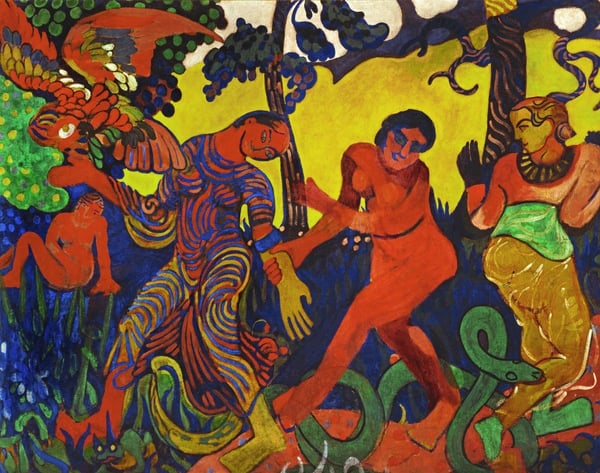
The Dance (1906) by André Derain reflected his eclectic style and interest in a variety of Western and non-Western artistic traditions. He painted The Dance in the autumn of 1906, after he returned from London to Paris, and after he visited the Paul Gauguin retrospective at the annual Paris exhibition Salon d’Automne (Autumn Salon).
Although Derain combined several influences in The Dance, Gauguin’s influence is the most dominant. Most evidently, the exotic elements and landscape in The Dance relate to Gauguin’s Tahitian paintings that celebrated the lush, tropical environment. For example, the seated figure in the background is similar to those painted by Gauguin. Derain even borrows some elements from Gauguin’s symbolism, such as the long serpent intertwined between the dancing figures. The serpent with its religious and symbolic implications was a motif in Gauguin’s Self Portrait with Halo and Snake (1889) and Exotic Eve (1890-1894). However most importantly, Derain’s use of color no longer reflected the ideas of Neo-Impressionists. Instead, in The Dance Derain built upon Gauguin’s Synthetic style, which aimed to synthesize between the outward appearance of the subject, the artist’s emotional response to the subject and the aesthetic considerations of line, form and color. Inspired by Gauguin, Derain painted large areas of bold flat colors and used non-local colors not to merely imitate nature, but also to express the emotional and spiritual qualities of things.
The emphasis on the decorative elements in The Dance can be attributed to Gauguin, but these also relate to another source – French Romanesque sculpture. Derain’s treatment of the drapery worn by the dancer on the left is most similar to the sculptures from the Burgundy area, in the cathedrals in Autun, Saulieu and Vezelay. Even though there is no evidence that Derain visited Burgundy, examples were available to Derain in photographs and in museum collections – specifically, Derain visited the National Museum of French Monuments that holds life size casts of the cathedrals in Burgundy. Derain also found inspiration in the Louvre, likely modeling the figure on the right after the servant figure in Eugène Delacroix’s Women of Algiers (1834).
The other major influence is non-Western art, a combination of sources of African and Asian art. In The Dance these elements reflect Derain’s interest in Gauguin and the influence of non-Western art on his work, as well as his own affinity for these artistic traditions. Derain had access to many of these artworks through the Guimet Museum in Paris, which holds one of the largest collections of Asian art outside of Asia. The Dance is similar to Indonesian relief sculpture in terms of composition and the motif of dancing figures against a flat stylized landscape. In particular, the three central figures resemble a 10th century pediment from the Cambodian temple Banteay Srei at the Guimet Museum. In the context Derain’s body of work, The Dance concluded the artist’s decorative Fauve style, after which he painted in a more sculptural style inspired by Cézanne and the Cubist movement.
Museum / Gallery
Visually similar
20 works with related composition and palette
Departure of Summer
Man Ray
The Joy of Life
Henri Matisse
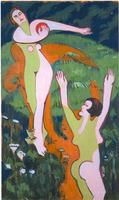
Women Playing with a Ball
Ernst Ludwig Kirchner
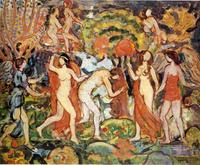
Fantasy
Maurice Prendergast
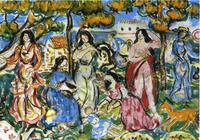
Figures in a Landscape
Maurice Prendergast
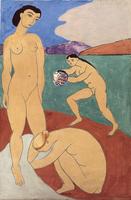
Le Luxe (II)
Henri Matisse
Fresque
Rupert Bunny
Day of Steel
Max Pechstein
Rose Nudes
Harry Phelan Gibb
Woman picking flowers
Kazimir Malevich
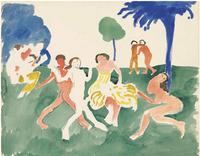
The Gavotte
Andre Derain
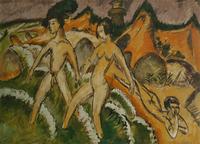
Male and Female Nudes Striding into the Sea
Ernst Ludwig Kirchner
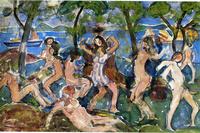
Bathers
Maurice Prendergast
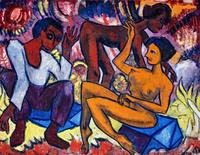
Hungarian gipsies
Endre Bartos
Beach No. 3
Maurice Prendergast
Satirical Composition ('The Dance' by Matisse)
Salvador Dali
Badende
Otto Mueller
Three Nudes in the Forest
Ernst Ludwig Kirchner
Drei Akte in Landschaft
Otto Mueller
Nudes in the park
Jozsef Rippl-Ronai