Description
Style: Neoclassicism · Genre: genre painting
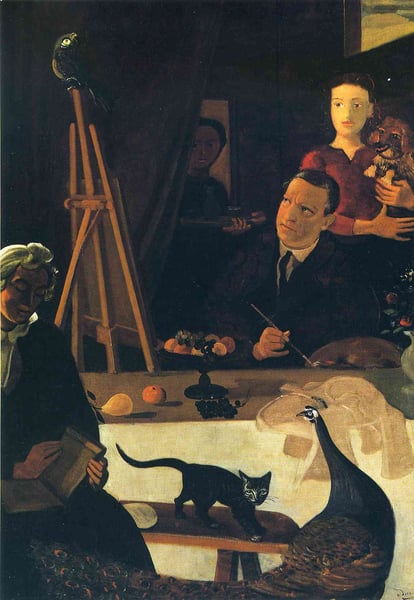
The painter and his family (ca. 1939) by André Derain is more than a self-portrait or family portrait, it is a manifesto of Derain’s beliefs and views on painting. Much like the 19th century The Artist’s Studio (1854-1855) by Gustave Courbet, the painting is an allegorical representation of the life of an artist. While Courbet presented himself among admirers and members of the public, Derain surrounded himself with female family members and pets. The scene did not reflect his working conditions, Derain usually worked in a studio away from his family. The emphasis on the intimate and domestic realm possibly expressed his desire to withdraw from the public and the worsening political situation of the inter-war period. In this period, Derain especially identified with 17th century painters like Diego Velasquez. It is possible that The painter and his family was inspired by Velasquez’s painting Las Meninas (1656), in which the artist is seen at the studio painting the young girls of the Spanish royal court.
The painting depicts Derain working at his easel, while his wife Alice reads a book of myths. This is a reference to their common interest in legends and myths. Derain also painted a peacock, a reference to chivalric literature and a cat that symbolized his fascination with arcane and mystical practices. The painting relates to an earlier work by Derain, The Artist in his Studio (1920), that also shows the artist painting at his easel. The Artist in his Studio depicts a similar domestic environment: his wife Alice is reading in the background while a small boy holds a bowl of fruit in the foreground. The two paintings have a similar dark palette, mainly black with highlights of green, red and white. However, the scene in The painter and his family is richer in detail and occupied by more figures. Suzanne Géry, Alice’s sister, is seen in the background holding a tray, while her daughter Geneviève is behind the artist holding a small pooch.
Suzanne and Geneviève were an intimate part of Derain’s family circle: from 1928 the two lived in the Derain’s home, and later in 1935 they moved to La Roseraie at Chambourcy, where they lived across the courtyard from Derain and his wife. Derain treated Geneviève as his own daughter, and painted her many times. In The painter and his family her face is luminous, and her position behind the artist places her in the role of a guiding light or a muse. In addition, the dog is a medieval symbol of fidelity: his presence can signify Geneviève’s loyalty to the artist or maybe Derain’s loyalty and devotion to art. The symbolism and atmosphere of The painter and his family corresponds with Derain’s understanding of painting. Derain believed that art should ‘equalize time’, meaning that regardless of its superficial form, art should deal with universal truths that define the human experience. In both The Artist in his Studio and The painter and his family Derain proclaimed that the nature of art to be private and intimate, and therefore he depicted himself working in a domestic setting.
Museum / Gallery
Visually similar
20 works with related composition and palette
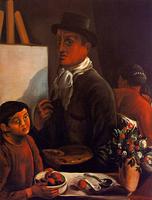
The Artist in his Studio
Andre Derain
Amateur
Vasily Perov
Double Self-portrait
Antonio Bueno
The Luncheon
Claude Monet
Self-Portrait with Doll
Jose Gutierrez Solana
Artist's Family
Greta Freist
The Drawing Lesson
Jacob Ochtervelt
Self Portrait
Frederick Carl Frieseke
The Farewell
Harriet Backer
Luncheon in the Studio
Edouard Manet
The sale of the painting
Vito d'Ancona
Frouzette And Her Father
Raoul Dufy
A Young Artist (Ditlev Blunck) Examining a Sketch in a Mirror
Wilhelm Bendz
A Studio in the Batignolles (Homage to Manet)
Henri Fantin-Latour
Self portrait of painter with his model
Yiannis Tsaroychis
Portrait of the Artist Igor Grabar
Boris Kustodiev
The Drawing Lesson
Jan Steen
Sleeping Grandfather and Hugging Couple
Friedrich Mosbrugger
Self-portrait
Istvan Ilosvai Varga
Artist in His Studio
Gerrit Dou