Expertenanalyse zu Andre Derains The Port of Collioure
Stil: Pointillism, Neo-Impressionism · Genre: landscape
Expert Analysis: "The Port of Collioure" by André Derain
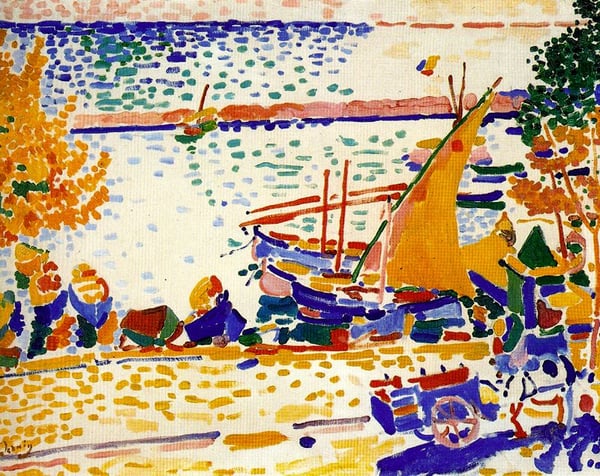
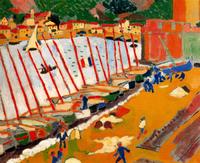
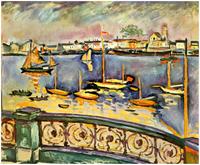
Within the canon of early twentieth-century modernism, André Derain’s The Port of Collioure stands as a pivotal synthesis of two revolutionary movements: the rigorous color theory of Neo-Impressionism and the expressive liberation of Fauvism. Although Derain would soon become a key figure in Fauvism, this work—executed during the landmark summer of 1905 he spent alongside Henri Matisse in the fishing village of Collioure—demonstrates his deep engagement with the pointillist technique derived from Georges Seurat and Paul Signac.
Technical Execution and Pointillist Structure
True to the Neo-Impressionist doctrine, Derain builds the scene through meticulous, separate dabs of pure pigment. The harbor, the distant mountains, and the sky are rendered as mosaics of tiny dots and dashes. Unlike the more systematic, scientific application of Seurat’s A Sunday on La Grande Jatte, Derain’s touch is looser and more varied—particle sizes fluctuate, and the dots occasionally merge into short strokes. This allowed him to introduce a greater sense of immediacy and emotional temperature. The color palette is intensely saturated: cadmium reds, emerald greens, ultramarine blues, and bright oranges are juxtaposed without premixing, relying on the viewer’s eye to optically blend them into luminous, vibrating tones.
Significance within Neo-Impressionism
Derain’s contribution here is a crucial expansion of the Neo-Impressionist vocabulary. While Seurat and Signac often treated landscapes with a quiet, monumental stability, Derain injects a raw, almost turbulent energy. The water of the port is not calm but shimmers with antagonistic complements—blue and orange, green and red—creating a surface that seems to tremble with light and heat. This is no mere exercise in optical theory; it is a record of the intense Mediterranean sun, the dry mistral wind, and the very sensation of place.
Bridge to Fauvism
The Port of Collioure is historically significant as a transitional work. Derain and Matisse were challenging the primacy of local color and naturalistic representation; here, Derain pushes the pointillist system to its breaking point. The dots are arranged not to model form or depth but to produce a flat, decorative pattern. The mountains rise in unmodulated patches of violet and pink, and the boats are built from blocks of pure chrome yellow. By prioritizing emotional color over accurate rendering, Derain prefigures the full-blown Fauvist approach that would debut later that same year at the Salon d’Automne.
Legacy and Influence
The painting captures a moment when the scientific precision of Neo-Impressionism collided with the subjective intensity of early Expressionism. Derain’s willingness to distort both color and brushwork while retaining a pointillist infrastructure influenced later artists who sought to merge structure with sensation. In this sun-drenched harbor, Derain demonstrates that pointillism need not be restrained—it can be wild, vibrant, and profoundly modern.
Museum / Gallery
Visuell ähnlich
20 Werke mit ähnlicher Komposition und Farbpalette
Boats at Collioure
Andre Derain
Boats in Port Collioure
Henri Martin
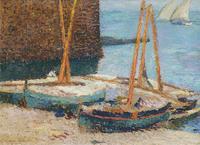
Boats in the Port of Collioure
Henri Martin
Collioure port July 14
Henri Martin
The Old Port of Marseille, People and Boats
Pierre-Auguste Renoir
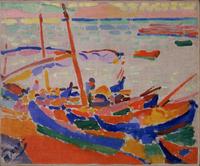
Fishing Boats, Collioure
Andre Derain
The Harbor
Georges Braque
The Port of Collioure
Andre Derain
Yacht
Andre Derain
Fishing Boats, Collioure
Andre Derain
Moored boats at the quay
Gregoire Boonzaier
Petit port, pecheurs et bateaux au quai
Jean Metzinger
Red sail
Vasily Polenov
Boats in the Port of St. Tropez
Henri-Edmond Cross
Landscape with boats
Marià Fortuny
Moored Boats
Vincent van Gogh
Fishing Boats at Sea
Vincent van Gogh
Port of Saint Tropez
Paul Signac
Port of Antwerp
Georges Braque
The Port Of Abail
Henri Matisse