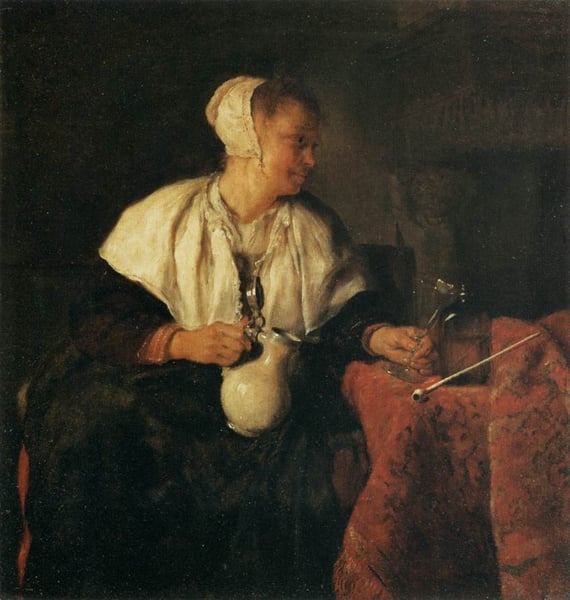
Expert analysis of Gabriel Metsu’s The Tippler (The Wine Drinker)
Style: Baroque · Genre: portrait
Expert Analysis of "The Tippler (The Wine Drinker)" by Gabriel Metsu
Gabriel Metsu’s The Tippler (The Wine Drinker) stands as a compelling example of Dutch Baroque portraiture, distinguished by its fusion of intimate character study with the moralizing undertones typical of the era. While Metsu is renowned for his genre scenes of domestic life, this work shifts focus to a single, absorbing figure, elevating the portrait to a vehicle for psychological nuance and social commentary.
Stylistic Significance within the Baroque Period
Executed during the height of the Dutch Golden Age, the painting exemplifies the Baroque fascination with realism and dramatic illumination. Metsu employs a restrained chiaroscuro that models the sitter’s face and hands with almost tactile precision, while the surrounding shadowy background isolates the figure and draws the viewer into an unguarded, private moment. The rich, warm palette—the deep ruby of the wine, the creamy white of the collar—demonstrates the era’s virtuoso handling of light and texture, particularly in the reflective sheen of the glass and the subtle translucency of the liquid. This attention to material detail not only showcases technical mastery but also aligns with the Baroque aim of making the painted world as palpable as the real one.
Portrait as Moral Mirror
As a portrait, The Tippler transcends mere likeness to function as a moral emblem. The subject’s flushed cheeks, half-lidded eyes, and slight, contented smile capture the transient pleasure—and implicit danger—of overindulgence. In the context of 17th-century Dutch society, where temperance was a civic and religious virtue, this depiction walks a fine line between celebration and warning. Metsu’s genius lies in his ambiguity: the viewer is left to decide whether this is a portrait of a specific individual’s vice or a universal human folly. The inclusion of the wine glass, nearly empty, hints at a narrative just past or about to unfold, giving the static format of portraiture a dynamic, storytelling quality.
Contribution to Metsu’s Oeuvre
While Metsu is often compared to contemporaries like Vermeer for their shared interest in interior light and quiet moments, The Tippler showcases a more direct engagement with character. Unlike the anonymous, generalized figures in many genre scenes, this portrait individualizes its subject—perhaps a known figure in Utrecht or Amsterdam—while embedding a larger ethical lesson. It bridges the gap between the commissioned portrait (often stiff and formal) and the genre scene (often narrative and playful), achieving a rare synthesis of intimacy and public morality. This work thus holds a significant place in understanding how Baroque artists used portraiture not just to record appearance, but to probe the human condition.
Museum / Gallery
Visually similar
20 works with related composition and palette
Interior - Having a meal
Cornelis Pietersz. Bega
The Sick Girl
Gabriel Metsu
A Young Woman Sewing
Nicolaes Maes
The Apple Peeler
Gabriel Metsu
The Admonition
Theodule Ribot
The new dress
Felix Schlesinger
Four Figures at Table
Le Nain brothers
Woman Drinking Wine
Gerard Terborch
The idle servant
Nicolaes Maes
Girl Peeling Apples
Gabriel Metsu
The Sleeping Seamstress
Jean-Francois Millet
A man offers a young girl money
Judith Leyster
The Letter Writer Surprised
Gabriel Metsu
Borch Woman Sewing
Gerard Terborch
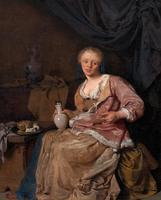
Young woman in an interior holding a glass
Cornelis Pietersz. Bega
The playful kitten
Pierre Jean Edmond Castan
Interior with Sleeping Kitchen Maid - The Idle Servant
Nicolaes Maes
The Embroiderer
Jean-Baptiste-Simeon Chardin
Baking of Flat Cakes
Bartolome Esteban Murillo
Portrait of Sarah Macholm in Prison
William Hogarth