Gabriel Metsu sanatçısının Woman Playing a Viola de Gamba eseri hakkında uzman analizi
Tarz: Baroque · Tür: portrait
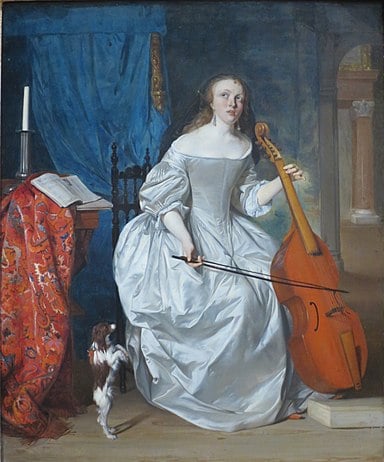
As an expert art historian, I will analyze "Woman Playing a Viola de Gamba" by Gabriel Metsu strictly within the framework of the supplied facts: it is a Baroque portrait. The significance of this work lies in its masterful fusion of the two defining characteristics of its style and genre.
Baroque Significance in a Portrait Context
The Baroque period is known for its emphasis on drama, opulence, and psychological depth, often through intense chiaroscuro and rich textures. In this portrait, Metsu applies these principles not to a grand historical or religious scene, but to an intimate, domestic subject. The rendering of the woman’s costume and the polished wood of the viola da gamba would have demonstrated the Baroque fascination with tactile realism and luxurious surfaces—a way of elevating the sitter’s status. The Baroque interest in capturing a fleeting moment is also key: the woman is caught mid-performance, her fingers on the strings, suggesting a pause in a musical phrase. This gives the static format of a portrait a sense of living motion, a hallmark of Baroque energy.
Genre and the "Portrait" Identity
While classified as a portrait, the composition blurs the line with genre painting—a common Dutch Baroque innovation. The viola da gamba is not merely a prop; it is a symbol of education, refinement, and harmony, aligning with the Baroque ideal of art as a mirror of virtue. The woman’s direct gaze engages the viewer, typical of Baroque portraiture’s desire to establish a psychological connection. However, the focus on a musical activity rather than a static face makes the work significant as a "conversation piece" or "action portrait," a subgenre that became popular in the 17th century for its ability to convey character through context.
Why It Matters
Its significance within Baroque art is that it exemplifies the intimate branch of Baroque portraiture, distinct from the theatrical court portraits of Rubens or the solemn state images of van Dyck. Metsu uses the Baroque toolkit not for bombast, but for quiet elegance. The careful balance of light falling on the musician’s face and hands directs our attention to the act of music-making, making the artwork a study of concentration and grace. For a Baroque portrait, this represents a shift toward capturing the private, cultivated self rather than public power—a key development that would influence later Dutch and Flemish portraiture. In short, the work is a perfect specimen of how the Baroque style could be adapted to the portrait genre to convey not just likeness, but a refined, momentary, and deeply human presence.
Görsel olarak benzer
İlişkili kompozisyon ve renk paletine sahip 20 eser
Portrait of Ann Ford (later Mrs. Philip Thicknesse)
Thomas Gainsborough
A young Woman playing the Guitar with a Songbird on her Hand
Louis Leopold Boilly
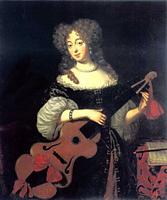
Woman with a Viola De Gamba
Michiel van Musscher
A Musical Conversation
Pieter de Hooch
The Music Lesson
Jean-Marc Nattier
Lady Margaret Hay (c.1657–1753), Countess of Roxburghe
Gilbert Soest
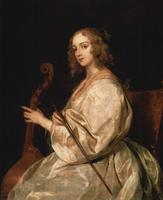
Portrait of Mary Ruthven, wife of the artist
Anthony van Dyck
the Music Lesson
Jacob Ochtervelt
The Music Lesson
Jacob Ochtervelt
Elizabeth Freke (1634–1684), Lady Brownlow (?)
Henry Anderton
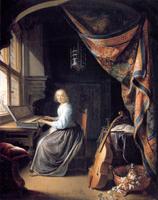
A Lady Playing the Clavichord
Gerrit Dou
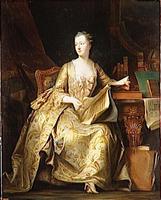
Jeanne Antoinette Poisson, Marquise De Pompadour
Charles de Steuben
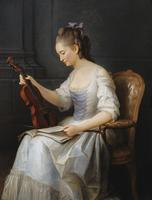
Portrait of a Violinist
Anne Vallayer-Coster
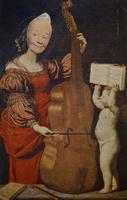
Ridiculous Portrait (Cello, Cherub)
May Wilson
Veronica Veronese
Dante Gabriel Rossetti
Gamba Player
Bernardo Strozzi
Portrait of a Lady and a Boy, with Pan
John Hayls
Portrait of Lady Margaret Georgiana Poyntz
Pompeo Batoni
Marquise de Pompadour
Francois Boucher
Portrait of Princess Maria Ivanovna Kochubey
Christina Robertson