Expert analysis of Vladimir Makovsky’s In the Kitchen
Style: Realism · Genre: genre painting
Expert Art Historical Analysis: "In the Kitchen" by Vladimir Makovsky
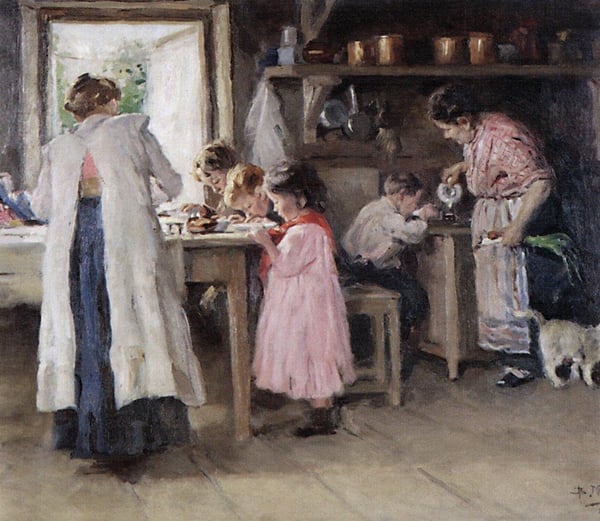
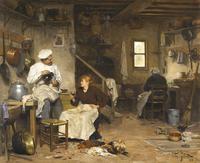
Vladimir Makovsky’s "In the Kitchen" stands as a compelling exemplar of Russian Realism, a movement that sought to depict the unvarnished truths of everyday life with honesty and emotional depth. As a genre painting—a scene from ordinary existence—the work gains its significance through its meticulous observation of domestic labor, its subtle social commentary, and its masterful use of light and texture to elevate a seemingly mundane moment into a narrative of quiet dignity.
Makovsky, a leading member of the Peredvizhniki (The Wanderers), was known for his keen eye for the details of lower- and middle-class life. In "In the Kitchen," the painting’s importance within the Realist style lies in its rejection of idealization. The kitchen is presented as a true, functional space—a world of worn surfaces, steam, and activity. Makovsky captures not a posed tableau but a slice of lived reality: perhaps a cook or maid absorbed in her task, the glow of a stove, the materials of meal preparation. Through careful composition, he invites the viewer into a private sphere, making the ordinary feel intimate and worthy of artistic attention.
The work is significant for its emotional restraint and authenticity. Where earlier genre painting might have moralized or sentimentalized, Makovsky offers a straightforward portrayal that respects his subjects. The play of light across the scene—likely from a window or hearth—demonstrates his technical skill while also symbolizing the illumination of common life. By focusing on a kitchen, a space of sustenance and toil, Makovsky aligns with Realism’s core mission: to reveal the beauty and truth in what was often overlooked—the daily rhythms of ordinary people. This painting is thus not merely a record of a room, but a quiet manifesto for the value of the everyday.
Museum / Gallery
Visually similar
20 works with related composition and palette
At the village school
Vladimir Makovsky
Child's Soup
Léon Augustin Lhermitte
Hope
Frank Holl
Pioneer Control
Alla Horska
The midday meal
Léon Augustin Lhermitte
The Village Choir
Anton Azbe
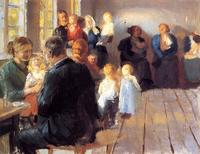
Vaccination
Anna Ancher
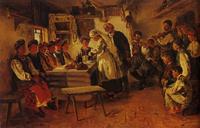
The bachelorette party
Vladimir Makovsky
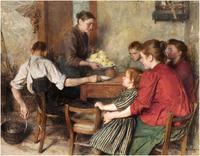
The frugal meal
Émile Friant
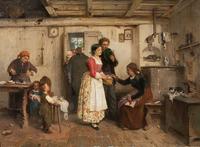
The introduction of the engaged couple
Gerolamo Induno
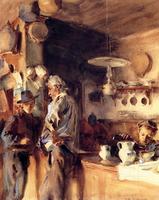
A Spanish Interior
John Singer Sargent
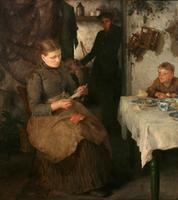
The Message
Henry Scott Tuke
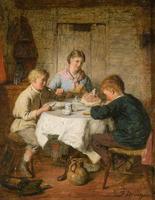
Dinner Time
Frederick Morgan
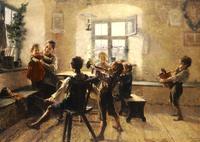
Children's concert
Georgios Jakobides
Morning tea
Vladimir Makovsky
The brood
Alessandro Milesi
The Dame School
Frederick George Cotman
Austeria rzymska
Aleksander Gierymski
The cooks
Victor Gabriel Gilbert
Month of Mary
Joan Brull