Expertenanalyse zu Mikhail Nesterovs The Hermit
Stil: Symbolism · Genre: portrait
Expert Analysis: "The Hermit" by Mikhail Nesterov
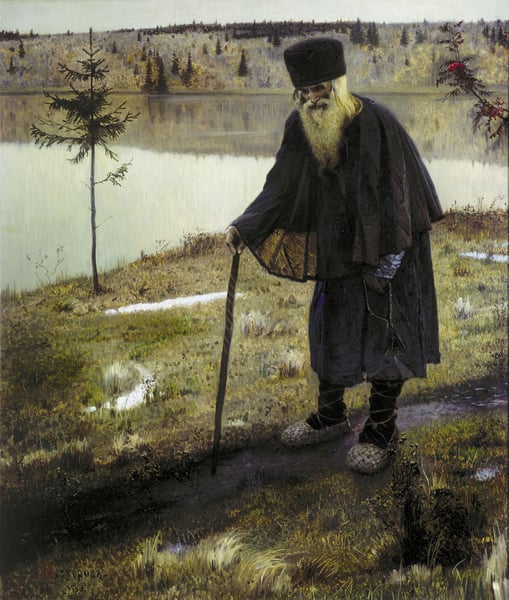
Mikhail Nesterov’s "The Hermit" (1888–89) stands as a seminal work within Russian Symbolism, marking a decisive shift from the narrative realism of the Peredvizhniki (The Wanderers) toward a more poetic, introspective spirituality. Painted during a period of personal and national soul-searching, this portrait transcends its genre by transforming a simple figure into a timeless emblem of solitude, faith, and harmony with nature.
Significance within Symbolism:
- Mystical Realism: Nesterov blends precise, almost icon-like detail (the hermit’s weathered face, the texture of his cloak) with a dreamlike, subdued palette of silvery greens, ochres, and muted blues. This technique evokes not a literal landscape but an inner, spiritual realm—a hallmark of Symbolist art.
- Nature as Sacred Mirror: The hermit is not merely posed in a forest; he is absorbed into it. The trees, water, and sky seem to breathe with his quiet contemplation. This fusion of human and natural elements reflects the Symbolist belief that the visible world is a veil for transcendent truths.
- Anti-Modernist Retreat: Created during Russia’s rapid industrialization, the painting rejects urban progress in favor of archaic, Orthodox monasticism. The hermit’s stillness offers a counter-narrative to the era’s materialism, positioning solitude as a radical, spiritual act.
Genre Redefined: Although categorized as a portrait, "The Hermit" functions as an allegorical icon. The subject’s anonymity (no specific saint or historical figure) universalizes the image. His downward gaze and folded hands suggest inner dialogue, inviting viewers into a meditative space. Nesterov later called such works “portraits of the soul”—a genre he pioneered within Russian art.
Historical Context: Painted just before Nesterov’s celebrated cycle of religious works (e.g., The Vision to the Youth Bartholomew), "The Hermit" foreshadows his lifelong exploration of Rus’ spiritual heritage. It also influenced younger Symbolists like Viktor Borisov-Musatov and even resonated with the Silver Age’s fascination with theosophy and mysticism.
In essence, "The Hermit" is significant not for dramatic action or surface likeness, but for its quiet power to evoke the ineffable—a core ambition of Symbolism. It remains a touchstone for how art can render the unseen palpable through restraint, reverence, and luminous silence.
Museum / Gallery
Visuell ähnlich
20 Werke mit ähnlicher Komposition und Farbpalette
The Philosophers: Portrait of Sergei Bulgakov and Pavel Florenskiy
Mikhail Nesterov
The old men
Andrei Ryabushkin
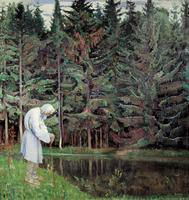
Elder (Abraham, the Servant of God)
Mikhail Nesterov
Peasant
Nikolay Bogdanov-Belsky
Hermit fathers and immaculate women
Mikhail Nesterov
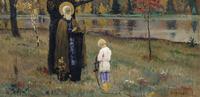
The Vision of the Young Bartholomew
Mikhail Nesterov
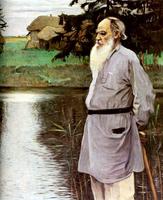
Portrait of Leo Tolstoy
Mikhail Nesterov
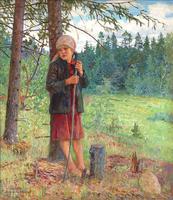
Girl in a Wood
Nikolay Bogdanov-Belsky
Silence
Mikhail Nesterov
Katolikos Hrimyan near Emiadzin
Ivan Aivazovsky
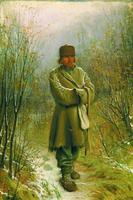
Contemplator
Ivan Kramskoy
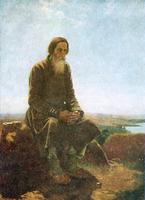
The farmer in the field
Vasily Perov
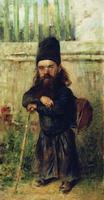
Monk - Tax Collector in the Temple
Konstantin Makovsky
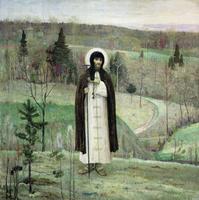
Venerable Sergius of Radonezh
Mikhail Nesterov
Cowboy
Nikolay Bogdanov-Belsky
Saint Russia
Mikhail Nesterov
Wayfarer
Mikhail Nesterov
Saint Sergius' labours (right part of the triptych)
Mikhail Nesterov
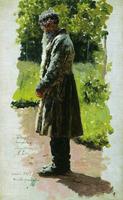
Old farmer
Ilya Repin
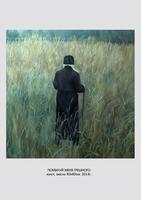
ПОМИЛУЙ МЕНЯ ГРЕШНОГО
Vlad Avanesov