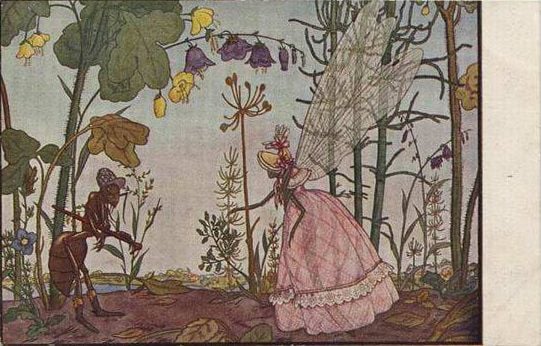
Illustration to Ivan Krylov's fable 'The Ant and the Dragonfly'
Details
Expertenanalyse zu Heorhiy Narbuts Illustration to Ivan Krylov's fable 'The Ant and the Dragonfly'
Stil: Art Nouveau (Modern) · Genre: illustration
Heorhiy Narbut’s Illustration to Ivan Krylov's fable 'The Ant and the Dragonfly' is a masterwork of the Petersburg period, where the artist fused the decorative elegance of Art Nouveau with the narrative demands of literary illustration. Executed in the early 20th century, this piece exemplifies Narbut’s skill in translating Krylov’s moral fable—a cautionary tale of diligence versus idleness—into a striking visual language.
Significance within Art Nouveau and Illustration:
Narbut was a central figure in the Ukrainian and Russian book-illustration revival, and this work demonstrates his ability to synthesize the sinuous lines, flat patterning, and ornamental borders characteristic of Art Nouveau (Modern style) with the clear storytelling required of a fable. The composition likely uses stylized, linear forms to contrast the hardworking ant (often depicted with geometric, grounded shapes) and the frivolous dragonfly (whose wings and posture suggest airy movement), embodying the fable’s moral tension through pure visual rhythm.
Petersburg Period Context:
During his Petersburg period (c. 1906–1917), Narbut worked alongside the World of Art group, absorbing their emphasis on refined graphic art and historical stylization. In this illustration, he applies that sensibility to a Russian literary classic, elevating Krylov’s popular fable into a modern, book-art object. The work’s significance also lies in Narbut’s merging of Western European Art Nouveau with Eastern Slavic folk motifs: the decorative borders and lettering often echo Ukrainian manuscript traditions, grounding the modern style in a local heritage.
Artistic Achievement:
This illustration is notable for its integration of text and image, a hallmark of Narbut’s design philosophy. The page likely functions as an integrated whole, where the illustration does not merely depict the story but comments on it through color contrasts and dynamic silhouettes. It stands as a key example of how early 20th-century illustrators reclaimed the fable genre from didactic simplicity, infusing it with sophisticated, modern expression while remaining faithful to Krylov’s timeless lesson.
Visuell ähnlich
20 Werke mit ähnlicher Komposition und Farbpalette
Fancy Costumes
Salvador Dali
Dragonflies
Wilhelm Kotarbinski
Et Overfall
Theodor Severin Kittelsen
La Belle Jardiniere – August
Eugène Grasset
WHEN CALIBAN WAS LAZY AND NEGLECTED HIS WORK
Arthur Rackham
Elves and Fairies, illustration for The Tempest
Edmund Dulac
Girls with Animals
Raphael Kirchner
Emblem from Cats’ Monita amoris virginei
Adriaen van de Venne
Where is Pease-Blossom
Arthur Rackham
Illustration to the fairy tale 'The War of mushrooms'
Heorhiy Narbut
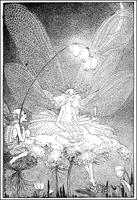
Illustration for Down-Adown-Derry
Dorothy Lathrop
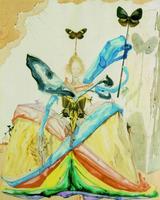
The Queen of the Butterflies
Salvador Dali
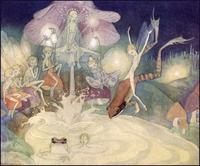
Illustration for Fairy Circus
Dorothy Lathrop
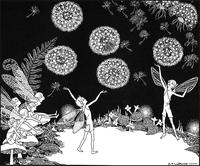
Illustration for Fairy Circus
Dorothy Lathrop
Fairies never say, 'We feel happy', what they say is, 'We feel dancey.'
Arthur Rackham
Illustration for Down-Adown-Derry
Dorothy Lathrop
The Wings are Sewn on the Party Dress
Gerda Wegener
Young Woman Fanning a fire with a bird's wing
Martin Schongauer
My Beautiful Lady
John Everett Millais
Pastoral
Serge Sudeikin